How to Choose a Zoho Implementation Partner (And What to Expect)
Not all Zoho partners are equal. Some configure the platform properly; others just activate default settings and hand you a login. Here's how to tell the difference before you sign.
If you're evaluating Zoho implementation partners in September or October 2026, you're in the right window. A full implementation takes 4 to 12 weeks. Lock in a partner by late October and your team starts January 2027 on a clean, tested setup. Wait until February and you're running the first half of 2027 on a system that needed replacing before the year even got going.
Choose a partner the way you'd pick a surgeon over a general practitioner: specialty beats general competence when the problem is specific. For eCommerce businesses, that means finding someone with documented Shopify, Amazon, or WooCommerce implementations behind them, a CA or CPA who understands how marketplace revenue flows into Zoho Books, and enough Q4 experience to run a go-live without breaking your inventory sync mid-November.
Zoho's ecosystem covers 45+ products. Configuring them to work together for your specific business is the hard part, not buying the subscription. That's why implementation partners exist.
"Zoho partner" is a broad term, though. Some firms have been building on the platform for a decade with deep product certifications. Others signed up for the partner program last month and are learning alongside you. A good implementation pays for itself within a quarter; a bad one creates technical debt you'll spend years unwinding.
Here's how to tell them apart.
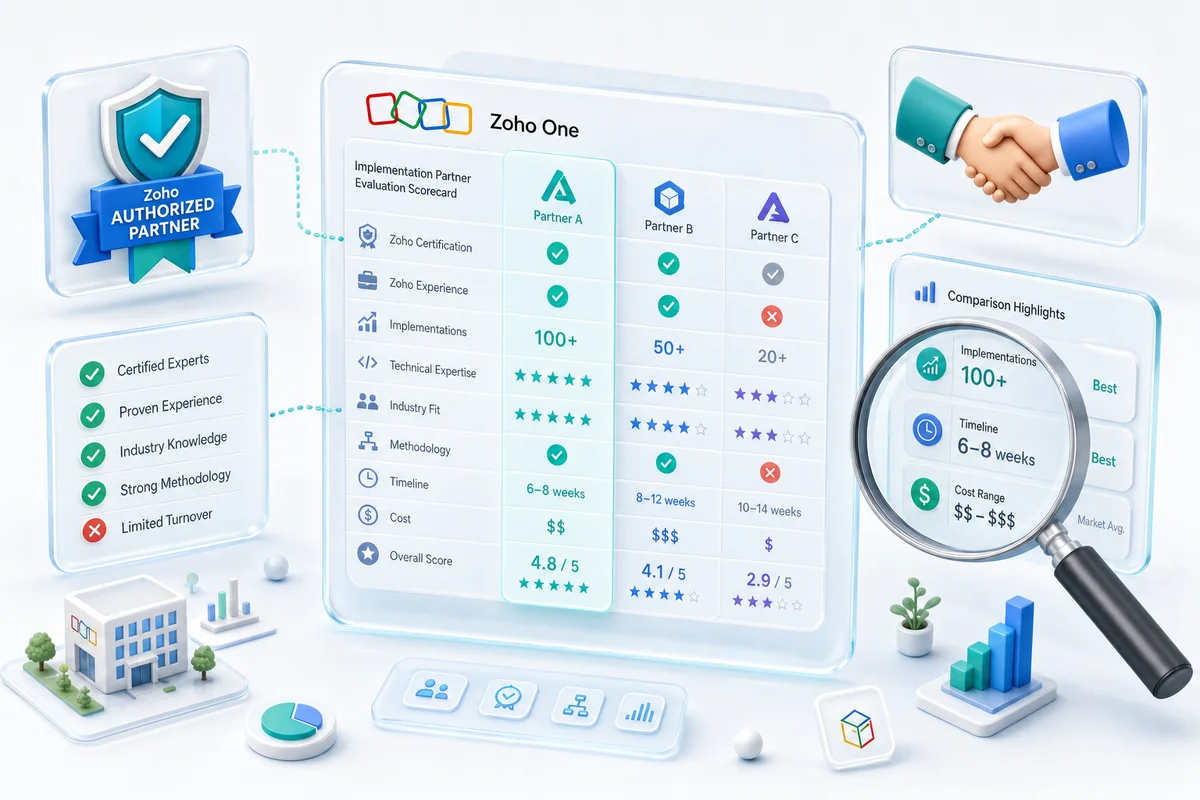
What "Zoho Authorized Partner" actually means
Zoho has a tiered partner program. The tiers in 2026, from baseline to highest: Partner, Advanced Partner, Premium Partner. Zoho Finance Partners carry an additional certification on the financial product suite (Books, Inventory, Subscriptions, Expenses, Payroll) and are separately listed on the Zoho Finance Partner directory.
To become an Authorized Partner, a firm needs:
- Completed Zoho product certifications (specific to the products they implement)
- A track record of implementations with documented customer outcomes
- Active deal registration and customer satisfaction scores above Zoho's threshold
- Ongoing product training as Zoho releases updates
What it doesn't guarantee: industry expertise, implementation quality, or post-launch support. It's a baseline credential. Think of it like a contractor's license: a licensed contractor can still build a crooked wall.
For eCommerce businesses, the Zoho Finance Partner designation carries more weight than the general Authorized Partner tier. It means the partner has passed finance-specific certifications and understands how Books, Inventory, and Subscriptions connect with your selling channels. When evaluating a partner for a Shopify or Amazon setup, ask specifically whether they hold Zoho Finance certification, not just the general Authorized tier.
Red flags when evaluating partners
They skip discovery
The biggest red flag. A partner who jumps straight to "let's configure your CRM" without understanding your sales process, team structure, and existing tools will build a generic setup that doesn't fit.
A proper discovery phase takes 1-2 weeks and covers: current workflows, pain points, team roles, data sources, integration requirements, and success criteria. No mention of discovery in the proposal is a hard no.
They quote by the hour, not the outcome
Hourly billing creates a perverse incentive: the longer the project takes, the more the partner earns. Look for fixed-price or milestone-based proposals where the partner bears the risk of scope management.
Good proposal structure: Phase 1 (Discovery): $X. Phase 2 (Configuration): $Y. Phase 3 (Training + Go-live): $Z. Total: fixed amount with defined deliverables.
They don't ask about your data
If the partner doesn't ask "what system are you migrating from?" and "how clean is your data?" in the first conversation, they haven't done enough migrations to know this is the number one source of delays and rework.
They sell hours, not training
An implementation isn't done when the CRM is configured. It's done when your team can use it confidently without calling the partner for basic questions. If the proposal doesn't include dedicated training sessions and documentation, you'll be paying for "support hours" indefinitely.
They can't name clients in your industry
A partner who's implemented Zoho for 50 eCommerce companies knows the patterns: channel integrations, reconciliation workflows, inventory touchpoints. A generalist is solving your problems for the first time. Ask for references in your specific industry.
For a vetted comparison of top Zoho development companies ranked by eCommerce capability, Top Zoho Development Companies for eCommerce in 2026 profiles each firm's platform coverage, partner tier, and accounting depth.
Specialist vs. generalist: what the gap actually costs
Most implementation partners are generalists who configure whatever products the client asks for. That works fine for CRM-only or marketing tool setups. It breaks for eCommerce, where the financial and inventory layers are too specific for someone working them out on your account for the first time.
| Criteria | eCommerce Specialist | Generalist Partner |
|---|---|---|
| Shopify/Amazon integration | Named method, past projects, edge cases | "Yes, we can connect that" |
| CA/CPA on staff | Reviews chart of accounts before go-live | Finance knowledge on the team |
| BFCM/Q4 go-live track record | Reference from a Q3 or Q4 client | General implementation experience |
| Marketplace fee handling | FBA storage, platform fees, clearing accounts | Generic expense categories |
| eCommerce revenue recognition | Payout reconciliation, multi-channel COGS | Standard revenue accounting |
| Zoho Finance Partner certification | Yes | Often general partner tier only |
The gap shows up at year-end. A generalist's Books setup usually has misclassified Amazon fees, a payout clearing account that never reconciles cleanly, and a COGS report that doesn't match inventory data. Fixing it in March costs more than getting it right in October.
eCommerce-specific partner criteria
Generic Zoho implementation experience isn't enough if you run an eCommerce business. You need someone with a documented track record on your specific stack: Shopify, Amazon, WooCommerce, or whatever combination you're operating.
Platform integration depth
Ask directly: have you connected Zoho Inventory to Shopify before? How?
A qualified partner names the connection method (native Zoho connector, marketplace app, or custom API bridge), describes what happens to order data at each step, and explains how returns and refunds flow back into Zoho Books. They can also describe what breaks when a Shopify payout runs a day late and how the Books reconciliation stays clean.
The same test applies to Amazon. FBA and FBM have different fee structures, different fulfillment timelines, and different cost-of-goods implications. A partner who treats Amazon as just another sales channel will misconfigure your Books accounts and leave FBA storage fees sitting in the wrong expense category.
For WooCommerce sellers, ask about the order-to-cash workflow: how does a WooCommerce order become a Zoho invoice, reconcile against a payment, and close out with zero manual entry? If the partner pauses on that question, they haven't built it before.
Q4 operational track record
BFCM and the Q4 holiday season stress-test every eCommerce operation. A partner who has only implemented Zoho in January hasn't seen what a 10x order spike does to an improperly configured inventory system.
Ask for a reference from a client who went live with Zoho Inventory or Zoho Books in Q3 or Q4. Better yet, ask what they did to prepare that client for peak season. Did they configure BFCM-specific reorder points? Set low-stock alerts per channel? Test the Shopify-to-Zoho sync under load before November?
If you're evaluating partners now and planning a go-live before BFCM, this question is not optional. See our BFCM inventory planning guide for Shopify and Amazon sellers for what a properly configured Zoho Inventory setup needs before the peak window opens. Our Q4 readiness guide for eCommerce operations covers the wider operational checklist.
Accounting depth for eCommerce
eCommerce accounting is not general accounting. Marketplace fees, platform payouts (Shopify Payments, Stripe, Amazon settlements), COGS tracking by SKU, multi-channel revenue recognition, 1099-K reporting: these require a partner with someone who understands both Zoho Books and how eCommerce revenue actually works.
The clearest signal: a Chartered Accountant or CPA on the implementation team who reviews your chart of accounts before configuration begins. Not a bookkeeper, not a "finance-focused consultant." A CA or CPA who can explain why your Shopify payout schedule requires a clearing account in your Books setup, and why Amazon FBA fees need their own expense sub-account.
What a good implementation looks like
A proper Zoho implementation follows a predictable structure. Here's what we run through at Zolify and what any competent partner should do:
Phase 1: Discovery (Week 1-2)
The partner maps your current state: how your team works today, where the friction is, what data exists and where, and what success looks like. This produces a requirements document that both sides sign off on before configuration begins.
At Zolify, this follows our 5-step process; discovery is Step 1 and it determines everything that follows.
Phase 2: Solution design (Week 2-3)
The partner translates your requirements into a Zoho configuration plan: which products, which modules, what custom fields, what automation rules, what integrations, what data migration approach. You review and approve before they start building.
Phase 3: Configuration and build (Week 3-6)
The actual setup: modules configured, fields created, workflows built, integrations connected, data migrated from your existing systems. Good partners do this in a sandbox first, then deploy to production after testing.
Phase 4: Training and go-live (Week 5-7)
Hands-on training with your team. Not a feature demo, but actual training on the workflows they'll use daily. Followed by a monitored go-live period where the partner watches for issues and adjusts configuration based on real-world usage.
Phase 5: Post-launch support (Month 2-3)
30-60 days of support for questions, bug fixes, and optimization. Your team will discover things in the first month that need adjusting; this is normal and should be included in the engagement.
How much should it cost?
Implementation costs vary based on scope. Realistic ranges for 2026:
| Scope | Typical Cost | Timeline |
|---|---|---|
| Single product (CRM only) for 5-10 users | $2,000-$5,000 | 2-4 weeks |
| Multi-product (CRM + Books + Inventory) for 10-30 users | $5,000-$12,000 | 4-8 weeks |
| Full Zoho One deployment for 30-50 users | $10,000-$20,000 | 6-12 weeks |
| eCommerce multi-channel (Shopify + Amazon + Books + Inventory) | $8,000-$15,000 | 5-9 weeks |
| Complex enterprise with custom dev and legacy migration | $15,000-$25,000+ | 8-16 weeks |
Add Zoho subscription costs on top: $20-$52/user/month for individual products, or $45/user/month for Zoho One (all 45+ apps).
If a partner quotes well below these ranges, ask what's excluded. Cheap implementations almost always cut discovery, training, or data migration. Those three determine whether the setup actually works.
For a detailed breakdown of what drives cost across scope, team size, and channel complexity, see Zoho eCommerce Implementation Cost: Real Ranges from 100+ Projects. For Zolify's specific packages, see our pricing page.
Questions to ask before signing
"How do you handle discovery?" Good answer: "We run a structured discovery over 1-2 weeks with documented requirements." Bad answer: "We'll figure it out as we go."
"Can I speak with a client in my industry?" Good answer: Provides a name and introduction. Bad answer: "Our clients prefer to stay anonymous."
"What happens after go-live?" Good answer: "30-60 days of included support, then optional retainer." Bad answer: "You can buy hours if you need help."
"Who does the work?" Good answer: "A certified consultant who'll be your primary contact throughout." Bad answer: "Our team will handle it." Which team member? What certification level?
"What's your refund or satisfaction policy?" Good answer: Milestone-based payments where you approve each phase before paying for the next. Bad answer: 100% upfront with no milestones.
For eCommerce: "Have you connected Zoho Inventory to Shopify or Amazon before? Walk me through how you did it." Good answer: Names the client type, describes the connection method, explains what edge cases came up. Bad answer: "Yes, we handle eCommerce." That's not an answer.
For eCommerce: "Do you have a CA or CPA who reviews financial configurations?" Good answer: Names the person and their role in the engagement. Bad answer: "We have accounting knowledge on our team." Accounting knowledge is not the same as a qualified accountant reviewing your chart of accounts.
If you're also evaluating firms for ongoing eCommerce operations support after the implementation phase, How to Choose an eCommerce Operations Partner covers the additional criteria that apply once the initial build is complete.
Why Zolify
We're an Official Zoho Finance Partner with certifications across CRM, Books, Inventory, and the developer platform. Our focus is eCommerce: Shopify, Amazon, WooCommerce, and growing businesses that need their selling channels, inventory, and accounting talking to each other.
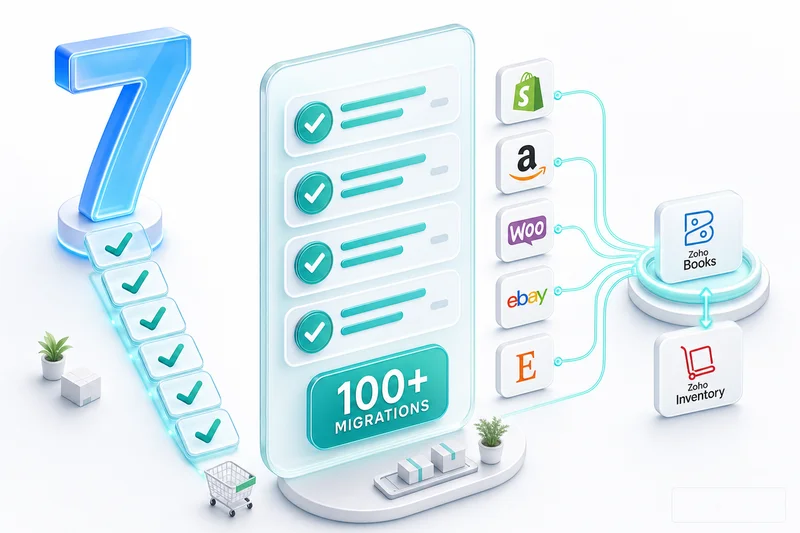
Across 100+ Zoho implementations for eCommerce, we've built multi-channel setups connecting Shopify, Amazon, and WooCommerce to Zoho Books and Zoho Inventory. That includes Q3 and Q4 go-lives with BFCM preparation built into the implementation scope. If you're locking in a partner now to have your 2027 operations running on a clean Zoho setup from January, that's exactly the kind of timeline we plan for.
Most implementation partners don't have a Chartered Accountant on staff. We do. That CA reviews every financial configuration before it goes live. Your chart of accounts, reconciliation workflows, and reporting setup get accounting-correct treatment, not just a technically valid structure. Shopify payout reconciliation and Amazon fee categorization land in the right sub-accounts and clearing accounts, and you close the year without reclassification surprises.
If you're weighing Zolify against US-based Zoho consultants on cost, communication, and eCommerce depth, Zolify vs US-Based Zoho Consultants covers where each type of firm tends to deliver differently.
Not sure your current Zoho setup is ready for peak season? Start with an eCommerce Operations Audit. We map what's configured correctly, what's broken, and what gaps will cost you volume before your next Q4 spike.
Book a free consultation and we'll scope what a Zoho implementation looks like for your business.
Frequently Asked Questions
Zoho Authorized Partner is a certification tier awarded by Zoho to consulting firms that meet specific requirements: completed implementations, product certifications, and customer satisfaction scores. It means the partner has been vetted by Zoho, has access to partner-level support, and stays current on product updates. It's the minimum credibility baseline; beyond that, look at industry specialization and implementation track record.
Professional Zoho implementations range from $2,000-$25,000 depending on scope. A single-product setup (just CRM or just Books) for a 5-10 person team runs $2,000-$5,000. A multi-product implementation (CRM + Books + Inventory + Analytics) for a 20-50 person team runs $8,000-$15,000. Complex enterprise setups with custom development, multiple integrations, and data migration from legacy systems can reach $25,000+.
Typical timelines: single-product setup (2-4 weeks), multi-product implementation (4-8 weeks), complex enterprise deployment (8-16 weeks). The biggest variable is discovery and data migration, not the configuration itself. Partners who skip discovery deliver faster but produce setups that need rework within months.
Look for documented Shopify and Amazon integration experience: the partner should name the connection method (native Zoho connector, marketplace app, or custom API bridge), cite stores they have connected before, and explain how order-to-cash reconciliation flows into Zoho Books. A CA or CPA on staff who understands eCommerce revenue recognition, marketplace fees, and COGS tracking is the clearest differentiator. A generalist partner will configure the CRM correctly and leave your accounting workflows broken.
Five questions that separate good partners from bad ones: (1) How do you handle discovery? (2) Can I speak to a reference client in my industry? (3) What's included in post-launch support? (4) Who does the actual configuration, a certified consultant or a junior? (5) What happens if the timeline slips? A good partner answers these confidently with specifics. A bad one gives vague reassurances.
See exactly where your Shopify, Amazon, or WooCommerce ops are leaking — free.
Get a personalised eCommerce Ops Audit: inventory gaps, accounting leaks, and order-flow bottlenecks — with a Zoho fix roadmap. Delivered in 48 hours, at no cost.