SAP Business One vs Zoho One for eCommerce: Real Costs for Mid-Market Sellers
SAP Business One delivers more ERP than most mid-market eCommerce sellers need, at a licensing cost that doesn't match the scale. Here's the honest comparison for Shopify, Amazon, and WooCommerce sellers evaluating whether the switch to Zoho One makes sense.
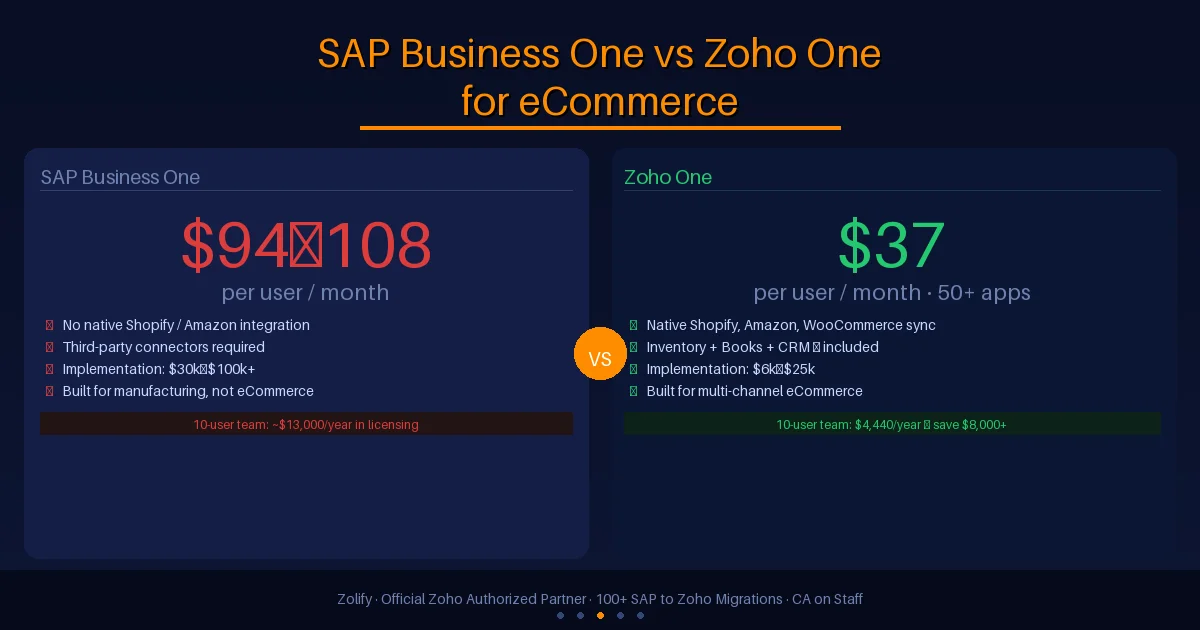
For mid-market sellers on Shopify, Amazon, and WooCommerce, the licensing math isn't close. SAP Business One costs $94–108 per user per month at list price before implementation fees. Zoho One costs $37 per user per month and includes 50+ integrated apps: accounting, inventory, CRM, marketing, analytics, and more. For a 10-user eCommerce team, that's a $7,000–$9,000 annual licensing difference, before implementation and maintenance costs on either side.
| SAP Business One | Zoho One | |
|---|---|---|
| Licensing cost | $94–108/user/month | $37/user/month |
| Apps included | Core ERP modules | 50+ apps (Books, Inventory, CRM, Analytics, …) |
| Shopify / Amazon native integration | Third-party connector required | Native (Zoho Inventory) |
| eCommerce inventory sync | Add-on required | Zoho Inventory — included |
| Implementation cost (mid-market) | $30,000–$100,000+ | $6,000–$25,000 |
| Best for | Complex manufacturing, multi-entity | Multi-channel eCommerce, mid-market |
Disclosure: Zolify is an Official Zoho Authorized Partner. We have completed 100+ SAP to Zoho migrations. This comparison is honest because our reputation depends on it — we tell clients when a migration is worth the effort and when it is not.
Why SAP Business One costs more than it returns for eCommerce
A 10-person eCommerce team on SAP Business One cloud pays $11,000–$13,000 per year in licensing alone. That number grows when you add annual support contracts, per-incident maintenance fees, and the consulting cost for every configuration change — SAP Business One customizations require specialist developers who charge accordingly.
Zoho One puts the same team at $4,440 per year. The gap compounds quickly. Over three years, a 10-user operation pays $33,000–$39,000 for SAP Business One licensing versus $13,320 for Zoho One. Add the implementation cost difference (SAP Business One mid-market deployments typically run $30,000–$100,000+ vs. $6,000–$25,000 for a Zoho One eCommerce setup) and the first-year total cost gap is even starker.
For a Shopify or Amazon seller doing $2M–$20M per year, the question is whether those capabilities justify the cost. For most, they don't.
What SAP Business One does well
SAP Business One is a genuine enterprise ERP with capabilities that matter in specific environments. Production planning, quality control, material requirements planning (MRP), and multi-entity financial consolidation at high transaction volume are areas where SAP Business One earns its premium. For a manufacturing business running multiple legal entities across different countries with intercompany transactions, the architecture fits.
These are real strengths. For most mid-market eCommerce businesses on Shopify, Amazon, WooCommerce, eBay, and Etsy, none of them are the actual problem. The eCommerce challenge is different: Shopify orders need to hit inventory the moment they are placed, Amazon marketplace fees need to reconcile automatically against settlement reports, COGS needs to post correctly per channel, and CRM needs to connect to the same customer records that accounting and marketing use. SAP Business One isn't designed for that workflow.
What mid-market eCommerce sellers need — and what Zoho One covers
Multi-channel inventory sync across Shopify, Amazon, and WooCommerce
Zoho Inventory (included in every Zoho One subscription) connects natively to Shopify, Amazon, WooCommerce, eBay, and Etsy. Orders flow in, inventory levels update across channels, and fulfilment status syncs back to each storefront. For an FBA seller, Amazon fulfilment events map to Zoho Inventory automatically. For a Shopify seller working with a third-party logistics provider, outbound orders trigger pick-pack-ship workflows without manual entry.
SAP Business One has no native connectors to Shopify, Amazon, or WooCommerce. Those integrations require third-party middleware or custom API development — a maintenance dependency you own permanently. When the connector breaks after an Amazon API update, SAP won't fix it.
Marketplace accounting for Amazon and Shopify sellers
The accounting complexity in multi-channel eCommerce is not invoicing — it is reconciliation. Amazon settlement reports bundle sales, refunds, FBA fees, advertising costs, and chargebacks in a single file. Shopify payouts combine multiple days of transactions with Shopify Payments fees and refunds. Each channel produces a different data format that needs to map correctly to your chart of accounts before revenue, COGS, and expenses mean anything.
Zoho Books handles this with channel-level revenue accounts, marketplace fee expense categories, and automated COGS posting from Zoho Inventory. Zolify builds the chart of accounts specifically for the eCommerce stack during implementation: separate income lines per channel, fee accounts per marketplace, and FIFO or weighted-average COGS depending on the business's inventory method. This is operational accounting, not just bookkeeping.
CRM, marketing, and analytics in one system
Zoho One includes Zoho CRM, Zoho Campaigns, and Zoho Analytics. For an eCommerce operation, this means the same system managing inventory and accounting also manages customer records, lifecycle email campaigns, and business intelligence dashboards. A returning Amazon customer's order history, contact record, and email engagement all sit in one connected system.
SAP Business One includes CRM functionality, but marketing automation and analytics at this level are typically add-ons or separate integrations. Adding them means more cost and more things to maintain — both of which a Zoho One subscription sidesteps from day one.
SAP Business One vs Zoho One: feature comparison
| Feature | SAP Business One | Zoho One |
|---|---|---|
| Multi-channel inventory (Shopify, Amazon, WooCommerce) | Third-party connector required | Native (Zoho Inventory) |
| Marketplace fee reconciliation | Manual or custom | Configurable in Zoho Books |
| COGS automation per channel | Configurable | Native with Zoho Inventory |
| CRM | Included | Zoho CRM — included |
| Marketing automation | Add-on / separate | Zoho Campaigns — included |
| Business intelligence | SAP Crystal Reports | Zoho Analytics — included |
| Production planning / MRP | Strong | Limited |
| Multi-entity consolidation | Strong | Suitable for 2–3 entities |
| Annual licensing (10 users) | $11,000–$13,000+ | $4,440 |
| Official partner network | Available | Zoho Authorized Partner network |
What moving from SAP Business One to Zoho One looks like
An SAP to Zoho migration is more involved than switching from QuickBooks or Xero. SAP Business One stores data in a structured way that requires a proper audit before anything moves. The key phases are: a full audit of your SAP setup, chart of accounts rebuild for Zoho's structure, Zoho Books and Inventory configuration, data export and import, eCommerce channel reconnection, and a parallel running period to validate the numbers before cutting over.
For a mid-market eCommerce company with standard data volume, that is a 10–16 week process. The parallel running period (keeping SAP live alongside Zoho for a minimum of four weeks) is where the migration either proves itself or surfaces gaps. Skipping the parallel run is the most common mistake in ERP migrations.
For the complete step-by-step process, see our SAP to Zoho ERP Migration Guide.
Zolify's track record on SAP to Zoho migrations
Zolify has completed 100+ SAP Business One to Zoho migrations for eCommerce businesses, including sellers on Shopify, Amazon, WooCommerce, and eBay. Our CA reviews opening balances before go-live: every account balance, every open invoice, every stock quantity. That review catches the kind of discrepancies that would otherwise show up three months after go-live, when your accountant can't reconcile the P&L and nobody knows why.
As an Official Zoho Authorized Partner, Zolify has a direct line to Zoho's partner engineering team. When an implementation issue comes up, it doesn't sit in a general support queue. That matters when a go-live date is fixed.
Is the switch worth it for your business?
The answer depends on what your SAP Business One installation is actually doing for your business today. If your team uses SAP primarily for accounting, inventory, and CRM, and your eCommerce channels need Shopify or Amazon connectivity that currently runs through a third-party connector, Zoho One is a direct replacement at a lower cost with better native eCommerce integrations built in.
If your business relies on SAP's manufacturing modules, high-volume multi-entity consolidation, or compliance workflows built specifically into the SAP configuration, the migration is a more complex conversation worth evaluating carefully.
The starting point is an honest audit of what SAP is handling for you today and what the Zoho equivalent covers. That's what Zolify's discovery sprint covers, before you commit to anything.
For more on how Zoho One fits the full eCommerce operations stack, see Zoho One as an eCommerce ERP. For the complete eCommerce operations setup Zolify implements — finance reconciliation, multi-channel inventory, CRM, and analytics — the Zoho One foundation covers it all.
For a parallel cost breakdown comparing NetSuite licensing against Zoho One, see our NetSuite vs Zoho One comparison for eCommerce. For eCommerce businesses on SAP Business ByDesign specifically — which reaches end of mainstream maintenance in December 2027 — see the SAP Business ByDesign migration guide.
If your business is paying $80–150/user/month for SAP Business One and using less than half of what it delivers, get an eCommerce Ops Audit. Zolify's CA reviews your current SAP setup, maps what Zoho One covers, and gives you a clear picture of migration cost and timeline before you commit.
Frequently Asked Questions
SAP Business One cloud runs $94–108 per user per month at list price, putting a 10-user team at $11,000–$13,000 per year in licensing alone — before implementation, support contracts, or customization. Zoho One is $37 per user per month billed annually, so the same team pays $4,440 per year for 50+ integrated apps. The annual licensing gap is typically $7,000–$9,000 for a 10-user eCommerce operation.
Yes. Zoho Inventory — included in Zoho One — connects natively to Shopify, Amazon, WooCommerce, eBay, and Etsy. Orders, inventory levels, and fulfilment status sync across channels. Zoho Books handles the accounting side: revenue recognition per channel, marketplace fee reconciliation, COGS automation, and sales tax compliance. The operational stack a multi-channel seller needs is covered within Zoho One without additional connectors.
SAP Business One is built for complex manufacturing: production planning, quality control, material requirements planning (MRP), and multi-entity financial consolidation with high transaction volume. These are real enterprise capabilities. For eCommerce companies whose core needs are multi-channel inventory, marketplace accounting, CRM, and reporting, SAP Business One delivers functionality the business is paying for but not using.
A mid-market eCommerce migration with standard data volume takes 10 to 16 weeks from audit to go-live. The phases are: audit and chart of accounts mapping (2–3 weeks), Zoho configuration (1 week), data export and import (1–2 weeks), eCommerce channel reconnection (1–2 weeks), and a parallel run period (4–6 weeks). Complex setups with multiple entities or many active channels should budget 4 to 6 months.
SAP to Zoho migrations are more involved than a QuickBooks or Xero migration. The audit phase — mapping SAP account codes to Zoho's structure and documenting integration dependencies — benefits from partner-led project management. A CA on the migration team is especially valuable for opening balance reconciliation. Zolify provides CA-supervised SAP to Zoho migrations with fixed-price scoping from the discovery sprint.
See exactly where your Shopify, Amazon, or WooCommerce ops are leaking — free.
Get a personalised eCommerce Ops Audit: inventory gaps, accounting leaks, and order-flow bottlenecks — with a Zoho fix roadmap. Delivered in 48 hours, at no cost.