Zoho One as an ERP for eCommerce: Full-Stack Operations at One Price
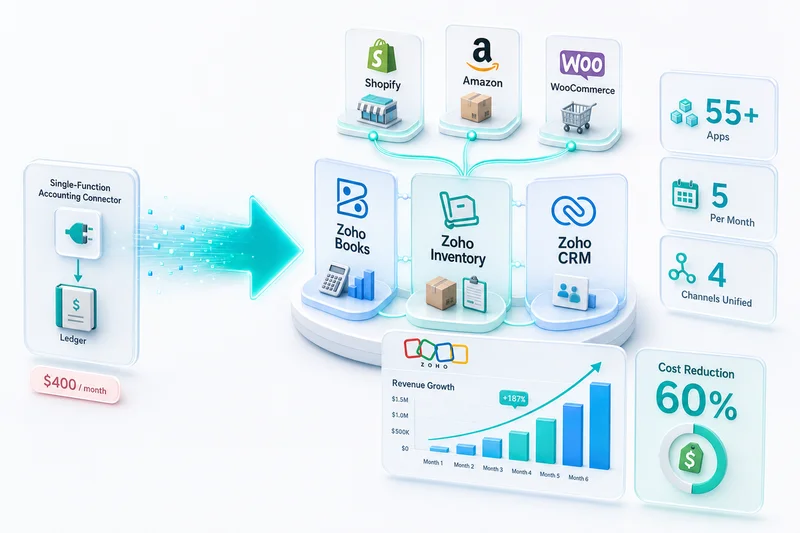
Legacy ERP systems like NetSuite or SAP cost $2,000–$5,000 a month and take six to twelve months to implement, and most weren't designed for multi-channel eCommerce. Zoho One gives online retailers a full-stack operations platform covering accounting, inventory, CRM, and analytics at a fraction of the cost, already connected to Shopify, Amazon, and WooCommerce.
For eCommerce sellers on Shopify, Amazon, or WooCommerce with up to $50M in revenue, Zoho One is the practical answer to the ERP question. It delivers accounting, inventory, CRM, and analytics at $37 to $90 per user per month, already connected to your sales channels. NetSuite starts at $2,000 to $5,000 per month and takes six to eighteen months to implement. SAP Business One typically runs higher. For most online retailers, that cost gap does not map to a proportional capability gap.
Mid-market eCommerce sellers hit a familiar wall. Shopify handles storefront operations well, but it was not built to be a business backend. When you add a second sales channel, hire a controller, or try to see inventory costs against actual margin per SKU, you need more than Shopify's built-in reports and a disconnected QuickBooks account.
Traditional ERP systems solve this problem for manufacturers. NetSuite, SAP Business One, and Microsoft Dynamics cover procurement, production, multi-entity accounting, and complex warehousing. For eCommerce sellers, they cost $2,000–$5,000 per month, take six to twelve months to implement, and arrive loaded with modules an online retailer will never use.
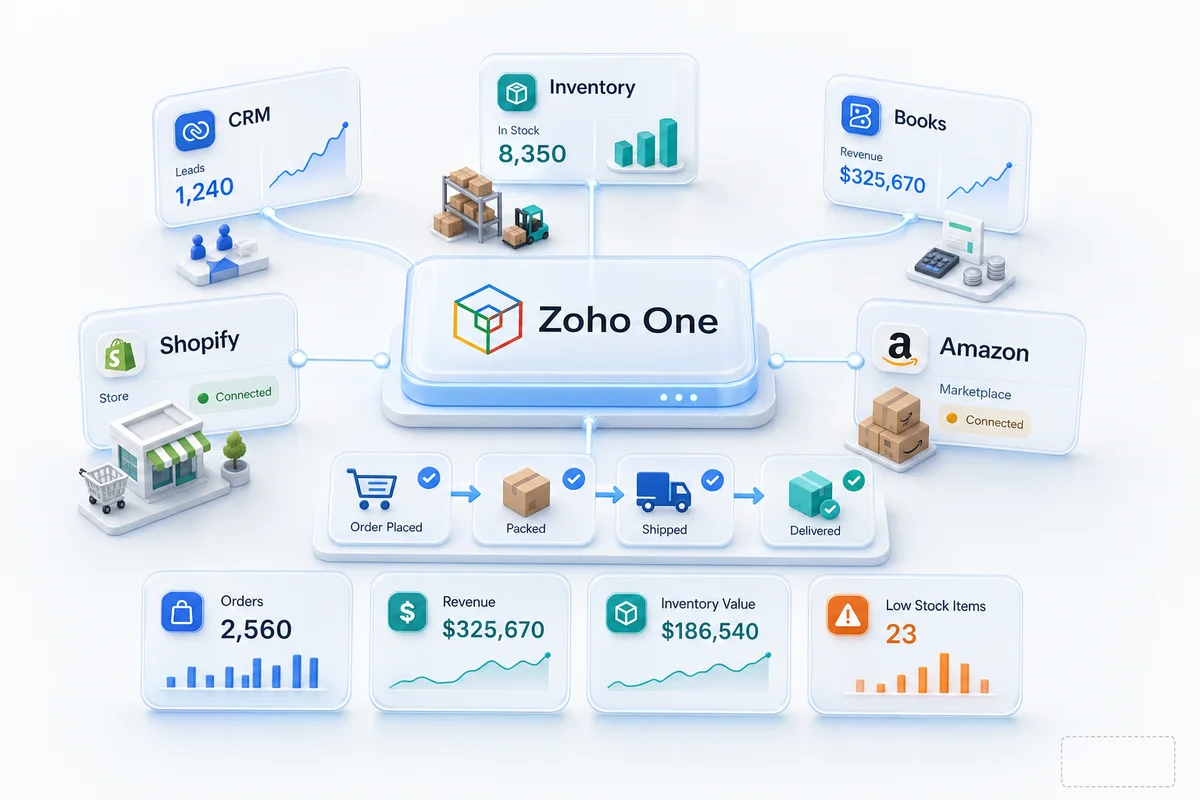
Zoho One is not a traditional ERP. It is a full-stack business operating system covering accounting, inventory, CRM, customer support, analytics, and automation, built as a connected ecosystem rather than a set of bolted-together point solutions. For eCommerce sellers on Shopify, Amazon, or WooCommerce with up to $50M in annual revenue, it replaces the ERP question with a more direct answer.
For an overview of the full Zoho eCommerce stack, see our Zoho for eCommerce operations guide. New to Zoho One? Start with our Zoho One eCommerce guide for a plain-language walkthrough of what the platform includes and what each app does.
What Makes an ERP for eCommerce Different
Manufacturing ERPs were built around production runs, bills of materials, and complex procurement. eCommerce operations have different requirements entirely.
An online retailer needs inventory tracked in real time across multiple sales channels, not a single warehouse. Revenue needs to record by channel, with marketplace fees separated from gross sales at the transaction level. COGS must flow automatically from inventory costs as units sell, not estimated manually at month end. Customer data lives inside Shopify and Amazon, not in a database you own, which creates its own CRM complexity.
The functional requirements for an eCommerce ERP look like this: multi-channel inventory sync, order-to-cash automation, marketplace fee reconciliation, sales tax management, per-SKU profitability tracking, and a CRM that works around marketplace data restrictions.
Zoho One covers all of these. What it does not cover: complex manufacturing routing, MRP, multi-entity consolidation at the parent company level, or sophisticated revenue recognition for SaaS or subscription models. For subscription eCommerce specifically - recurring billing cycles, subscription boxes, and per-cycle fulfillment - Zoho Billing handles the billing-to-inventory workflow natively; see our subscription eCommerce guide. For on-demand operations, those gaps rarely apply.
What Zoho One Covers for eCommerce Operations
Zoho Books: Accounting That Understands eCommerce
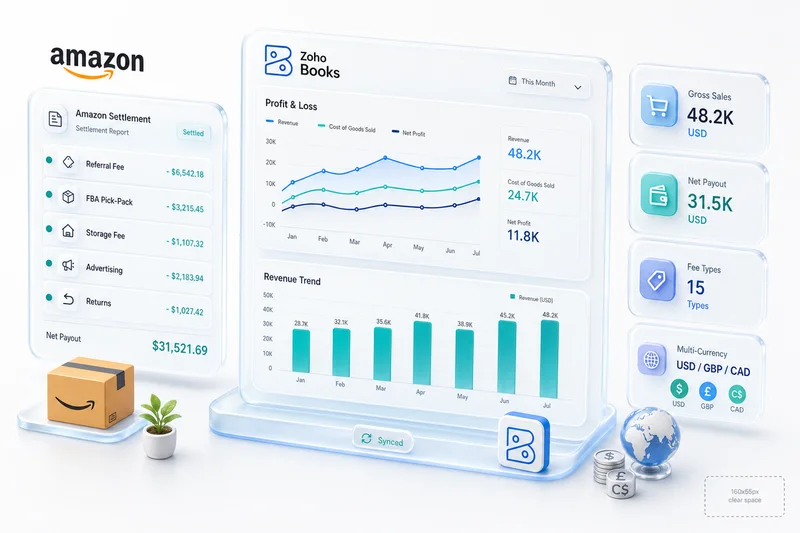
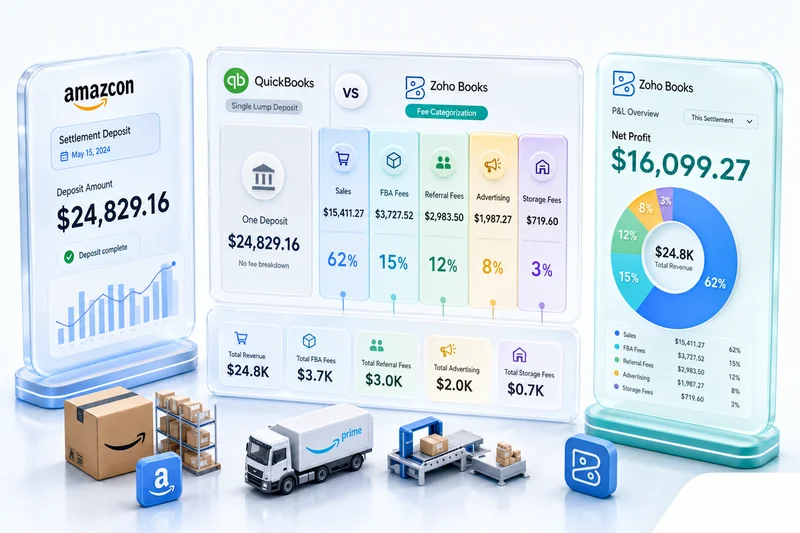
Zoho Books handles eCommerce accounting differently than QuickBooks because it connects natively with Zoho Inventory — no middleware, no month-end reconciliation step to close the gap.
When a Shopify order ships and a unit leaves Zoho Inventory, the COGS entry posts automatically to Zoho Books. You do not reconcile inventory to accounting at month end; it happens as transactions occur. For sellers processing hundreds of orders per month, this eliminates the largest source of manual bookkeeping work.
Zoho Books also handles multi-channel tax complexity. You can configure tax groups for different customer locations, handle VAT for international orders, and connect to TaxJar or Avalara for automated rate lookup when your nexus footprint requires it. For the full breakdown, see our eCommerce sales tax guide for Zoho Books. For sellers managing 10 or more active suppliers, Zoho Books handles the full accounts payable cycle natively; our eCommerce AP automation guide covers PO matching, approval workflows, and batch payments in detail.
Zoho Inventory: Multi-Channel Order and Inventory Management
Zoho Inventory connects to Shopify, Amazon, WooCommerce, eBay, and Etsy. When an order comes in from any channel, it routes to Zoho Inventory for fulfillment. When stock falls below a reorder point, a purchase order generates automatically to your supplier.
The multi-warehouse capability matters for sellers using Amazon FBA alongside their own fulfillment. FBA inventory shows as one warehouse in Zoho Inventory; your own warehouse shows as another. You see total available stock across both in a single view, and the accounting distinguishes between FBA inventory (Amazon holds it) and owned inventory (you hold it).
For Shopify sellers specifically, our Zoho Inventory for Shopify guide covers the connection in more detail. For the full multi-channel operations picture, including how to run Shopify, Amazon, and WooCommerce through a single inventory layer, see our multi-channel inventory operations guide and the multi-channel eCommerce solution page.
Zoho CRM: Customer Data You Actually Own
Amazon restricts buyer contact information. Shopify stores it in their system. Neither is a CRM. Zoho CRM, connected to your storefronts, builds purchase history and customer profiles inside a system you control.
Post-purchase email sequences, abandoned cart follow-ups, repeat buyer identification, and support ticket escalation all benefit from customer data that lives in your CRM rather than inside a platform you do not control. For multi-channel sellers, a unified customer view across Shopify, Amazon, and WooCommerce is difficult to build any other way. If you're evaluating whether Zoho Campaigns handles that email layer for your eCommerce stack, the Zoho Campaigns for eCommerce guide covers post-purchase sequencing, list segmentation, and Shopify integration depth.
Zoho Analytics: eCommerce Reporting Without a Separate Data Warehouse
Zoho Analytics pulls data from Zoho Books, Zoho Inventory, Zoho CRM, and directly from Shopify and Amazon. You can build dashboards showing revenue by channel, margin by SKU, inventory turnover, customer acquisition cost, and lifetime value, all in one place, without a separate BI tool.
For a detailed look at what eCommerce reporting looks like in Zoho Analytics, see our Zoho Analytics dashboards guide.
Zoho One vs Traditional ERP for eCommerce
| Factor | Zoho One | NetSuite | SAP Business One |
|---|---|---|---|
| Monthly Cost | $37–90/user/mo | $2,000–5,000+/mo | $3,000–7,000+/mo |
| Implementation Time | 4–16 weeks | 6–18 months | 9–18 months |
| eCommerce Native Connectors | Shopify, Amazon, WooCommerce, eBay, Etsy | Shopify via SuiteCommerce, limited | Limited; third-party required |
| Inventory-Accounting Link | Native (Zoho Books + Inventory) | Native | Native |
| Marketplace Fee Reconciliation | Yes, with implementation | Requires configuration | Requires configuration |
| Per-SKU Profitability | Yes, with Zoho Analytics | Yes | Yes |
| Manufacturing / MRP | Basic | Full | Full |
| Multi-Entity Consolidation | Basic | Full | Full |
| US SMB eCommerce Fit | High (under $50M) | Medium ($5M–$500M) | Medium ($2M–$100M) |
Zoho One trades manufacturing depth and multi-entity sophistication for a lower price point and faster implementation. For eCommerce sellers without production operations or complex holding company structures, that trade is clear.
For a detailed cost breakdown of SAP Business One vs Zoho One for mid-market sellers, see our SAP Business One vs Zoho One comparison.
For a direct comparison with another enterprise ERP's licensing model and implementation costs, see our SAP Business One vs Zoho One comparison for eCommerce.
For sellers evaluating open-source ERP options alongside Zoho, the Zoho vs Odoo for eCommerce comparison covers connector depth, developer dependency, and total implementation cost side by side.
When Zoho One Works, and When You Need Something Else
Zoho One is the right answer for eCommerce sellers who:
- Sell on one to five channels (Shopify, Amazon, WooCommerce, eBay, Etsy)
- Have $500K–$50M in annual revenue
- Need accounting, inventory, CRM, and analytics connected without six months of implementation
- Want a path to advanced automation and custom workflows without switching platforms later
Zoho One is not the right answer if you:
- Have multi-entity accounting consolidation requirements (multiple subsidiaries, intercompany transactions)
- Need manufacturing resource planning or production scheduling
- Require complex revenue recognition for subscription billing or multi-year contracts
- Are above $100M revenue and need enterprise-grade compliance and audit infrastructure
For most growing eCommerce businesses, the ceiling on Zoho One is well above where they are today. The platform scales with team size and channel count without requiring a platform switch.
Implementing Zoho One for eCommerce
A Zoho One eCommerce implementation is not a configuration task; it is a system integration project. The work involves connecting Shopify or Amazon to Zoho Inventory, building the chart of accounts in Zoho Books with eCommerce-specific account categories (marketplace fees, COGS by channel, returns), configuring tax settings, building CRM workflows for customer data import, and setting up Analytics dashboards.
Zolify has completed 100+ eCommerce implementations on Zoho. The most common failure mode in self-implementations is the chart of accounts: generic accounting setups do not separate revenue from fee reductions, do not track COGS by channel, and do not handle marketplace fee types correctly. The accounting logic has to be right from the start; correcting six months of misclassified transactions is expensive.
Our team includes a Chartered Accountant who reviews every chart of accounts design before go-live. Every financial data flow has CA-validated logic behind it, not just software configuration. As an Official Zoho Authorized Partner, Zolify also has access to Zoho partner resources that make the implementation process faster and the post-go-live support stronger.
A Zolify eCommerce Ops Audit ($500–$700) gives you a complete Zoho One architecture recommendation for your specific operations before any implementation work begins. It is the right starting point for any eCommerce business evaluating Zoho One as their operations backend. See the full scope of what an implementation covers on our eCommerce operations solution page.
Frequently Asked Questions
Zoho One is not a traditional ERP in the SAP or Oracle sense: it does not include manufacturing, MRP, or complex multi-entity consolidation out of the box. For eCommerce operations, it covers everything that matters: accounting (Zoho Books), inventory and order management (Zoho Inventory), CRM (Zoho CRM), customer support (Zoho Desk), marketing automation (Zoho Campaigns), analytics (Zoho Analytics), and automation (Zoho Flow). For most Shopify, Amazon, and WooCommerce sellers under $50M revenue, Zoho One replaces the need for a traditional ERP.
Zoho One costs $37/user/month (billed annually) for all 50+ apps. NetSuite's starting price is roughly $1,000/month for the base license plus per-user fees, putting a small team at $2,000–$5,000/month. SAP Business One typically runs $3,000–$7,000/month for implementation plus licensing. For eCommerce sellers who don't need manufacturing or complex multi-entity consolidation, the functional difference does not justify the cost gap.
Zoho Inventory (included in Zoho One) connects to Shopify, Amazon, WooCommerce, eBay, and Etsy. The connections cover order sync, inventory level updates, shipment tracking, and returns processing. Zoho Books handles financial data from those same platforms: revenue recording, fee categorization, payment reconciliation. The connections exist natively within the ecosystem; custom integrations build on top of them for business-specific edge cases like custom bundles, dropshipping, or complex returns workflows.
The core eCommerce stack in Zoho One: Zoho Books (accounting), Zoho Inventory (inventory and order management), Zoho CRM (customer relationships), Zoho Desk (customer support), Zoho Campaigns (email marketing), Zoho Analytics (reporting and dashboards), Zoho Flow (automation), and Zoho Creator (custom apps). You also get Zoho Commerce if you want Zoho's own storefront. For businesses already on Shopify or Amazon, Commerce is optional; the operations layer is what matters.
A single-channel Zoho One implementation (one storefront, accounting, and inventory) typically takes four to eight weeks. A full multi-channel setup covering Shopify, Amazon, and WooCommerce with CRM and analytics takes eight to sixteen weeks depending on integration complexity, data migration requirements, and how many custom workflows your operations need. Zolify has completed 100+ eCommerce implementations on Zoho; the timeline depends on the complexity of your existing stack, not just the number of channels.
See exactly where your Shopify, Amazon, or WooCommerce ops are leaking — free.
Get a personalised eCommerce Ops Audit: inventory gaps, accounting leaks, and order-flow bottlenecks — with a Zoho fix roadmap. Delivered in 48 hours, at no cost.