Shopify Plus and Zoho: Building an Enterprise Operations Backend for High-Volume Merchants
Shopify Plus unlocks APIs and features unavailable on standard Shopify plans. Pairing it with Zoho One gives high-volume merchants a full enterprise operations stack without the SAP price tag.
Shopify Plus merchants typically reach the platform because standard Shopify hit a ceiling: API rate limits, limited storefront customization, no native wholesale channel, no multistore management without expensive app stacks. Shopify Plus solves those problems on the storefront side. What it doesn't solve is the operations backend: where orders go after checkout, how inventory syncs across channels and warehouses, how accounting stays accurate at scale, and how B2B customer relationships get managed.
That's the gap Zoho fills. For Shopify Plus merchants, the relevant question isn't whether to connect Zoho. It's which Zoho products fit the operation and how to configure them for enterprise requirements.
Direct answer: Shopify Plus plus Zoho One is the standard configuration for high-volume merchants who need inventory, accounting, CRM, and analytics on one platform. The connection runs via API and requires eCommerce-specific configuration rather than generic Zoho defaults. For a standard Shopify Plus retail operation, implementation takes 8-12 weeks.
What Shopify Plus adds to the integration picture
Standard Shopify and Shopify Plus connect to Zoho the same way for basic requirements: orders flow in, inventory updates flow out, financial data posts to Zoho Books. The differences show up when you need Shopify Plus-specific capabilities.
Higher API rate limits
Standard Shopify gives 2 API calls per second (REST) or 1,000 cost units per second (GraphQL). Shopify Plus gives 4 calls per second (REST) or 2,000 cost units per second (GraphQL). For merchants doing 1,000+ orders per day, the higher limits keep real-time sync reliable instead of queuing and lagging.
Multistore management
Shopify Plus lets you run up to 9 expansion stores from one admin. For Zoho, that means a multi-organization or multi-currency setup in Zoho Books and multi-location inventory in Zoho Inventory tracking stock across stores. Without the right configuration, inventory counts drift between stores quickly.
Wholesale channel
Shopify Plus includes a dedicated B2B wholesale channel with separate customer access, custom pricing, and net payment terms. For Zoho CRM, the wholesale channel is where the most complex requirements sit: purchase order matching, credit limit enforcement, account-based pricing, and B2B billing workflows that standard Shopify doesn't support.
Shopify Flow
Shopify Plus includes Shopify Flow for workflow automation within Shopify. For Zoho integration, Flow handles pre-Zoho steps: tagging high-value orders for priority fulfillment, triggering loyalty workflows, or flagging orders that need manual review before syncing to Zoho.
Zoho products for Shopify Plus merchants
Not every Shopify Plus merchant needs all of Zoho. Here's what maps to which requirements.
| Requirement | Zoho Product |
|---|---|
| Order and transaction accounting | Zoho Books |
| Inventory across multiple locations and channels | Zoho Inventory |
| B2B wholesale customer management | Zoho CRM |
| Customer support connected to order data | Zoho Desk |
| Multi-store reporting and analytics | Zoho Analytics |
| Custom portals, approval workflows, B2B apps | Zoho Creator |
| Email and SMS marketing by customer segment | Zoho Campaigns |
| Subscription billing for recurring orders | Zoho Billing |
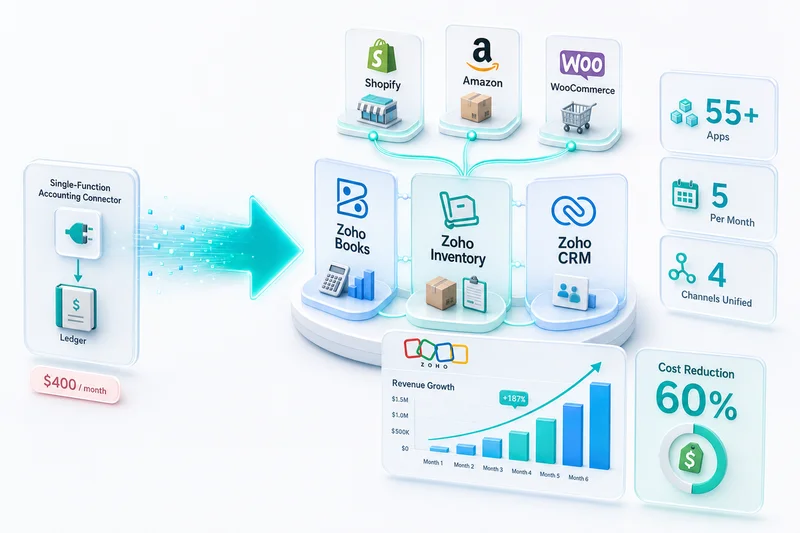
Zoho One bundles all of these at $37-90/user/month, which is usually more cost-effective than purchasing individually once you need more than three products.
The core integration: Shopify Plus to Zoho Books and Inventory
For accounting and inventory, the integration works like this.
Orders sync from Shopify to Zoho Inventory when placed. Zoho Inventory creates a sales order, triggers picking, and updates inventory levels across configured locations. When the order fulfills, Zoho Books records the revenue.
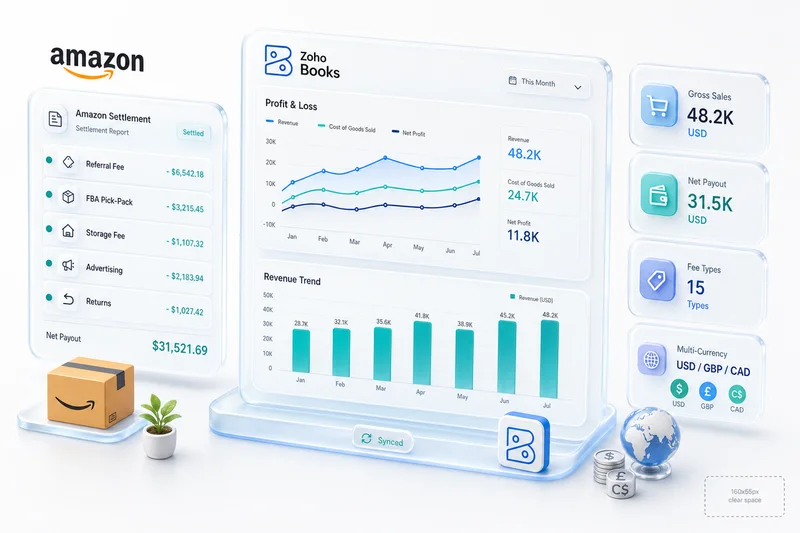
Payments post to Zoho Books with payment gateway fees separated. Shopify Payments, PayPal, and other gateways each have distinct fee structures that need specific chart of accounts mapping.
Refunds reverse correctly: inventory returns to stock, revenue reverses, and gateway fees post to the correct account (refund processing fees differ from original transaction fees and need separate treatment).
Multi-currency for international expansion stores posts exchange-rate-adjusted amounts to Zoho Books. If you have expansion stores in GBP, EUR, or CAD, Zoho Books handles the conversion and foreign currency accounting without bolt-on apps.
The difference between a generic Shopify-Zoho integration and an eCommerce-grade one is whether those flows handle edge cases correctly from day one. Returns with partial refunds, split shipments, gift card redemptions, and subscription renewals each carry specific accounting logic. That logic needs to be built into the setup, not discovered post-launch. For the full Zoho Books configuration Shopify Plus requires at enterprise scale — multi-location inventory accounts, gift card liabilities, multi-currency clearing accounts, and deferred revenue for subscriptions — see our Shopify Plus enterprise accounting guide.
B2B wholesale with Shopify Plus and Zoho CRM
The Shopify Plus wholesale channel is where the Zoho CRM integration delivers the most value. Standard Shopify orders don't have credit terms, purchase orders, or account-based pricing. The wholesale channel does, and Zoho CRM connects to all three.
Account setup: B2B buyers in Shopify Plus have accounts with custom pricing tiers. In Zoho CRM, those accounts exist as records with associated contacts, purchase history, credit limits, and open invoice data pulled from Zoho Books.
Order flow: When a wholesale buyer places an order, Zoho CRM updates the account's open order value. If a purchase order number was submitted, it matches against the Shopify order. Net payment terms create a payable in Zoho Books with the correct due date.
Credit management: Credit limits set in Zoho CRM can trigger review workflows in Shopify Plus when a B2B buyer approaches their limit. That coordination requires Zoho Creator for the custom logic connecting both systems.
For B2B eCommerce sellers using Shopify Plus, this configuration replaces separate ERP systems that carry $50,000+/year in licensing costs. For a complete guide to designing the deal stages, custom B2B fields, multi-tier price books, and credit approval routing in Zoho CRM for wholesale account acquisition on Shopify Plus, see the B2B wholesale sales pipeline guide for Zoho CRM.
Reporting across stores
Shopify Plus analytics cover one store at a time and don't connect to Zoho data. For multi-store merchants, understanding profitability (which store is growing, where inventory turns fastest, which products return most often) requires pulling data across systems.
Zoho Analytics connects to Zoho Books, Zoho Inventory, and Shopify directly via API. A multi-store reporting setup in Zoho Analytics gives you:
- Revenue and margin by store and by channel
- Inventory turnover by SKU across all locations
- Return rate by product, store, and channel
- COGS accuracy by channel (critical for multi-channel sellers also on Amazon or WooCommerce)
- Cash flow projections based on current order pipeline and net payment terms on open B2B invoices
This replaces standalone BI tools or the manual spreadsheet work most Shopify Plus merchants default to as they scale. For what Zoho Analytics can do for eCommerce specifically, see our Zoho Analytics for eCommerce reporting guide. For merchants selling across Shopify Plus, Amazon, and WooCommerce simultaneously, our multi-channel eCommerce solutions page covers how the Zoho stack handles unified operations across all channels.
What implementation looks like for Shopify Plus
A Shopify Plus to Zoho One implementation runs 8-16 weeks depending on scope.
Discovery (1-2 weeks): Mapping order flows, multi-store structure, wholesale channel requirements, current accounting setup, and integration points. For Shopify Plus merchants with prior systems (QuickBooks, a legacy ERP, spreadsheet-based workflows), this phase identifies what migrates and what gets replaced.
Configuration and build (4-8 weeks): Zoho product configuration, API integration development, chart of accounts design with CA review, and custom logic for Shopify Plus-specific requirements (wholesale channel, multi-store inventory, Flow trigger integrations).
Testing (2-3 weeks): End-to-end testing with real transaction data across all stores and channels. Edge case identification and resolution before go-live.
Launch and stabilization (2-3 weeks): Go-live with post-launch support covering the initial period when unusual transaction types hit the live system.
For cost ranges by scope, see Zoho eCommerce implementation cost: real numbers from 100+ projects.
When to use Zoho One vs individual products
Shopify Plus merchants often start with Books and Inventory, then add products as operations complexity grows. Here's where the decision points typically sit.
Add Zoho CRM when you have a wholesale channel with more than 20 B2B accounts, or when post-purchase relationship management (upsell, retention, loyalty) is a revenue driver.
Add Zoho Analytics when you have more than one store, sell on multiple channels, or want to connect marketing spend data to actual sales margin by channel.
Add Zoho Creator when you need workflows that don't fit standard Zoho products: custom wholesale portals for B2B buyers, approval workflows for large orders, integration with 3PLs or custom fulfillment systems.
Add Zoho Campaigns when customer lifecycle email (abandoned cart recovery, post-purchase sequences, loyalty campaigns) is managed in-house. For Shopify Plus merchants on Klaviyo, the migration question is whether Zoho Campaigns meets your segmentation requirements. For most standard use cases, it does.
Zolify's experience with Shopify Plus
Zolify has implemented Zoho for Shopify Plus merchants across apparel, health and wellness, specialty retail, and B2B wholesale. Our Shopify Plus implementations always include a CA reviewing the chart of accounts before go-live, test reconciliation against real transaction data, and post-launch support through the stabilization period.
As an Official Zoho Authorized Partner, we have direct Zoho support channel access when edge cases require Zoho's engineering team. For merchants evaluating a Shopify Plus to Zoho migration, our Shopify and Zoho solution page details the full integration scope.
Book a free eCommerce Ops Audit and we'll map out the specific configuration for your Shopify Plus operation, including which Zoho products you actually need vs which are optional at your current scale.
Frequently Asked Questions
Shopify Plus gives access to APIs and features unavailable on standard plans: the Wholesale Channel API, Multipass for SSO, Script Editor for custom pricing logic, Shopify Flow automations, and higher API call limits. For Zoho integration, this means automating wholesale order processing separately from retail, implementing custom pricing rules that sync to Zoho CRM, and handling higher order volumes without hitting API throttling issues.
Yes. Zoho Inventory connects to Shopify Plus the same way it connects to standard Shopify, but Shopify Plus merchants typically need multi-location inventory management across stores, warehouses, and fulfillment centers. Zoho Inventory handles this natively. If you also sell on Amazon FBA, that inventory connects to the same Zoho Inventory system so stock levels are accurate across all channels.
Yes, and this is one of the strongest use cases for the combination. Shopify Plus's Wholesale Channel gives B2B buyers a separate ordering portal with custom pricing. Zoho CRM connects to that wholesale channel to track B2B accounts, deal history, credit limits, and post-purchase relationships. Net payment terms, purchase order matching, and B2B billing all flow from Zoho CRM into Zoho Books.
Shopify Plus implementations sit at the more complex end of the range: $12,000-30,000 for a full Zoho One implementation, depending on the number of channels, whether the wholesale channel is included, pricing logic complexity, and whether data migration from a prior system is required. Implementation time runs 8-16 weeks. Our Zoho eCommerce implementation cost guide has the full range breakdown.
At minimum, you need Zoho Books and Zoho Inventory for a complete Shopify Plus integration covering accounting and inventory. Zoho One makes sense if you also need Zoho CRM for B2B wholesale management, Zoho Analytics for multi-store reporting, Zoho Creator for custom portals or approval workflows, or Zoho Desk for post-purchase support connected to order data. For a standard retail-only Shopify Plus merchant, Books plus Inventory covers the core. Add products as operations complexity grows.
See exactly where your Shopify, Amazon, or WooCommerce ops are leaking — free.
Get a personalised eCommerce Ops Audit: inventory gaps, accounting leaks, and order-flow bottlenecks — with a Zoho fix roadmap. Delivered in 48 hours, at no cost.