A2X Alternative: Why eCommerce Sellers Are Switching to Full Zoho Operations
Outgrowing A2X? See why eCommerce sellers switch to Zoho for unified accounting, inventory, CRM, and operations, all in one connected platform.
If you sell on Amazon, Shopify, or any other marketplace, you've probably come across A2X. It's a solid tool that does one thing well: it takes your marketplace transactions and posts clean, summarized journal entries into QuickBooks or Xero. For a lot of sellers, that's the first real step toward having accurate books.
But here's the thing. A2X only solves one piece of a much larger puzzle. And if you're reading this, you've probably started to feel the edges of what it can do.
Maybe you've added a second sales channel. Maybe your inventory tracking is a mess of spreadsheets. Maybe you're paying for five different tools that don't talk to each other and spending hours each week manually connecting the dots. If any of that sounds familiar, you're not alone. It's the most common pattern we see across the 100+ eCommerce implementations we've completed at Zolify.
This post breaks down where A2X works, where it doesn't, and what a full-stack A2X alternative looks like when you're ready to stop patching gaps and start running unified operations.
Disclosure: Zolify is an Official Zoho Authorized Partner. We implement Zoho for eCommerce businesses. That means we know the platform deeply, including where it falls short. This comparison is honest because our reputation depends on it.
What A2X Does Well
Credit where it's due. A2X carved out a niche because it solves a real, painful problem.
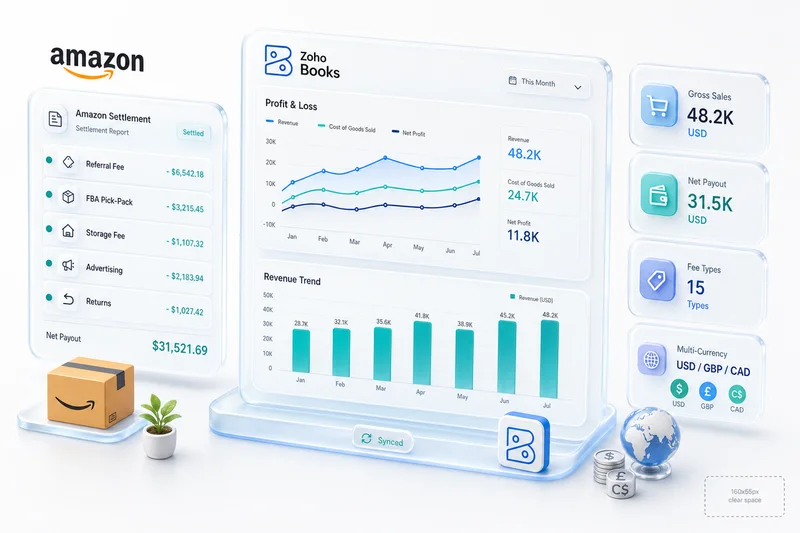
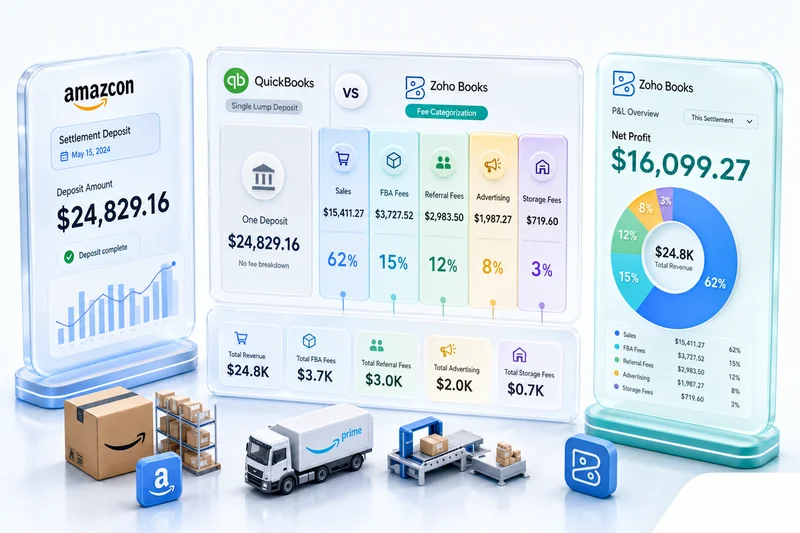
Before A2X existed, eCommerce sellers were either manually entering marketplace settlements into their accounting software or dumping raw transaction data that didn't reconcile properly. Amazon payouts, for example, lump together product sales, shipping fees, FBA fees, refunds, and advertising charges into a single bank deposit. Trying to book that correctly in QuickBooks or Xero without a tool like A2X is a nightmare.
A2X fixes that by:
- Parsing marketplace settlement reports into clean, accrual-based journal entries
- Matching entries to bank deposits so reconciliation actually works
- Supporting Amazon, Shopify, eBay, Etsy, and Walmart transaction formats
- Posting summarized entries rather than individual transactions (which keeps your books clean instead of flooding them with thousands of line items)
For a single-channel Shopify seller doing $20,000-$50,000 per month in revenue who's already set up on QuickBooks and just needs their books to be accurate, A2X is genuinely good at what it does. No complaints there.
The problem isn't what A2X does. It's everything it doesn't do.
Where A2X Breaks Down
A2X is an accounting sync tool. That's it. It takes marketplace data and pushes it into your accounting software. Once you need anything beyond that, you're on your own.
Here's what we mean:
No inventory management
A2X doesn't track your stock levels. It doesn't know how many units you have in your warehouse, how many are in transit to FBA, or when you need to reorder. You need a separate inventory management tool for that (Cin7, SkuVault, Linnworks, or something similar). That's another $100-$300 per month, another login, another integration to maintain.
No CRM or customer data
A2X processes transactions, not customers. It doesn't capture who bought what, their purchase history, lifetime value, or whether they've contacted support. If you want to understand your customers or run any kind of retention marketing, you need a separate CRM. That's another $50-$150 per month.
No multi-channel unification
If you sell on Amazon and Shopify, A2X can post entries from both channels into your accounting software. But it doesn't unify your operations across channels. Inventory isn't synced. Customer records aren't merged. Orders aren't managed in one place. You're still running two parallel operations and hoping the numbers match up at the end of the month.
No operational automation
A2X doesn't automate your purchase orders when stock gets low. It doesn't trigger email sequences when a customer places their third order. It doesn't generate profitability reports by channel or by product. The tool starts and stops at the accounting ledger.
Locked into QuickBooks or Xero
This is the one that catches a lot of sellers off guard. A2X only posts to QuickBooks Online and Xero. If you decide to switch accounting platforms (for pricing reasons, feature reasons, or because you're moving to a unified platform) A2X can't come with you. Your investment in setting up A2X mappings, categorizations, and workflows is tied to a specific accounting platform.
For eCommerce sellers specifically evaluating Xero against Zoho Books, the Xero vs Zoho Books comparison for eCommerce sellers breaks down the inventory gap, connector costs per channel, and true monthly total for operators running Shopify, Amazon, and WooCommerce simultaneously.
The real cost: tool sprawl
The pattern we see over and over again looks something like this:
| Tool | Purpose | Monthly Cost |
|---|---|---|
| A2X | Accounting sync | $19-$99 |
| QuickBooks Online | Accounting | $30-$200 |
| Cin7 or similar | Inventory management | $99-$349 |
| HubSpot or similar | CRM | $50-$150 |
| Mailchimp or similar | Email marketing | $30-$100 |
| Google Sheets | Reporting (manual) | "Free" (but hours of labor) |
Total: $228-$898 per month, plus the hidden cost of manually connecting these systems, dealing with sync errors, and spending hours each week on data entry that should be automated.
That's not a tech stack. That's a junk drawer with a credit card attached. For a detailed breakdown of why Zapier middleware doesn't scale for eCommerce operations, see why Zapier falls short for eCommerce integrations.
The Full-Stack A2X Alternative: Zoho for eCommerce
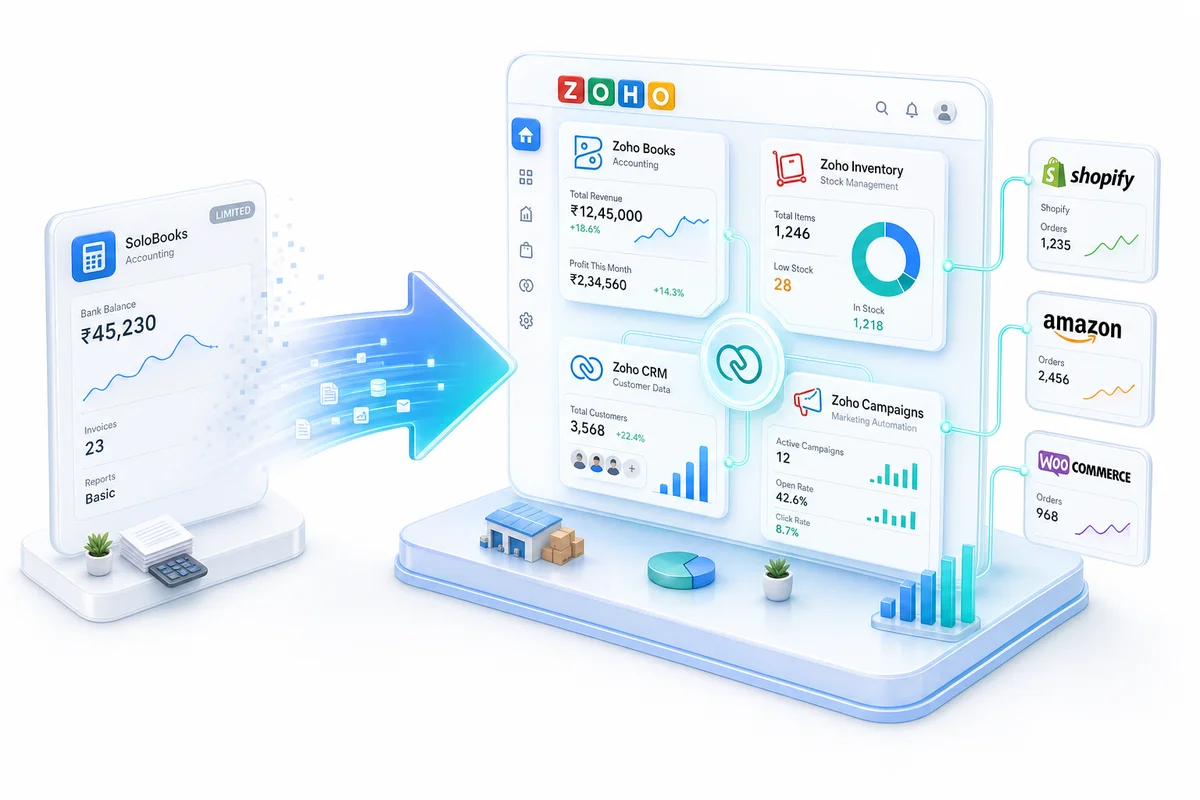
Here's the fundamental shift: instead of bolting together five or six single-purpose tools and hoping they play nice, you run your entire eCommerce operation on one connected platform.
The Zoho ecosystem gives you:
Zoho Books: Accounting
Full double-entry accounting with multi-currency support, automated bank reconciliation, invoicing, bill management, expense tracking, and financial reporting. It handles everything QuickBooks does, typically at 40-60% lower cost. For eCommerce specifically, it supports accrual-based revenue recognition and handles the complexity of marketplace fee structures.
Zoho Inventory: Order and inventory management
This is where the A2X comparison gets interesting. Zoho Inventory connects directly to Amazon, Shopify, eBay, Etsy, and WooCommerce. It pulls in orders, manages stock levels across warehouses and FBA, generates purchase orders, handles bundling and kitting, and tracks shipments. And because it's natively connected to Zoho Books, every order that flows through Inventory automatically creates the correct accounting entries, no middleware needed.
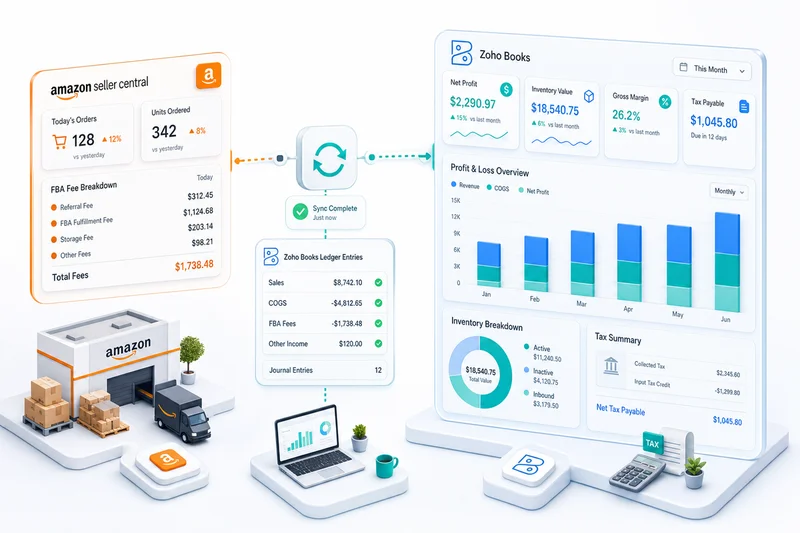
That last part is worth repeating: the accounting sync that A2X provides as a standalone product is built into Zoho Inventory as a native feature. Orders come in from your marketplaces, inventory is updated, and accounting entries are created, all in one workflow. For a deep dive on how revenue recognition, fee categorization, and reconciliation work across channels in Zoho Books, see our multi-channel eCommerce accounting guide.
Zoho CRM: Customer relationships
Every customer who buys from any of your channels gets a unified record in Zoho CRM. Purchase history, support tickets, email interactions, lifetime value. It's all there. You can segment customers, track sales pipelines for wholesale accounts, and actually understand who your buyers are instead of just knowing what they bought.
Zoho Analytics: Business intelligence
Connect your sales data, inventory data, and financial data into dashboards that update in real time. Profitability by channel. Sell-through rates by product. Customer acquisition cost trends. The kind of reporting that would take hours in spreadsheets happens automatically.
Zoho Campaigns: Email marketing
Customer segments from CRM feed directly into email campaigns. Set up automated sequences for post-purchase follow-ups, review requests, restock notifications, and win-back campaigns. No CSV exports, no third-party integrations, no hoping the data synced correctly.
Everything else
Zoho One includes 55+ applications. Zoho Desk for customer support. Zoho Projects for product launches. Zoho Sign for vendor contracts. Zoho Flow for custom automations between any Zoho app. You probably won't use all of them, but having them available (and natively connected) means you never hit a wall where you need yet another third-party tool.
Feature Comparison: A2X + QuickBooks vs. Zoho Stack
| Capability | A2X + QuickBooks | Zoho (Books + Inventory + CRM) |
|---|---|---|
| Marketplace transaction sync | Yes (A2X core feature) | Yes (native in Zoho Inventory) |
| Accrual-based accounting | Yes (via QB) | Yes (Zoho Books) |
| Multi-currency support | Limited (QB charges extra) | Native (included in all plans) |
| Inventory management | No (need separate tool) | Yes (Zoho Inventory) |
| Multi-channel inventory sync | No | Yes (Amazon, Shopify, eBay, Etsy, WooCommerce) |
| Purchase order automation | No | Yes (auto-reorder at threshold) |
| CRM / customer records | No (need separate tool) | Yes (Zoho CRM) |
| Email marketing | No (need separate tool) | Yes (Zoho Campaigns) |
| Custom reporting / BI | Basic (QB reports only) | Advanced (Zoho Analytics) |
| Workflow automation | No | Yes (Zoho Flow, Deluge scripting) |
| Customer support ticketing | No | Yes (Zoho Desk) |
| Bank reconciliation | Yes (via QB) | Yes (Zoho Books) |
| Sales tax compliance | Yes (via QB) | Yes (Zoho Books) |
| API access | Limited | Full REST API across all apps |
The pattern is clear. A2X plus QuickBooks covers accounting. Period. Everything else requires additional tools, additional integrations, and additional cost. The Zoho stack covers accounting and everything around it in one subscription.
The Cost Math: A2X Stack vs. Zoho
Let's put real numbers on this for a mid-sized eCommerce seller doing $50,000-$150,000 per month across two or three channels.
Typical A2X-based stack
| Tool | Plan | Monthly Cost |
|---|---|---|
| A2X | Professional (2 channels) | $69/month |
| QuickBooks Online | Plus | $90/month |
| Cin7 Core | Small Business | $149/month |
| HubSpot CRM | Starter | $50/month |
| Mailchimp | Standard | $45/month |
| Reporting | Manual (spreadsheets + time) | $0 (but 5-10 hrs/week labor) |
| Total | $403/month |
And that's before you factor in the integration costs. Many of these tools need Zapier or custom middleware to pass data between them. That's another $30-$70 per month for a Zapier plan that handles the volume.
Zoho stack
| Tool | Plan | Monthly Cost |
|---|---|---|
| Zoho One | 1 user, all apps | $45/month |
| Additional users (2) | $90/month | |
| Total (3 users) | $135/month |
That $135 per month gives you Zoho Books, Zoho Inventory, Zoho CRM, Zoho Analytics, Zoho Campaigns, Zoho Desk, and 50+ other applications. All natively connected. No middleware. No Zapier. No integration maintenance.
Savings: roughly $270 per month, or $3,240 per year. That's a conservative estimate. Sellers with larger tool stacks or higher-tier plans on their existing tools see even bigger gaps.
The savings get more dramatic as you grow. Adding a fourth sales channel on A2X means upgrading to a higher plan. Adding more users on QuickBooks means per-user charges. Adding more contacts on HubSpot means tier upgrades. With Zoho One, the price scales linearly per user, and the feature set stays the same regardless of how many channels, contacts, or transactions you process.
When A2X Still Makes Sense
We're not going to pretend A2X is the wrong choice for everyone. There are legitimate scenarios where it's the right tool:
You're a single-channel Shopify seller. If you only sell on Shopify, your accounting needs are straightforward, and you're happy with QuickBooks or Xero, A2X does the job efficiently. You probably don't need multi-channel inventory management or a CRM yet.
Your accountant insists on QuickBooks. Some accountants are deeply embedded in the QuickBooks ecosystem and won't work with anything else. If keeping your accountant happy is the priority and you're not experiencing operational pain, A2X plus QuickBooks is a proven combination.
You're doing under $10,000 per month in revenue. At this stage, simplicity matters more than features. A2X's lower-tier plans plus QuickBooks Simple Start might be all you need. The operational complexity that justifies a unified platform usually kicks in around $30,000-$50,000 per month.
You have no plans to add sales channels. If you're committed to a single marketplace and a single sales channel, the multi-channel unification benefits of Zoho don't apply to you. A2X handles single-channel accounting sync well.
Be honest with yourself about where you are. If you're in one of these categories and you're not experiencing pain, switching platforms for the sake of switching doesn't make sense.
When It's Time to Switch
On the other hand, here are the signals that you've outgrown A2X and the patchwork tool stack:
You're selling on two or more channels. The moment you add a second marketplace (say Amazon plus Shopify, or Shopify plus Etsy) inventory management becomes a real problem. Overselling, stockouts, and manual stock counts are symptoms of disconnected systems.
You're spending more than 5 hours per week on manual data work. Exporting CSVs from one tool, cleaning them up, and importing them into another tool is not operations. It's data janitorial work. If that describes your week, your tools aren't doing their job.
You're outgrowing QuickBooks. QuickBooks Online works well up to a point. Once you need advanced multi-currency support, deeper automation, or more granular reporting, you start hitting walls. If you're already thinking about moving off QuickBooks, you might as well move to a platform that eliminates the need for A2X at the same time.
You want to actually understand your customers. If you have no idea who your repeat buyers are, what their lifetime value is, or which acquisition channels bring in the most profitable customers, you need a CRM connected to your sales data. A2X can't help with that.
You need inventory visibility across channels and warehouses. Knowing your stock levels, in real time, across every location including FBA, isn't optional once you're doing serious volume. If you're managing this in spreadsheets or logging into three different dashboards, something is going to break. It's a matter of when, not if.
You're tired of paying for five tools that should be one. Sometimes the frustration is simpler than any specific feature gap. You're just tired of managing multiple subscriptions, multiple logins, multiple support channels, and multiple integration points. That's a valid reason to consolidate.
How Zolify Implements the Switch
Moving from a patchwork tool stack to a unified platform is a significant project. It touches your accounting, your inventory, your customer data, and your daily workflows. We take it seriously.
Here's what our process looks like:
Discovery and mapping (Week 1)
We start by understanding exactly what you're running today. Which tools, which channels, which workflows, which manual processes. We map your current chart of accounts, document your inventory structure, and identify every integration point that needs to be replicated or replaced.
This is also where we identify what's working. Not everything needs to change. If your Amazon FBA workflow is solid, we're not going to reinvent it. We're going to connect it to the rest of your operations.
Financial configuration (Weeks 2-3)
This is where our CA/CPA on staff gets involved. Every chart of accounts mapping, every tax configuration, every revenue recognition rule gets reviewed by a credentialed accountant. Not a software consultant reading documentation, but an actual accountant who understands GAAP, multi-state sales tax, and the specific accounting challenges of eCommerce businesses.
We configure Zoho Books to match your financial reporting requirements, set up automated bank feeds, and build the transaction rules that keep your books clean without manual intervention.
Channel and inventory setup (Weeks 3-4)
We connect your marketplaces to Zoho Inventory, configure your warehouse locations (including FBA), set up reorder points, and build the workflows that keep inventory synced across all channels. If you're using a 3PL, we integrate that too.
This phase also includes setting up Zoho CRM with your customer data and configuring the automation rules that keep customer records unified as orders come in from different channels.
Parallel operations and validation (Weeks 4-6)
We don't flip a switch and hope for the best. We run your new Zoho stack in parallel with your existing tools for at least two weeks. Every transaction gets verified. Every inventory count gets cross-checked. Every bank reconciliation gets reviewed.
Only after the parallel run confirms that everything matches do we cut over to the new system.
Training and handoff
Your team gets hands-on training on the new workflows. Not a generic Zoho tutorial, but specific training on your configuration, your processes, your daily tasks. We also document everything so you're not dependent on us for tribal knowledge.
Total timeline: 3-6 weeks
Smaller operations (single channel, straightforward inventory) land closer to 3 weeks. Complex multi-channel sellers with multiple warehouses and custom workflows are closer to 6 weeks. We've completed 100+ implementations at this point, so we know where the common pitfalls are and how to avoid them.
What Our eCommerce Clients Typically See After Switching
We'll keep this grounded in realistic outcomes rather than marketing hyperbole.
Software cost reduction of 40-60%. Consolidating five or six tools into Zoho One consistently reduces monthly software spend. The exact number depends on what you're currently paying, but the math almost always works out.
5-10 hours per week reclaimed from manual data work. When your inventory, accounting, and CRM are natively connected, the CSV exports, manual reconciliations, and data entry tasks disappear. That time goes back to activities that actually grow the business.
Fewer stockouts and oversells. Real-time inventory sync across channels means your stock levels are accurate everywhere. Sellers who were experiencing weekly overselling issues on their secondary channels typically see those drop to near zero.
Actual customer insight. For the first time, many of our clients can answer basic questions like "who are my top 50 customers by lifetime value?" or "what percentage of my Amazon buyers also buy from my Shopify store?" That data was always there. It just wasn't connected.
Cleaner books at month-end. When accounting entries are generated automatically from operational data instead of being manually posted or synced through middleware, month-end close gets faster and more accurate. Our clients with a CA/CPA-reviewed Zoho Books configuration typically close their books in 2-3 days instead of 7-10.
Ready to Move Beyond A2X?
If you're feeling the limitations of A2X and a patchwork tool stack, we should talk. Not a sales pitch, but a genuine conversation about whether Zoho makes sense for your specific situation. Our managed accounting service handles the entire transition and ongoing bookkeeping, and our Shopify–Zoho integration connects your storefront to a full operations backend.
We'll review your current tools, your sales channels, your monthly volume, and your operational pain points. If Zoho is the right fit, we'll map out exactly what the implementation looks like. If it's not the right fit, we'll tell you that too.
As an Official Zoho Authorized Partner with 100+ eCommerce implementations and a CA/CPA on staff reviewing every financial configuration, we bring both the technical depth and accounting expertise to get this right.
Book a Free eCommerce Operations Consultation →
No commitment. No pressure. Just a clear-eyed look at whether unified operations would actually help your business.
The full case for replacing a patchwork tool stack with a unified platform is covered in depth in Zoho for eCommerce: The Complete Operations Platform Guide, including how Shopify, Amazon, WooCommerce, eBay, and Etsy connect into a single operations backend. For the Amazon accounting setup specifically, see Amazon accounting with Zoho Books.
Frequently Asked Questions
The Zoho ecosystem (Zoho Books + Zoho Inventory + Zoho CRM) is the strongest A2X alternative for sellers who need more than just accounting sync. While A2X only handles transaction posting to QuickBooks or Xero, Zoho covers accounting, inventory management, customer relationships, multi-channel order management, and marketing automation in a single connected platform, typically at a lower combined cost.
Yes. Zoho Books handles the accounting that QuickBooks provides, and Zoho Inventory handles marketplace order syncing and inventory tracking that A2X partially addresses. Together, they replace two separate subscriptions with one integrated system. You also gain multi-currency support, automated bank reconciliation, and native CRM integration that neither A2X nor QuickBooks offer on their own.
The Zoho One bundle costs $45 per user per month and includes 55+ applications covering accounting, inventory, CRM, analytics, email marketing, and more. Compare that to a typical A2X plus QuickBooks plus separate inventory tool plus separate CRM stack, which runs $200 to $500 or more per month. Most sellers see 40-60% savings on software costs alone after switching.
Yes. Zoho Inventory integrates with Amazon, Shopify, eBay, Etsy, and WooCommerce for order syncing, inventory management, and fulfillment tracking. Unlike A2X, which only posts summarized financial transactions to your accounting software, Zoho Inventory manages the full operational workflow, from incoming orders to shipping labels to accounting entries in Zoho Books.
A typical migration takes 3 to 6 weeks. This includes mapping your chart of accounts, migrating historical data, connecting marketplace channels, configuring inventory workflows, and running parallel operations to verify accuracy. Zolify has completed 100+ eCommerce implementations and every financial configuration is reviewed by a CA/CPA on staff.
See exactly where your Shopify, Amazon, or WooCommerce ops are leaking — free.
Get a personalised eCommerce Ops Audit: inventory gaps, accounting leaks, and order-flow bottlenecks — with a Zoho fix roadmap. Delivered in 48 hours, at no cost.