eCommerce Operations Partner: What to Look For and 7 Questions to Ask
Most eCommerce sellers hire an accountant and an IT consultant separately, and end up with systems that don't talk to each other. An eCommerce operations partner covers both, connecting storefronts to Zoho inventory, finance, and CRM in one coordinated implementation.
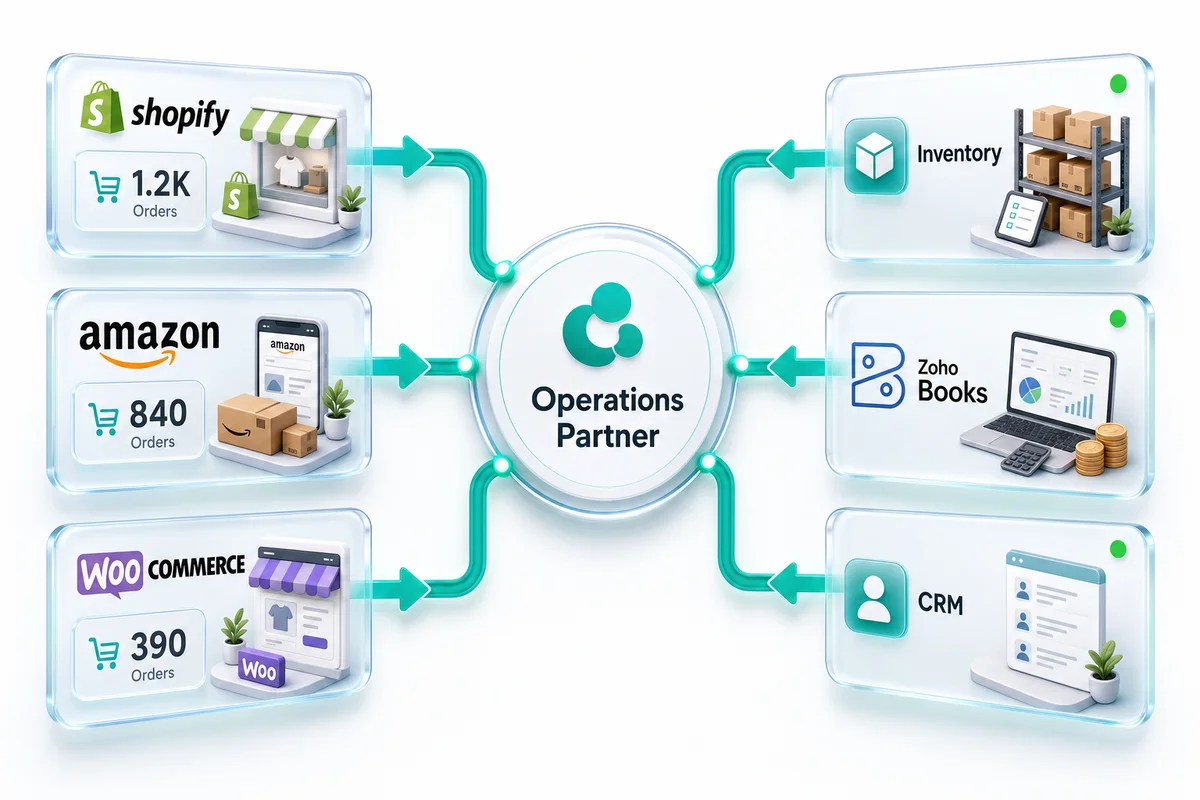
An eCommerce operations partner connects your storefronts to your back-end systems (inventory, accounting, and CRM) and designs those connections around how eCommerce actually works, not how Zoho documentation says it should work.
There are plenty of Zoho consultants, accountants, and IT professionals who can each handle a piece of the problem. None of them cover the full picture: integration, accounting design, and operational workflow in one engagement.
Most eCommerce sellers end up with a back-end built the same way: hire an accountant for the books, find an IT person to configure the software, and hope the two systems communicate. They usually don't. Orders flow from Shopify but don't reach Zoho Books. Inventory counts in Zoho Inventory diverge from what's actually on the shelf. Amazon fees land in a single "marketplace fees" line that tells you nothing about where your margin went.
TL;DR: An eCommerce operations partner connects your Shopify, Amazon, WooCommerce, eBay, and Etsy storefronts to a Zoho-powered back-end covering inventory, accounting, and CRM. The key differentiator from a general Zoho consultant is eCommerce domain expertise: knowing how marketplace fees, multi-channel inventory, returns, and sales tax work in practice. Seven questions at the bottom of this post separate genuine experience from surface-level claims.
eCommerce operations partner vs. other specialists
Most sellers piece together a team because no single generalist covers the full scope. The problem is each specialist optimises for their own area, and the gaps between them are where errors and manual work collect.
| Capability | Bookkeeper | IT Consultant | General Zoho Partner | eCommerce Ops Partner |
|---|---|---|---|---|
| Records and categorises transactions | Yes | No | No | Yes |
| Configures Zoho products | No | Partially | Yes | Yes |
| Designs eCommerce-specific workflows | No | No | Rarely | Yes |
| Understands marketplace fee structures | Sometimes | No | Rarely | Yes |
| CA or CPA on the team | Sometimes | No | Rarely | Yes (Zolify standard) |
| Connects Shopify, Amazon, WooCommerce APIs | No | Sometimes | Varies | Yes |
| Multi-channel inventory architecture | No | No | Rarely | Yes |
| Post-launch monitoring and support | No | No | Varies | Yes |
| Typical cost | $200–800/mo | Project-based | $2,000–15,000 | $2,500–15,000+ |
The cost overlap between a general Zoho partner and an eCommerce ops partner is real. The difference is what you get for it. A general partner configures what you specify. An eCommerce ops partner has the domain knowledge to determine what the specification should be — and that distinction matters most in eCommerce, where incorrect fee mapping, wrong accounting basis, and mis-structured inventory compound over months before anyone notices.
For a full evaluation framework, how to choose an eCommerce operations partner covers the process in detail.
What an eCommerce operations partner actually does
The category exists because eCommerce operations sit at the intersection of technology, accounting, and retail operations, and most professionals specialise in one of the three, not all of them.
A bookkeeper records what happened. An IT consultant configures what you tell them to configure. A general Zoho partner sets up Zoho the way the product documentation says to. An eCommerce operations partner designs the system based on how your business actually runs and then builds it.
That design work includes:
- Workflow mapping: how does an order move from placement through fulfilment, accounting, and customer communications in your specific business?
- Fee categorisation: which fee types appear in your Amazon settlements, and which account does each one belong in?
- Inventory architecture: do you warehouse across multiple locations? Do you dropship some SKUs? Do you bundle products? Each scenario requires different setup in Zoho Inventory.
- Returns logic: does a return go back to saleable stock, get marked damaged, or get discarded? The accounting and inventory implications differ for each path.
- Tax compliance: which states have you reached economic nexus in? What is your VAT exposure for international orders?
These are not questions a Zoho configuration guide answers. They require experience with production eCommerce systems.
When you need one
Not every eCommerce seller needs an operations partner at every stage. The triggers that indicate you've outgrown basic tools:
Multi-channel selling. Once you're on Shopify plus Amazon, or adding WooCommerce to an existing Shopify store, inventory and accounting become multi-system problems. Every platform has its own data format, fee structure, and settlement timing. Keeping them synchronised manually is a full-time job that generates errors.
Volume where errors cost real money. At 50 orders a month, a misposted fee is a minor correction. At 1,000 orders a month, systematic miscategorisation of Amazon FBA fees or Shopify payment processing fees creates material misstatements in gross margin. For a concrete look at how fee categorisation affects P&L accuracy, see what Zoho Books does for Amazon sellers.
Outgrowing A2X, Webgility, or spreadsheet reconciliation. These tools handle basic accounting summaries. They don't manage inventory across channels, don't automate order-to-cash workflows, and don't give you product-level margin data. When you need more than a reconciliation summary, you need an integrated operations stack.
Preparing to scale. Building the right infrastructure before a growth phase is cheaper than retrofitting it mid-stride. If you're adding two sales channels in the next 12 months, the time to build the operations architecture is now, not after you're processing 3,000 orders a week. The same applies to replatforming: migrating from WooCommerce to Shopify requires rebuilding every Zoho connector — Inventory, Books, and CRM — before go-live, and that reconfiguration needs to run in parallel with the platform build, not after it.
Why DIY implementation costs more than it saves
Many sellers try to self-implement Zoho before calling an operations partner. The logic is fair: Zoho's documentation is detailed, there are walkthrough videos, and the software is designed to be configured without a developer. Roughly 70% of self-implemented Zoho setups require professional rework within the first year — not because the setup wizard is bad, but because it builds a generic business configuration, not an eCommerce one.
What the documentation doesn't cover is the eCommerce-specific design layer.
The standard Zoho Books setup guide doesn't explain how to structure a chart of accounts for a business running Amazon FBA, Shopify, and WooCommerce simultaneously. It doesn't address how Amazon's bi-weekly settlement cycles interact with your Zoho inventory cutoffs. It doesn't tell you what happens to stock counts when a Shopify return is partially refunded but not yet physically received back.
Sellers who DIY typically hit one of three failure modes:
The accounting-correct-but-operationally-wrong setup. Zoho Books is running, transactions are posting, but the P&L doesn't show channel-level profitability. You can't separate Amazon margin from Shopify margin. Fixing this means retrofitting the chart of accounts while live data is flowing through — a disruptive project at the worst possible time.
The integration that breaks at volume. A Shopify-to-Zoho connection via Zapier or a basic connector handles standard orders. Then you run a sale, 200% order volume hits over two days, bundle SKUs get ordered, and the connector starts dropping records. Inventory goes out of sync. Reconciliation takes two weeks.
The partial build that never finishes. Zoho Inventory gets set up for one warehouse. CRM gets a basic pipeline. The connections between them (how a Zoho CRM deal triggers a pick in Zoho Inventory, how a fulfilment event updates the CRM record) were never built. The system is live but the manual handoffs are still there.
An operations partner surfaces these before implementation starts. The discovery sprint ($500–$700) is designed to catch them in the design phase, before they become live problems you're fixing while orders are processing.
7 questions to ask before hiring
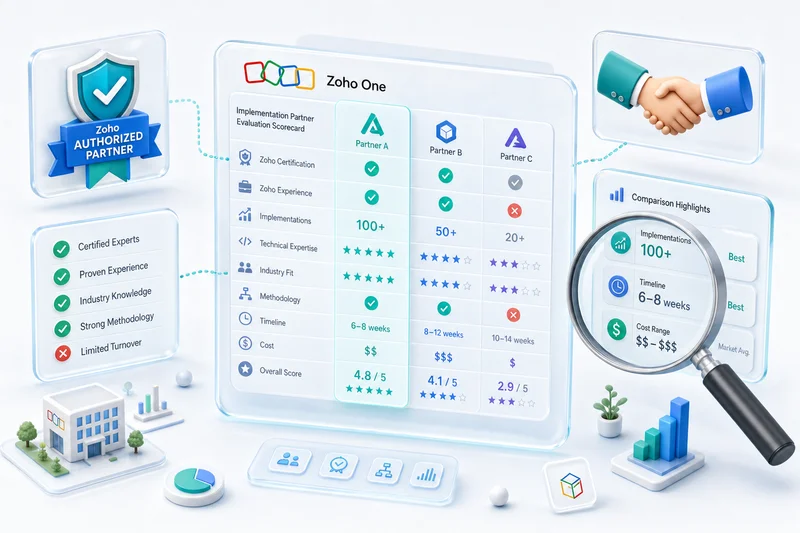
These questions are direct. The answers separate partners with production eCommerce experience from consultants who have configured Zoho for a few businesses and listed "eCommerce" as a skill.
1. How many eCommerce integrations have you delivered in production?
The answer should be a number with specifics. "Dozens" is a non-answer. "We've completed 50 Shopify-to-Zoho integrations, 30 Amazon-to-Zoho setups, and 20 multi-channel projects" is a real answer. Production means real financial data flowing through real systems for live businesses, not proof-of-concept work.
2. Do you have a CA or CPA on the team?
Accounting-correct eCommerce integration requires someone who understands how revenue should be recognised, how fees should be categorised, and how inventory valuation affects COGS. A CA or CPA on the team is not optional. It's what prevents an integration that's technically functional but accounting-wrong.
3. Have you connected the specific platforms I'm on?
Shopify, Amazon, WooCommerce, eBay, and Etsy each have different APIs, different data formats, and different fee structures. Experience with one does not transfer automatically to another. Amazon's FBA fee calculation varies based on seller account type (Professional vs Individual), fulfilment method (FBA vs FBM), and product category. Shopify Payments fee reconciliation in Zoho Books alone involves four separate line items that most consultants collapse into one.
4. Can you show me how you handle fee reconciliation for my platforms?
Ask for a specific example: how do you map Amazon's referral fee, FBA fulfilment fee, and sponsored products advertising charge to Zoho Books accounts? If the answer is "they all go into an Amazon fees account," that's a red flag. Each fee type belongs in a different account for your P&L to tell you anything useful.
5. What does your discovery process look like?
Good implementations start with a paid discovery sprint that documents your current systems, maps your workflows, and produces a detailed scope and architecture recommendation. If a partner is ready to give you a fixed price without a discovery phase, they're either padding the price for unknowns or haven't thought through the complexity.
6. What happens after go-live if something breaks?
Post-launch support matters for integrations processing financial data. What is the response time for a Shopify sync error? Who monitors the integration? Is there a managed services option? An integration that runs clean for three months and then starts dropping orders in month four is not a completed project.
7. What are your hourly rates and total estimate for my scope?
Get numbers. Offshore Zoho consultants range from $28–65/hour. US-based Zoho consultants run $150–275/hour. Know what you're comparing when you evaluate proposals. An offshore partner at $45/hour on a 150-hour project ($6,750) may deliver the same output as a US-based consultant at $200/hour ($30,000). The expertise level, not the rate, is what determines quality.
Red flags in partner evaluation
Warning signs that indicate a partner may not have genuine eCommerce operations experience:
- No mention of fee categorisation by type — describes "connecting Shopify to Zoho" without discussing how Shopify Payments fees, transaction fees, and refunds are handled separately
- No CA or CPA on the team and no mention of accounting review in the process
- Unable to explain the difference between Amazon FBA and FBM settlement handling
- No discovery sprint, ready to quote a fixed price on a multi-channel project immediately
- No post-launch support offering, considers the project complete at go-live
- References limited to one or two platforms with "we've done others" for the rest
These warning signs have direct financial consequences. A team that skips CA review and cannot explain platform fee reconciliation will produce an incorrect chart of accounts from day one. For the five specific accounting errors that result, see why generalist Zoho agencies fail eCommerce businesses.
What working with an eCommerce operations partner looks like
A structured engagement typically runs in phases:
Discovery sprint (2–3 weeks, $500–700): Document current state: which storefronts, which tools, which manual processes. Map the desired end state. Assess the gap. Produce a scope document, architecture recommendation, and fixed-price estimate.
Implementation (4–12 weeks, scope-dependent): Build the integrations, configure Zoho products, map chart of accounts, test against production data, train the team. Parallel run period for financial validation before cutover.
Go-live and stabilisation (2–4 weeks): Cut over from manual to automated processes. Monitor for edge cases. Resolve anything that surfaces with real order volume.
Ongoing support (optional, monthly retainer): Sync monitoring, error resolution, optimisation as the business changes, updates when Zoho or platform APIs shift.
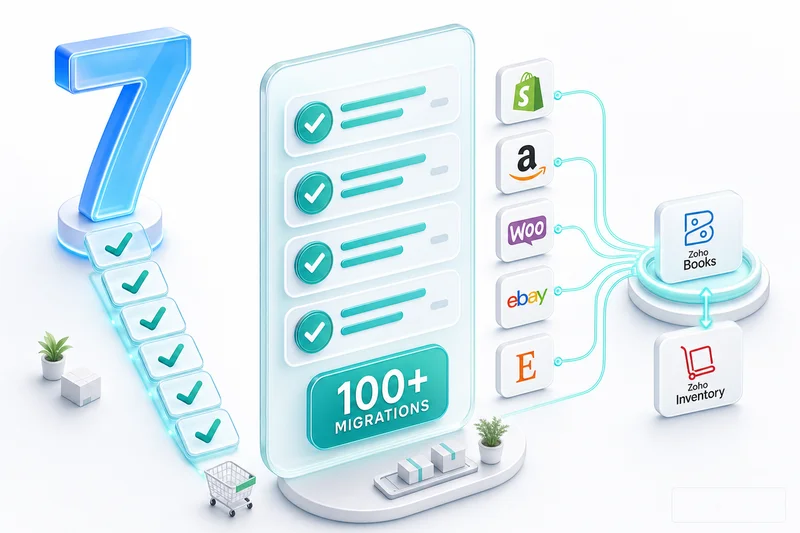
Zolify has completed 100+ eCommerce operations implementations across Shopify, Amazon, WooCommerce, eBay, and Etsy. Our team includes a CA who reviews every chart of accounts and fee mapping before go-live, as part of the design phase and before a single transaction posts incorrectly. As an Official Zoho Finance Partner, we have direct access to Zoho support and partner resources when edge cases surface, and access to Zoho One licence structures that non-partners cannot offer.
If you're evaluating operations partners for your eCommerce business, start with an eCommerce ops audit, a structured review of your current setup that shows what an integrated operations stack would look like for your specific channels and workflows.
Frequently Asked Questions
An eCommerce operations partner connects your storefronts (Shopify, Amazon, WooCommerce, eBay, Etsy) to your back-end systems: inventory management, accounting, CRM, and marketing automation. The role covers both the technical integration work (connecting systems via API) and the operational design work (mapping your eCommerce workflows to Zoho processes). It's different from a bookkeeper, who records transactions; different from an IT consultant, who configures software; and different from a general Zoho partner, who may not have eCommerce-specific experience.
The common triggers are: scaling to multiple channels (selling on Shopify plus Amazon plus WooCommerce), outgrowing manual processes or basic tools like A2X or spreadsheet-based reconciliation, experiencing regular inventory sync errors or stockouts caused by disconnected systems, or preparing for rapid growth and wanting the operations infrastructure built correctly before revenue scales. A discovery sprint with an eCommerce operations partner typically costs $500–$700 and gives you a clear implementation roadmap before you commit to a full project.
A general Zoho partner configures Zoho products based on your requirements. An eCommerce operations partner understands eCommerce workflows deeply enough to design those requirements: how Amazon FBA fees should be categorised, how multi-warehouse inventory should be structured, how returns from different channels should flow through accounting. Without that eCommerce domain knowledge, a Zoho configuration can be technically correct but operationally wrong for online retail.
Costs vary by scope. A single storefront connected to Zoho Books and Zoho Inventory typically runs $2,500–$6,000. Multi-channel setups (Shopify plus Amazon plus WooCommerce) typically start at $6,000. Full-stack implementations including Zoho One, CRM, and custom automations start at $10,000. Discovery sprints ($500–$700) define scope and produce a detailed estimate before any larger commitment. Managed services for ongoing operations support run $1,500–$5,000 per month.
Ask: How many eCommerce integrations have you delivered in production? Do you have accounting expertise on the team, a CA or CPA? Have you connected the specific platforms I'm on (Shopify, Amazon, WooCommerce, etc.)? Can you show me examples of fee reconciliation setup for my platforms? What does your discovery process look like? What happens after go-live if something breaks? And what is your hourly rate and total estimate for my scope? These questions separate partners with production experience from those who are learning on your project.
See exactly where your Shopify, Amazon, or WooCommerce ops are leaking — free.
Get a personalised eCommerce Ops Audit: inventory gaps, accounting leaks, and order-flow bottlenecks — with a Zoho fix roadmap. Delivered in 48 hours, at no cost.