Why Generalist Zoho Agencies Fail eCommerce Businesses (And What to Look for Instead)
When a developer without accounting training configures your Zoho Books eCommerce integration, the result looks functional until tax season. Five specific errors explain why eCommerce operators need a CA-backed specialist, not a generalist who also does Salesforce and custom software.
Generalist Zoho agencies fail eCommerce businesses for one reason: they configure software without accounting knowledge. Data flows from your Shopify, Amazon, WooCommerce, eBay, or Etsy storefront into Zoho Books — but it lands in the wrong accounts. Revenue is understated, fees disappear from expense accounts, and COGS records at the wrong point in the fulfillment cycle. The implementation looks functional until your accountant opens the books at tax season.
The problem is not price. It is financial accuracy at the eCommerce accounting layer, and that gap separates a developer who "knows Zoho" from a CA-backed specialist who has completed 100+ eCommerce implementations. For eCommerce operators evaluating Zoho, or who already have an implementation that has never been audited, the five errors below are where to start.
The Zoho Generalist Problem
What Happens When a Developer Configures eCommerce Accounting
Generalist agencies treat Zoho implementations as configuration projects. The goal is to make data move from point A to point B: orders flow in, invoices get created, payments are recorded. That approach works for basic CRM setups. It breaks at the financial layer of eCommerce because the financial layer requires accounting knowledge, not just software configuration skill.
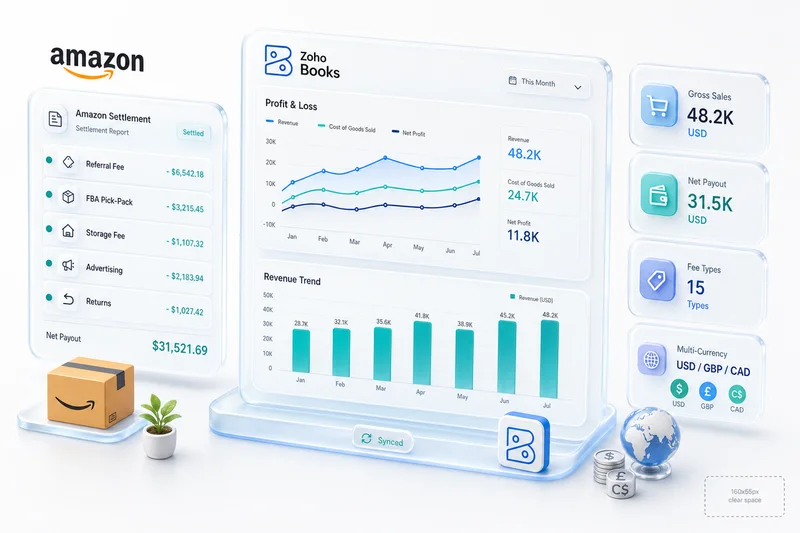
A developer can map the Amazon Settlement Report to Zoho Books. What they often cannot do is determine which of the 25+ line items on that report belong in Gross Sales, which are contra-revenue, and which belong in separate operating expense accounts. Without that accounting knowledge, the data goes somewhere that makes the report balance. The resulting financials are wrong from day one.
eCommerce accounting has specific structures that are not obvious from a software interface. Marketplace payouts are net figures (gross sales minus fees). Multi-currency transactions use exchange rates tied to accounting dates, not payment dates. COGS records at a specific point in the fulfillment cycle, not at order creation. Multi-state tax nexus applies differently across US states. These are accounting questions, not software configuration questions.
The Five Most Common Zoho eCommerce Implementation Errors
These five errors appear in nearly every eCommerce Zoho implementation Zolify has been asked to audit after a generalist delivered it.
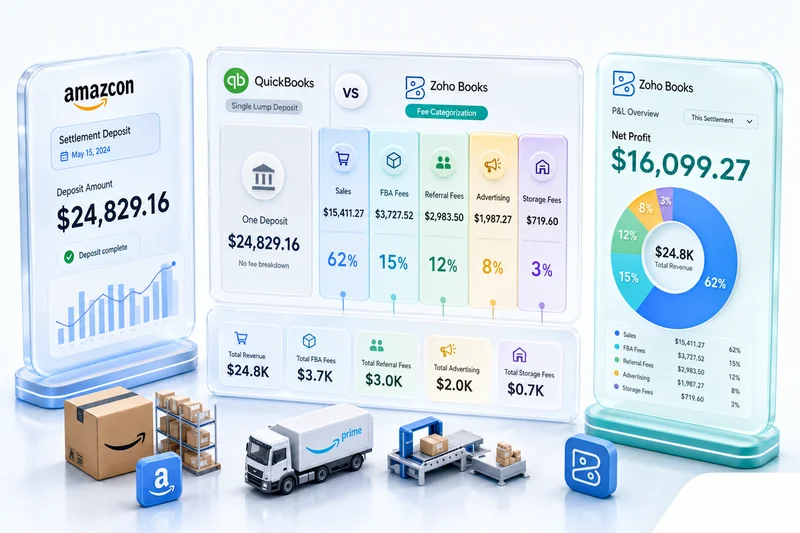
Error 1: Recording the Amazon settlement net payout as revenue. Amazon deposits a net amount after deducting fees. When a developer books that deposit as revenue, gross sales are understated and $8,000 to $40,000 per year in deductible fees disappear from the expense accounts entirely.
Error 2: Wrong exchange rate timing on eBay and Etsy multi-currency sales. The correct exchange rate for a multi-currency transaction is the rate on the transaction date, not the payment date. When the implementation uses the payment date rate, forex variance accumulates across months and produces a reconciliation error that grows every time exchange rates move. See multi-currency eCommerce accounting with Zoho Books for how exchange rate timing works across Zoho's multi-currency engine.
Error 3: Missing Shopify payment processing fees. Shopify charges 2.4 to 2.9% on transactions processed through Shopify Payments. These fees are an operating expense. When they are not configured in Zoho Books, gross margin is overstated by the full fee amount on every Shopify sale.
Error 4: COGS recorded on order creation instead of fulfillment. COGS should record when inventory leaves the warehouse, at fulfillment, not when the order is placed. When COGS records at order creation, gross margin in any period with unfulfilled orders is wrong. This distorts every multi-channel inventory report and month-end reconciliation.
Error 5: Multi-state tax nexus not configured per state. US eCommerce sellers with economic nexus in multiple states must collect the correct sales tax rate per state. A blanket configuration or no configuration creates audit exposure across every state where the business has nexus. For a full look at the software options for managing this, see eCommerce sales tax accounting software — the Zoho Books configuration approach is covered in detail.
Why These Errors Are Not Obvious Until Reporting or Tax Season
Each of these errors produces data that looks reasonable month to month. Revenue appears. Expenses appear. The bank balance reconciles — eventually. The errors surface when the numbers need to be accurate: at month-end close, at Q4 tax filing, or when you pull a multi-channel P&L and the margin figures do not match your expectations. By that point, the generalist has moved to their next project and the correction cost — restating transactions, rebuilding the chart of accounts, reconciling multi-currency variances — is entirely yours. Across 100+ eCommerce implementations, Zolify's audit work finds that 70% of generalist-delivered setups require significant rework within 12 months of go-live.
5 Questions to Ask Any Zoho Implementation Partner Before You Sign
These five questions separate a specialist from a generalist in a 15-minute discovery call. Ask them directly and listen for specificity in the answers.
1. How Many Zoho Books eCommerce Integrations Have You Delivered in Production?
Not Zoho CRM. Not Salesforce. Zoho Books integrations for live eCommerce businesses processing real orders. The number matters because eCommerce accounting edge cases (marketplace fee structures, multi-currency reconciliation, FBA vs FBM fulfillment paths) only appear at scale. A partner with fewer than 10 Zoho Books eCommerce integrations in production is learning on your project. For a ranked comparison of eCommerce-focused Zoho development firms, see top Zoho development companies for eCommerce in 2026.
2. Do You Have a CA or CPA Who Reviews Financial Configurations?
This question exposes the single largest differentiator between a development team and an accounting-capable implementation team. A developer can configure Zoho. Only a CA or CPA can confirm that the chart of accounts is correct for your eCommerce business, that revenue accounts match your tax obligations, and that the COGS method matches your inventory valuation approach. If the answer is no, you are getting a software configuration, not an accounting implementation.
3. What Is Your Official Zoho Partnership Status?
Official Zoho Authorized Partners are listed in Zoho's partner directory. They have met Zoho's certification requirements and have access to partner resources, early product updates, and a dedicated Zoho account manager. If a provider cannot name their Zoho partnership tier or is not listed in the directory, they are not a Zoho partner. They are a consultant who happens to know the product.
4. Can You Show Me a Verified eCommerce Client Reference?
Not a testimonial. Not a logo on a website. A verifiable reference: an eCommerce business that used this partner for a Zoho Books implementation and is willing to speak with you. If a partner cannot provide three such references, their portfolio claims are unverifiable.
5. How Do You Handle Multi-Channel Fee Reconciliation for Shopify, Amazon, WooCommerce, eBay, and Etsy?
This question requires platform-specific accounting knowledge to answer correctly. The correct answer names specific accounts: Amazon settlement report line items mapped to Gross Sales, contra-revenue, and separate expense accounts; Shopify transaction fees as a distinct operating expense; eBay managed payments reconciliation; Etsy's four fee types (listing, transaction, offsite ads, payment processing). A generalist gives a generic answer about "mapping fees." A specialist names the accounts and explains the reconciliation logic.
What Generalist Zoho Agencies Typically Miss
Marketplace Fee Reconciliation: The Amazon Settlement Payout Problem
Amazon pays sellers a net settlement every two weeks. That settlement is not revenue. It is gross sales minus referral fees, FBA fees, storage fees, advertising costs, refunds, and reimbursements. When a generalist books the settlement deposit as a single revenue entry in Zoho Books, the entire fee structure disappears from the P&L. Revenue is inflated, expenses are understated, and the financial statements are wrong by the total amount of all fees. For a mid-volume Amazon seller, that figure runs $8,000 to $40,000 per year. See how Zoho Books handles Amazon seller accounting for the correct account structure.
Multi-Currency Exchange Rate Timing on eBay and Etsy Cross-Border Sales
eBay and Etsy sellers with buyers in the UK, EU, Canada, or Australia collect in local currency. Zoho Books handles multi-currency, but the implementation must specify which exchange rate date applies to each transaction type. The accounting standard is the transaction date rate. When the implementation uses the payment date rate instead, foreign exchange variance accumulates every time a currency moves between sale and payment. The result is a forex adjustment entry that grows each month and cannot be reconciled without restating every affected transaction. For the full configuration walkthrough, see multi-currency eCommerce accounting with Zoho Books — it covers exchange rate setup, forex gain/loss accounts, and Zoho's base currency rules in detail.
COGS Recording on Fulfilment vs Order Creation: Why It Matters
COGS records when inventory physically leaves the warehouse, at fulfillment, not when the customer places the order. This matters because orders placed at the end of a reporting period may not ship until the next period. When COGS records at order creation, period gross margin includes cost for revenue that has not yet been recognized. The next period's margin is understated by the same amount. For multi-channel sellers with high order volumes, this distortion is material every single month.
Shopify Payment Processing Fees: Revenue Reduction or Expense Account?
Shopify payment processing fees are operating expenses, not revenue reductions. A revenue reduction lowers gross revenue. An expense account keeps gross revenue intact and shows the fee as a cost of doing business. The distinction matters for margin analysis and tax treatment. Most generalist implementations omit the fees entirely (the most common error) or reduce revenue by the fee amount (the second most common error). A correctly configured Shopify to Zoho integration routes these fees to a separate expense account so gross margin is always based on true gross revenue.
Multi-State and International Tax Nexus: The Configuration Developers Skip
US eCommerce sellers who exceed economic nexus thresholds in multiple states must collect and remit sales tax per state. Zoho Books supports multi-state tax configuration. Generalists often skip this configuration entirely or apply a single blanket tax rate. The correct implementation maps each state where the business has nexus to the appropriate sales tax rules in Zoho Books, with exemptions for products that are non-taxable in specific states. The exposure for getting this wrong is an audit liability per state, not a software error.
Generalist Agency vs eCommerce Specialist: The Real Comparison
| Factor | Generalist Agency | Zolify (eCommerce Specialist) |
|---|---|---|
| Zoho Books eCommerce implementations | Unverifiable claims | 100+ in production |
| Finance expertise | Developer review only | CA (Chartered Accountant) on every implementation |
| Zoho partnership status | Often none | Official Zoho Authorized Partner + Zoho Finance Partner |
| Hourly rate | $15 to $50/hr | $28 to $60/hr |
| Portfolio verification | Claims only | Verified references available |
| Marketplace fee reconciliation | Generic mapping | Platform-specific (Shopify, Amazon, WooCommerce, eBay, Etsy) |
| Own Zoho products | None | Published Zoho Marketplace extensions |
Portfolio Size and Verifiability
A verifiable portfolio matters because eCommerce accounting edge cases require real-world repetition to solve correctly. A partner who has completed 100+ eCommerce implementations has encountered partial fulfillments, multi-currency returns, FBA reimbursement handling, and bundle COGS issues repeatedly. A partner who has completed 5 has not. The claim "100+ implementations" is only meaningful if you can verify it through reference clients or published case studies.
Finance Expertise: Developer Review vs CA/CPA Sign-Off
Developer review catches software bugs. CA/CPA sign-off catches accounting errors. These are different categories of error, and only one of them matters for eCommerce financial data accuracy. A developer who does not know the difference between a revenue account and a contra-revenue account will not catch the Amazon settlement error, even on review. A CA who reviews the same configuration catches it before the first transaction processes.
Zoho Partnership Status: The Credential That Separates Partners From Consultants
The Official Zoho Authorized Partner credential is tied to a formal relationship with Zoho's partner team. It requires meeting certification standards and is renewed based on implementation performance. A consultant who lists Zoho on their website without holding this credential has no formal relationship with Zoho, no escalation path to Zoho's team when issues arise, and no signal of implementation quality that Zoho itself has validated.
Rate vs Total Cost: When the Cheaper Option Costs More
The $10 to $15/hr rate gap between a generalist and Zolify adds up to $1,000 to $1,500 on a 100-hour project. Fixing five financial configuration errors post-go-live — restating historical transactions, rebuilding the chart of accounts, reconciling multi-currency variances — costs multiples of that. The right question is not "what is the hourly rate?" It is "what is the total cost if this implementation needs to be redone?" For a full breakdown of what eCommerce Zoho implementations actually cost across implementation types and scope sizes, see Zoho eCommerce implementation cost: real ranges from 100+ projects.
Red Flags When Evaluating a Zoho Implementation Partner
"We Do Zoho, Salesforce, HubSpot, and Custom Software"
That pitch means Zoho is one tool in their stack, not their craft. Zoho Books eCommerce integrations require deep platform knowledge: undocumented API behaviors, reconciliation edge cases, Zoho's multi-currency logic, and how Zoho Inventory's COGS calculation interacts with fulfillment configuration. A team splitting attention across Salesforce, HubSpot, and custom software does not develop this depth. Ask them how many of their last 20 projects were Zoho-only.
No Published Zoho Marketplace Products
Zoho reviews and lists Marketplace extensions built by its partners. Publishing a product requires meeting Zoho's quality bar and completing a formal review process. Partners with published Marketplace extensions have demonstrated the ability to build, maintain, and support Zoho-native software at production quality. A team with no Marketplace products has not cleared that bar.
Hourly-Only Pricing With No Scope Definition
Hourly-only pricing with no defined scope is the standard underbidding approach. An implementation quoted at "$2,500 estimated" on hourly billing routinely runs to $6,000 or more when scope gaps, rework, and discovery surprises accumulate. A partner who has delivered 100+ eCommerce implementations knows what the work costs and delivers a fixed-price scope after a structured discovery process — because they have scoped it before.
Developer Team With No Finance or Accounting Professional
Any team building Zoho Books eCommerce integrations without a CA or CPA on staff is operating below the quality threshold this work requires. Configuration is not enough. The implementation team must be able to design a chart of accounts, evaluate COGS methods, and confirm that the resulting financial data matches accounting standards. That requires an accounting professional, not just a developer who has read the Zoho Books documentation.
Can't Provide Three Verified Zoho Books Reference Clients
References are the most direct signal of a verifiable portfolio. A partner who cannot provide three eCommerce businesses using Zoho Books implementations they delivered has either not delivered enough eCommerce implementations to have three references, or delivered work their clients would not endorse. In either case, that is the signal you need before signing.
How Zolify Approaches eCommerce Zoho Implementation
Zolify's eCommerce Zoho implementations are built to one standard: the financial data produced must be accurate enough to file taxes from — not just close enough to look reasonable in a dashboard. Every configuration decision is made by a Chartered Accountant with eCommerce accounting background and validated against production outcomes across 100+ live implementations.
CA-Validated Chart of Accounts for Every Platform (Shopify, Amazon, WooCommerce, eBay, Etsy)
Every Zolify implementation begins with a chart of accounts designed by a CA for the specific platform combination the client operates. Shopify, Amazon, WooCommerce, eBay, and Etsy each have different fee structures, payout timing, and reconciliation requirements. The chart of accounts is built before any data flows — not retrofitted after the integration goes live. See eCommerce accounting automation for what a correctly structured implementation enables downstream.
100+ eCommerce Implementations: Production Systems, Not Proof-of-Concept
Zolify has completed 100+ eCommerce implementations connecting Shopify, Amazon, WooCommerce, eBay, and Etsy to Zoho Books and Zoho Inventory. These are production systems handling real financial data for real businesses. The edge cases — partial fulfillments, multi-currency returns, FBA reimbursement handling, bundle COGS, split-tax configurations — appear repeatedly across this portfolio, and the implementation patterns reflect solutions that have been tested in production. For a broader view of the full Zoho eCommerce stack, see Zoho for eCommerce.
Official Zoho Finance Partner: The Credential Generalists Can't Claim
Zolify is an Official Zoho Authorized Partner and Zoho Finance Partner, listed in Zoho's partner directory. This credential requires meeting Zoho's certification standards, is tied to an active partner relationship with Zoho's team, and is renewed based on implementation performance and customer outcomes. Generalists who offer Zoho as one of several platforms rarely hold this credential. For eCommerce operators, the practical difference is escalation access to Zoho's product team, implementation review by Zoho, and a partner-backed warranty on the configuration.
Discovery Sprint: Scope Before You Commit
Zolify's Discovery Sprint maps your current eCommerce stack against the Zoho architecture that fits it, produces a chart of accounts designed for your specific platforms, and delivers a fixed-price implementation scope before any integration work begins. This is how eCommerce operators evaluate an implementation partner without committing to a full project. Learn how choosing the right eCommerce operations partner affects every downstream outcome in your operations stack. For a step-by-step evaluation framework — including red flags, interview questions, timeline benchmarks, and eCommerce-specific criteria — see how to choose a Zoho implementation partner.
Get an eCommerce Implementation Assessment
If you are evaluating Zoho for your eCommerce operations or need to assess whether an existing implementation is financially accurate, Zolify's team covers your current setup against the five common errors above, identifies configuration gaps in Zoho Books and Zoho Inventory, and delivers a remediation plan with fixed-price scope.
Request an eCommerce implementation assessment or see our Shopify to Zoho integration service to see what a specialist-built implementation looks like from the start.
Frequently Asked Questions
A Zoho eCommerce specialist brings accounting domain expertise to the implementation. A CA or CPA reviews every financial configuration: chart of accounts design, marketplace fee reconciliation, exchange rate timing, COGS recording method, and multi-state tax nexus setup. A generalist developer configures Zoho to move data between systems — but without accounting knowledge, the data lands in the wrong accounts and produces financial reports that look correct and are materially wrong. The difference shows up at tax season, not at go-live.
Run five checks: (1) Does your Zoho Books revenue match gross sales, not the net payout from Amazon or Etsy? (2) Are Shopify payment processing fees recorded in an expense account, not deducted from revenue? (3) Is COGS recording triggered on fulfillment, not on order creation? (4) Are eBay or Etsy multi-currency sales using the transaction date exchange rate, not the payment date rate? (5) Is multi-state tax nexus configured per state with the correct rates, not set as a blanket rule? If any of these are wrong, the implementation needs a CA-led audit before your next filing.
An Official Zoho Authorized Partner is listed in Zoho's partner directory and has met Zoho's certification requirements for implementation quality and customer outcomes. Generalist consultants who offer Zoho as one of many platforms they support are often not Zoho partners at all — they have no Zoho partnership status, no access to partner resources, and no escalation path to Zoho's team when issues arise. The credential is verifiable: if a provider cannot point you to their listing in the Zoho partner directory, they are a consultant, not a partner.
eCommerce Zoho implementations involve financial configurations that require accounting knowledge — chart of accounts structure, revenue recognition method, COGS valuation approach, multi-currency transaction rules, and tax nexus compliance. A developer without accounting training can configure Zoho to make data move but cannot evaluate whether the data lands in the right accounts. A CA or CPA reviews every configuration before go-live, catching errors a developer would not recognize as errors because they require accounting judgment, not just software knowledge.
Five red flags that signal a generalist: (1) Their pitch includes Salesforce, HubSpot, and custom software alongside Zoho — meaning Zoho is not their primary focus. (2) They have no published products in the Zoho Marketplace, meaning they have never built anything Zoho has reviewed, tested, and listed. (3) They quote hourly-only pricing with no defined scope — a consistent pattern for teams that underestimate eCommerce accounting complexity. (4) Their team has no CA, CPA, or accounting professional. (5) They cannot provide three verifiable Zoho Books reference clients from eCommerce businesses.
See exactly where your Shopify, Amazon, or WooCommerce ops are leaking — free.
Get a personalised eCommerce Ops Audit: inventory gaps, accounting leaks, and order-flow bottlenecks — with a Zoho fix roadmap. Delivered in 48 hours, at no cost.