Etsy Seller Accounting with Zoho Books: Fees, Tax, and Payout Reconciliation
Etsy sellers deal with five or more fee types per transaction, weekly deposits that net everything out, and COGS calculations unique to handmade goods. Here's how to configure Zoho Books so the numbers are actually right — and why getting this set up before Q4 matters.
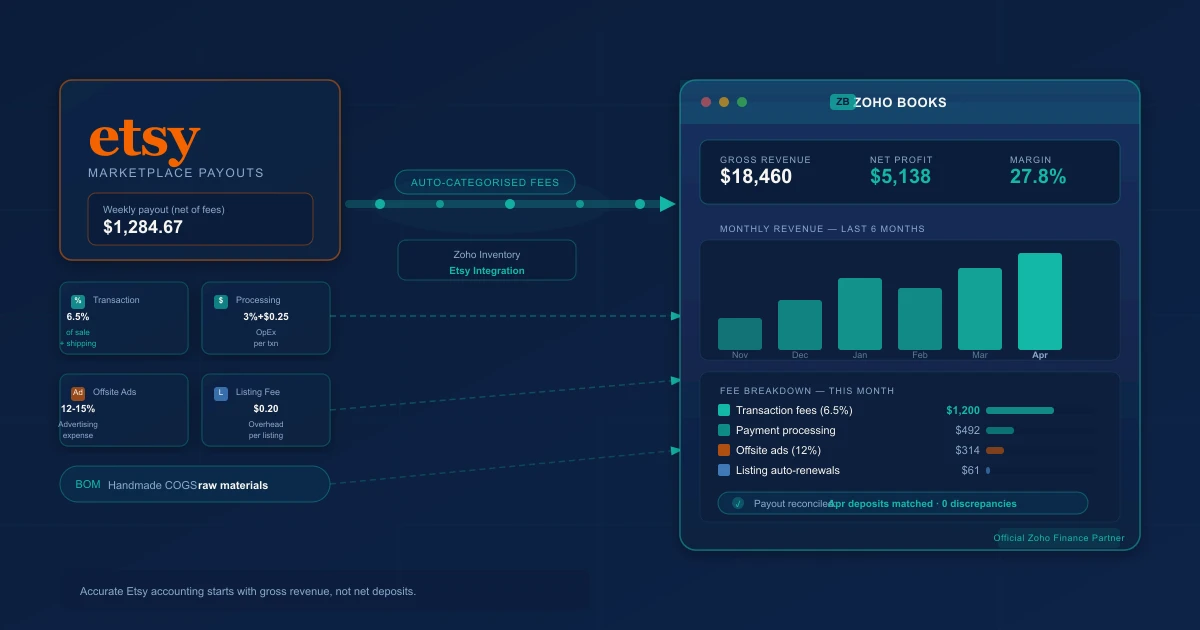
Etsy looks simple until you try to account for it correctly. Orders come in, Etsy processes the payment, a deposit lands in your bank every week. Record that deposit as revenue and your books are wrong (often by 20–35% of actual gross sales) because what you receive is net of Etsy's transaction fee, payment processing fee, listing auto-renewal fees, and any offsite ads charges for that period.
There's also a COGS problem that doesn't apply to sellers who buy and resell finished goods. Handmade goods COGS comes from raw materials. Each product consumes specific inputs at specific quantities, and those costs need to flow through accounting correctly if your gross margin is going to mean anything.
This matters most heading into Q4. For many Etsy sellers, November and December account for 35–50% of annual revenue. That's when any accounting gap — wrong revenue, invisible fees, untracked raw material costs — compounds fastest. Getting the configuration right in October means January close is clean. Getting it wrong means a year-end cleanup on top of everything else.
TL;DR: Etsy sellers need accounting that records gross sales (not net deposits) as revenue, maps five fee types to the correct accounts, calculates COGS from raw material inputs for handmade goods, and handles multi-currency for international sales. Zoho Books does all of this when configured correctly. The setup is the work. Once done, the books run accurately from there.
What makes Etsy accounting different
The payout is not your revenue
Etsy's weekly (or on-demand) deposit is the number most sellers look at when they want to know what they made. It's not that number. It's net of:
- Etsy transaction fee (6.5% of the sale price including shipping)
- Etsy Payments processing fee (3% + $0.25 in the US, variable by country)
- Listing fees auto-renewed during the period ($0.20 per listing)
- Offsite ads fees if any sales came from Etsy's ad placements
- Regulatory operating fees in some markets
Say you had $10,000 in Etsy sales and all those fees totalled $2,200. Your deposit was around $7,800. Record $7,800 as revenue and you've understated gross sales by 22%. Your P&L looks like a smaller business than it is. Margins look healthier than they are because fees aren't visible as costs. And tax filings reflect the wrong gross income figure.
During Q4, this gap widens. Higher offsite ads conversion rates, more listing renewals, and larger transaction volumes mean fees as a share of gross can increase meaningfully. Sellers who haven't separated fees from revenue often discover the problem when they try to close Q4 books and the numbers don't match what they expected.
Etsy's fee structure has more categories than most sellers account for
The rates below reflect Etsy's current 2026 structure. Rates have been stable since the 2023 transaction fee increase to 6.5%.
| Fee type | Rate | Accounting category |
|---|---|---|
| Transaction fee | 6.5% of sale price + shipping | Cost of Sales |
| Payments processing fee | 3% + $0.25 (US) | Cost of Sales |
| Listing fee (initial) | $0.20 per listing | Operating expense |
| Listing auto-renewal fee | $0.20 per renewal | Operating expense |
| Offsite Ads fee | 12–15% on qualifying sales | Advertising expense |
| Pattern subscription | From $15/month | Operating overhead |
| Regulatory operating fee | Market-dependent | Operating expense |
Each belongs in a different account. Transaction and payments processing fees are variable costs of sale. Offsite ads fees are paid acquisition costs. Listing and renewal fees are overhead. Lump them all in a single "Etsy fees" bucket and you lose visibility into whether your offsite ads spend is actually profitable, what your true margin is on each sale, and what it costs to maintain your listing count at scale.
Handmade COGS is a different calculation
Sellers who buy and resell finished goods have a simple COGS: purchase price per unit, multiplied by units sold. Handmade sellers have a different problem. Each product consumes specific raw materials at specific quantities, and those inputs have unit costs that shift when you buy in volume or when supplier prices change.
A candle might need 8oz of wax, 1.5oz of fragrance oil, one wick, and a glass vessel. The COGS per candle is the sum of each material at its current cost. Buy wax in bulk and the per-ounce cost drops, so COGS changes. Track this in a spreadsheet and forget to update after a bulk purchase, and your margin figures are stale from that day forward. This is especially problematic in Q4, when many handmade sellers do large pre-season material buys at better rates.
International sales add currency complexity
Etsy facilitates global sales. If you're based in the UK and sell to a US buyer, Etsy converts the price and deposits to you in GBP. The exchange rate on each transaction affects what you receive. Each sale should be recorded at the rate on the transaction date, not the deposit date, not a quarterly average.
For sellers with regular international volume, the difference between per-transaction spot rates and a quarterly average can produce visible margin variance in monthly reporting.
Setting up Zoho Books for Etsy
Chart of accounts
Set up separate accounts for each fee type before you import anything. Here's a working structure for Etsy sellers:
Revenue - Etsy Product Sales (gross sale price) - Etsy Shipping Revenue (if you charge for shipping)
Cost of Sales - Raw Materials / COGS (fed by Zoho Inventory BOMs) - Etsy Transaction Fees (6.5%) - Etsy Payments Processing Fees (3% + $0.25) - Packaging and Fulfilment Costs
Advertising - Etsy Offsite Ads
Operating expenses - Etsy Listing and Renewal Fees - Etsy Pattern Subscription (if applicable) - Etsy Regulatory Fees
Other Income - Etsy Reimbursements (rare)
With this structure, gross margin reflects the real cost of making and selling. Offsite ads show up as their own line so you can measure them properly. Overhead stays out of variable cost calculations.
Tracking raw material COGS with Zoho Inventory
Zoho Inventory supports bills of materials (BOMs): product recipes listing each raw material input and the quantity consumed per finished unit. Set up a BOM for each SKU:
- Create raw materials as items in Zoho Inventory (wax, fragrance oil, jars, wicks, etc.)
- Set a cost per unit for each material, updated when you purchase new stock
- Build a BOM for each finished product with materials and quantities
- When an Etsy order syncs, Zoho Inventory uses the BOM to calculate COGS and reduce raw material stock
The result is COGS calculated at the actual material cost basis at the time of each sale. If you buy 50lb of wax in March at $4.20/lb and 100lb in June at $3.85/lb, the COGS for each batch of candles sold reflects what you actually paid, not a blended average from a spreadsheet that hasn't been updated in six months.
Revenue recognition: order date matters
Record revenue when the order is placed and fulfilled, not when the deposit arrives. An order placed April 30 that deposits May 5 belongs in April. Record on deposit date and your monthly figures shift by however long Etsy's deposit cycle runs.
For sellers on weekly or biweekly deposits, month-end timing creates systematic understatement in one month and overstatement in the next. Zoho Books records on invoice or order date, which is the correct basis.
Handling offsite ads reconciliation
Offsite ads fees appear in your Etsy Payment Account statement alongside other fees. They're not a separate transaction. They come out of the same net deposit. When mapping statement data, identify offsite ads charges by transaction description and route them to your advertising account.
Once those fees are in their own account, you can compare organic margin against paid-acquisition margin. For sellers who can't opt out of Offsite Ads (annual Etsy sales above $10K), that split matters: do those ads bring in genuinely incremental sales, or do they mostly capture orders that would've come through organic search anyway? You can't answer that without clean advertising cost data separate from transaction fees.
For the full technical walkthrough of connecting your Etsy shop to Zoho Books accounts and setting up Managed Payments mapping, see Etsy Zoho Integration: Connect Your Etsy Shop to Zoho Books and Inventory.
Getting your books ready for Q4
October is when the year is decided for most handmade Etsy sellers. November and December bring the holiday gift buyers. For sellers with strong Q4 products (candles, jewellery, home decor, personalised gifts), this window is 35–50% of annual revenue. How your books are configured before that volume hits determines whether January close is straightforward or three weeks of reconciliation work.
Update raw material costs before orders arrive
If you bought wax, yarn, resin, or other materials in volume during Q3, those purchases changed your per-unit costs. Before holiday orders start processing, verify that all raw material unit costs in Zoho Inventory reflect your most recent purchases. A bulk buy at lower prices that isn't updated before Q4 orders process will overstate COGS and understate your holiday margins. The fix is quick: open each raw material item, update the cost, and Zoho Inventory applies it to subsequent BOMs automatically.
Offsite ads spending accelerates in Q4
Holiday gift searches drive higher Offsite Ads conversion on Etsy, which means the 12% or 15% fee will apply to a larger share of orders than in a typical month. Some sellers see offsite ads charges double from Q3 to Q4. That's fine if the margin supports it, but it needs to be visible. Zoho Books gives you a real-time view of offsite ads as a percentage of revenue so you can see the holiday lift as it happens rather than reconciling a surprise in January. For the full BFCM fee reconciliation workflow and December cash flow setup, see Etsy and Zoho integration guide for how Offsite Ads and other Etsy fees are categorized in Zoho Books. For sellers running BFCM promotions — flash sales, bundled pricing, and discount inventory management — the Etsy BFCM seller operations guide covers how Zoho Books handles the financial side of peak-season discounting.
Pre-reconcile in September or October
Running a bank reconciliation before peak season catches any account-mapping errors before they multiply across thousands of orders. Connect your Etsy settlement statements to Zoho Books and run through October's statement carefully. If fees are routing to the wrong accounts, fix the mapping now. Catch it after 3,000 holiday orders and you're correcting entries in bulk rather than in one place.
For the step-by-step process of importing Etsy settlement statements and matching them to accounts, see Zoho Books Bank Reconciliation for eCommerce: Shopify Payouts, Amazon Settlements, and More.
Plan cash flow around gross-to-net gaps
Etsy Offsite Ads fees and processing fees come out before you receive the net deposit. For sellers with higher average order values (personalised gifts and jewellery on Etsy often run $150–$400), the gross-to-net difference on individual orders is real. A $350 order might deposit around $285 after fees. If you're projecting cash flow from gross figures and spending against them, you'll be short when deposit cycles land. Zoho Books forecasting runs on correct accrual-basis figures; your cash flow view should use the net, not the gross.
Connecting Etsy into broader operations
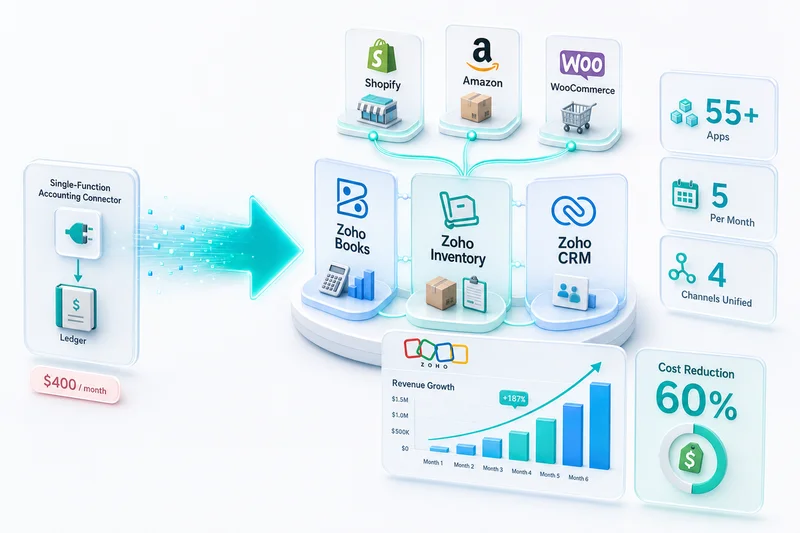
Most Etsy sellers who grow past a certain volume add channels: Amazon Handmade, their own Shopify store, wholesale to retailers. Once you're running more than one channel, you need one inventory system covering all of them. Our eCommerce operations services cover the full multi-channel setup for sellers expanding beyond a single marketplace. For the step-by-step Zoho Inventory, Zoho Books, and Zoho CRM configuration when adding Amazon or Shopify alongside Etsy, see Etsy and Zoho integration: connecting to Inventory, Books, and CRM.
Zoho Inventory connects to Etsy, Shopify, and Amazon. Raw material stock stays in one pool, decremented by sales from any connected channel. Zoho Books produces one P&L across all channels, with channel-level profitability available through Zoho Analytics.
For a handmade seller running Etsy alongside Shopify, separate inventory in separate systems produces regular stockout surprises: you sell the last unit through Shopify, Etsy doesn't know, and the next Etsy order is for something you don't have. One inventory pool prevents that problem at the source.
For the full picture of how Zoho handles multi-channel eCommerce, see our Zoho for eCommerce guide.
Getting the setup right
The configuration work is front-loaded: chart of accounts, BOM setup for each product, integration mapping. Once that's done correctly, the system handles categorisation automatically on every subsequent transaction.
The mistake most sellers make is connecting Zoho Books to their bank feed, seeing the net Etsy deposits, and calling that their accounting system. Bank feed accounting for Etsy gives you wrong revenue, invisible fee categories, and no COGS data for handmade goods. It's faster to set up. But it consistently produces wrong numbers, and those wrong numbers compound hardest during Q4 when volume is highest.
Zolify has configured Zoho Books for Etsy, Amazon, eBay, and Shopify sellers, including those with handmade goods, raw material tracking, and multi-channel inventory. Every implementation includes a CA reviewing the chart of accounts and COGS structure before go-live. The margin data is accurate from the start, not discovered to be wrong at year-end.
As an Official Zoho Finance Partner with 100+ eCommerce implementations — including dedicated Zoho Books implementations for Etsy sellers with handmade goods and raw material tracking — we've handled the edge cases: offsite ads charges that spike in November, raw material cost changes mid-year that need to roll through COGS correctly, multi-currency deposits that don't reconcile cleanly against order-date revenue. Those get handled in configuration, not surfaced six months after go-live.
If your current Etsy accounting records deposits as revenue, or you don't have raw material COGS tracking, get an eCommerce ops audit and we'll show you where the numbers are drifting. With Q4 approaching, October is the right time to get this sorted.
Frequently Asked Questions
Most Etsy sellers start with spreadsheets or Wave. Under 50 orders a month, that's manageable. Above it, Etsy's multi-tier fee structure and the need to track raw material costs for handmade goods makes spreadsheets error-prone and slow to close. Zoho Books handles Etsy's fee categorisation, connects to Zoho Inventory for raw material and product stock tracking, and supports multi-currency for international Etsy sales. During Q4, when order volume can triple or quadruple, automated fee mapping and COGS tracking is the difference between accurate books and a January cleanup project.
Etsy Payments processes all buyer payments (cards, PayPal, Apple Pay, etc.) and consolidates them into scheduled deposits to your bank, weekly by default, or on-demand. Each deposit is net of all fees accrued in that period: transaction fees, payment processing fees, listing fees auto-renewed, and any offsite ads charges. The correct approach is to record the gross sale as revenue when the order is placed, then record each fee type in its correct expense account. What hits your bank is the net. Recording it as revenue produces an understated figure that compounds across the year.
Etsy's Offsite Ads fee is charged when a buyer clicks an Etsy-placed ad on Google, Facebook, or another platform and then makes a purchase. Sellers with over $10,000 in annual Etsy sales are enrolled and charged 12% on offsite-ads sales; sellers below that threshold are charged 15% and can opt out. In accounting, offsite ads fees are advertising expenses, not cost of sales. They belong in a dedicated Etsy Offsite Ads or Marketplace Advertising account, so you can measure what percentage of Etsy revenue is going to paid acquisition versus organic sales within the marketplace.
Handmade goods COGS is built from raw materials: yarn, fabric, clay, resin, components, packaging, and similar inputs. In Zoho Books connected to Zoho Inventory, you create bills of materials (BOMs) for each product that list the raw material inputs and quantities consumed per unit. When a sale occurs, Zoho Inventory deducts the raw materials from stock and calculates COGS automatically based on the BOM. Your gross margin is then calculated against actual material costs rather than a rough estimate, which matters if raw material prices shift across the year.
Q4 is when most Etsy handmade sellers generate 35–50% of their annual revenue. Before October, sellers should update raw material costs in Zoho Inventory to reflect current supplier pricing (bulk buys at Q3 prices affect Q4 COGS directly), set aside cash for offsite ads fees that spike with holiday traffic, and confirm that Zoho Books chart of accounts is correctly mapped before volume surges. Running a trial bank reconciliation in September or early October catches any mapping errors before they compound across thousands of holiday orders.
See exactly where your Shopify, Amazon, or WooCommerce ops are leaking — free.
Get a personalised eCommerce Ops Audit: inventory gaps, accounting leaks, and order-flow bottlenecks — with a Zoho fix roadmap. Delivered in 48 hours, at no cost.