What Is Zoho One? The eCommerce Seller's Guide to Zoho's All-in-One Platform
Zoho One is Zoho's all-inclusive platform: 45+ apps, one price, one login. For eCommerce sellers juggling Shopify, Amazon, WooCommerce, QuickBooks, and a standalone CRM, it is the connective layer that turns disconnected tools into one operations system. Here is what is inside and what it means for your business.
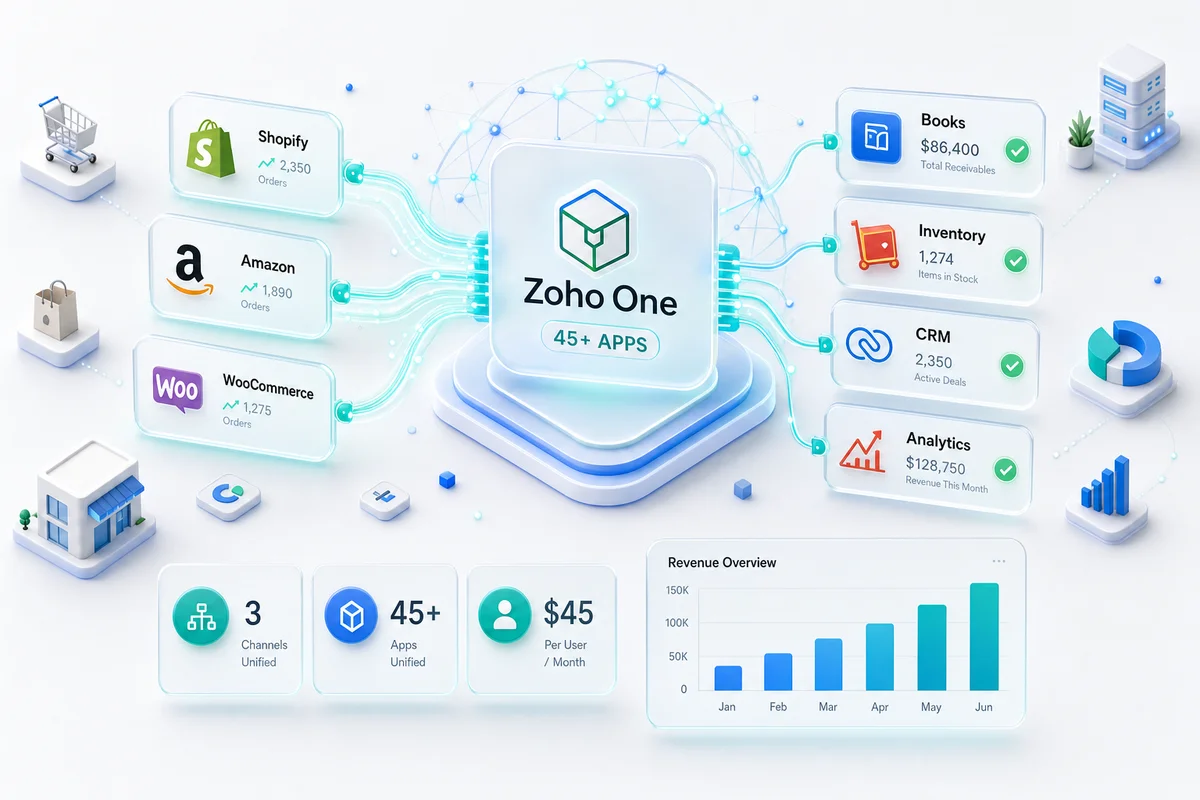
Zoho One is Zoho's all-in-one business platform: 45+ applications, one price, one login. At $37 per user per month (billed annually), it covers accounting, inventory management, CRM, customer support, analytics, and marketing automation.
For an eCommerce seller, the question matters because Zoho One is the platform that replaces the collection of disconnected tools most online sellers accumulate. It connects directly to Shopify, Amazon, WooCommerce, eBay, and Etsy.
If you are selling on two or more channels and your accounting does not match your inventory, and your CRM does not know what customers bought last week, Zoho One is worth understanding.
Quick summary: Zoho One costs $37/user/month and bundles 45+ apps — including Zoho Books (accounting), Zoho Inventory (multi-channel stock sync), and Zoho CRM — under one subscription. For a 10-person team, it runs $370/month versus $900+ for the equivalent disconnected stack. It connects natively to Shopify, Amazon, WooCommerce, eBay, and Etsy. Implementation takes 4–16 weeks depending on complexity. Zolify is an Official Zoho Finance Partner with a CA on staff and 100+ eCommerce implementations completed.
The eCommerce operations problem Zoho One solves
Most sellers grow into a fragmented stack. Shopify handles the storefront. QuickBooks or Xero handles accounting. Inventory lives in a spreadsheet or a standalone app. Customer emails go to Mailchimp. Support tickets land in Freshdesk or Zendesk. Monthly reporting means pulling data manually from four different platforms.
This works at low volume. At $500K in annual revenue across two channels, it starts breaking. At $2M across Shopify, Amazon, and WooCommerce, it costs real money in reconciliation time, data errors, and decisions made on stale information.
The problem is not that any individual tool is bad. It is that they do not share data with each other. An Amazon order does not automatically reduce WooCommerce inventory. A QuickBooks invoice does not know which channel the sale came from. Mailchimp does not pull from purchase history without a Zapier workflow someone has to maintain.
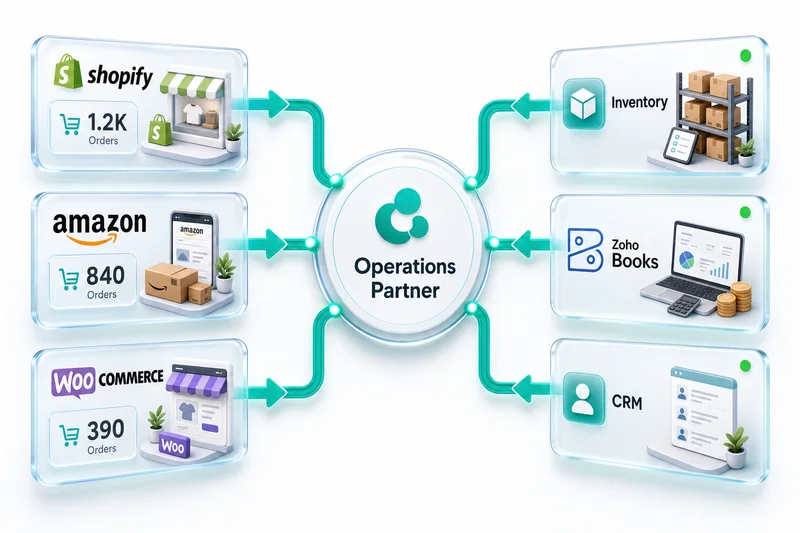
Zoho One is built around a different premise. All the apps share a common data layer. A contact in CRM is the same record as the customer in Books. A sale in Inventory creates the accounting entry in Books automatically. An order from any connected channel flows into the same reporting dashboard.
That shared data layer is the substantive difference between Zoho One and buying the same apps individually.
What is actually inside Zoho One for eCommerce
Zoho One includes 45+ applications. Most are not directly relevant to eCommerce operations. The ones that are:
Zoho Inventory
Order management, inventory tracking, and channel sync. Zoho Inventory connects to Shopify, Amazon, WooCommerce, eBay, and Etsy. When a sale happens on any channel, Inventory deducts the stock, updates counts on all other connected channels, and triggers fulfillment. It handles multi-warehouse routing, purchase orders, landed cost tracking, and COGS calculation.
For a seller on two or more channels, Zoho Inventory is the operational core of the Zoho One stack. See how it performs across all three major storefronts in our Zoho Inventory multi-channel guide for Shopify, Amazon, and WooCommerce.
Zoho Books
Accounting. Zoho Books handles your chart of accounts, bank reconciliation, invoicing, vendor bills, sales tax, multi-currency transactions, and financial reporting. For eCommerce, it connects to the same channels as Inventory and handles the accounting complexity those channels create: Shopify Payments fee breakdowns, Amazon settlement reconciliation, eBay and Etsy marketplace fees separated from gross sales at the transaction level.
Zoho Books is a full accounting product, not a bookkeeping add-on. It can replace QuickBooks or Xero for most eCommerce businesses. For a detailed breakdown of how it handles multiple storefronts in one ledger, see our multi-channel eCommerce accounting guide for Zoho Books.
Zoho CRM
Customer relationship management. For eCommerce, CRM is primarily a post-purchase layer. It captures who your customers are, what they have bought, how recently they purchased, and what their lifetime value is. CRM connects to Books so purchase history and outstanding balances are visible from one record, without switching applications.
Retention workflows live here too. Sequences triggered by purchase date, segment, or order value can run from CRM without a separate email platform. For how this plays out in practice, see our guide on eCommerce customer retention with Zoho CRM.
Zoho Desk
Customer support ticketing. Zoho Desk manages support requests from email, live chat, and social channels in one queue. For eCommerce, it integrates with CRM so support agents see a customer's full order history without context-switching. Escalation rules, SLA enforcement, and CSAT scoring are built in.
Zoho Campaigns
Email and SMS marketing. Zoho Campaigns pulls contact lists from CRM and handles broadcast campaigns, automated sequences, and winback flows. For sellers who have outgrown basic Mailchimp setups and want their marketing platform connected to purchase data, Campaigns removes the need for a third-party integration. For pricing tiers and a full feature breakdown, see our Zoho Campaigns review and pricing guide.
Zoho Analytics
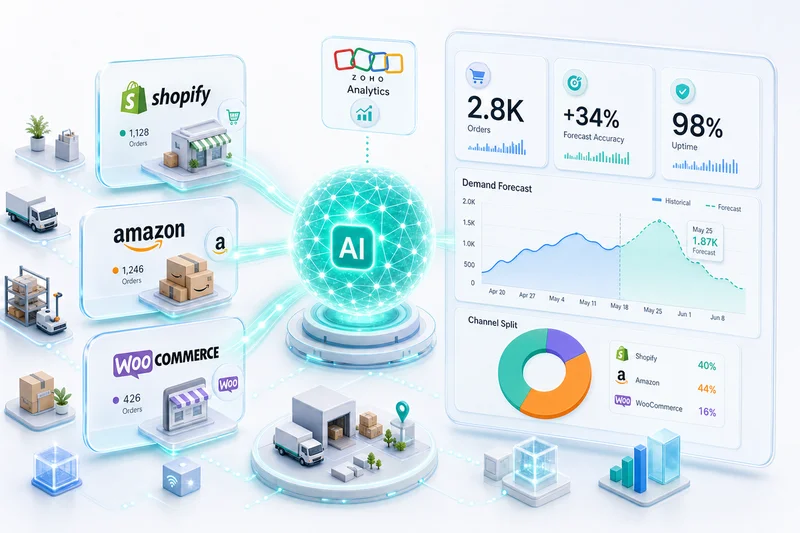
Business intelligence and reporting. Zoho Analytics connects to Inventory, Books, CRM, and your storefronts, and builds a cross-channel view: revenue by channel, margin by SKU, return rates, customer acquisition cost, and multi-channel P&L in one dashboard. For sellers across Shopify, Amazon, and WooCommerce, this is where you finally see the full picture.
Zoho Flow
Automation. Zoho Flow connects Zoho apps to each other and to third-party tools. For eCommerce, it handles edge cases the native integrations do not cover: triggering a Desk ticket when a return is created in Inventory, notifying a warehouse manager when a purchase order is approved, updating a CRM segment when a customer crosses a spend threshold.
Zoho Creator
Custom application development. Creator is a low-code platform for building custom apps on top of your Zoho data. It covers scenarios no out-of-the-box tool handles: a custom returns portal, a vendor performance dashboard, a dropshipping workflow with specific routing logic. Creator apps connect to Inventory, Books, and CRM data natively.
For a detailed look at how the core three apps work together, see our Zoho CRM, Books, and Inventory integration guide.
How Zoho One connects to your storefronts
The channel integrations are the most operationally important part of Zoho One for an eCommerce seller.
Shopify
Zoho Inventory connects to Shopify via native integration. Orders placed on Shopify sync to Inventory in real time, where they are fulfilled, routed to the correct warehouse, and tracked through shipment. Inventory updates push back to Shopify so the stock count customers see is always current. Zoho Books handles Shopify Payments settlements, fee categorization, and reconciliation against bank deposits.
Amazon
Amazon Seller Central connects to Zoho Inventory for order management and to Zoho Books for accounting. FBA and FBM orders both sync. Amazon's biweekly settlement reports map to Books accounts so gross sales, refunds, fees, and net proceeds are recorded at the transaction level rather than estimated manually. For FBA, landed cost tracking flows into COGS per unit.
WooCommerce
WooCommerce orders sync to Zoho Inventory via webhook-based integration. Inventory stays consistent across WooCommerce and every other connected channel without manual updates. Zoho Books handles WooCommerce accounting: payment gateway reconciliation, tax jurisdiction mapping, and multi-currency for international sellers.
eBay and Etsy
Zoho Inventory supports eBay and Etsy as additional channels alongside Shopify and Amazon. Orders sync, inventory updates, and shipment tracking flows back to both marketplaces. Zoho Books handles eBay's final value fees and Etsy's transaction and listing fees at the transaction level.
Zoho One pricing for a 5-15 person eCommerce team
Zoho One pricing: $37 per user per month, billed annually, under the All Employee plan. Every employee in your organization needs a license, including those who only use one app. A 10-person team pays $370 per month. A 15-person team pays $555 per month.
One constraint to know: under the All Employee plan, you cannot mix Zoho One users with individually licensed Zoho users in the same organization. If you want some employees on Zoho One and others on standalone Zoho CRM, you would need the Flexible User option at $105 per user per month, which changes the math significantly.
Practical cost model:
| Team size | Zoho One (monthly) | Comparable disconnected stack |
|---|---|---|
| 5 people | $185/month | QuickBooks + standalone CRM + inventory app typically runs $250–$400/month |
| 10 people | $370/month | Same stack at 10 users with per-user pricing runs $500–$800/month |
| 15 people | $555/month | Adding Desk, Analytics, and Campaigns individually adds $300+ at this team size |
The breakeven is roughly three apps per user. Below that, individual Zoho subscriptions are cheaper. At three or more, Zoho One wins on price and eliminates integration overhead.
Zoho One vs the disconnected stack: what you are actually replacing
Here is what a 10-person eCommerce operation commonly runs before consolidating to Zoho One:
Common disconnected stack:
- QuickBooks Online Plus: $90/month
- Shopify (storefront + inventory apps): $79/month base plus $50–150/month in third-party apps
- Mailchimp Standard (10,000 contacts): $100/month
- Zendesk Suite Team (10 agents): $350/month
- HubSpot Starter CRM: $150/month
- Zapier Business (automation between all of the above): $100/month
Total: $900–$1,100/month. Plus the maintenance overhead of keeping each Zapier workflow running, and the data gaps between systems that no workflow fully closes.
Zoho One for 10 users: $370/month. Books, Inventory, CRM, Desk, Campaigns, Analytics, Flow, Creator, and 37 more apps, all sharing a common data layer.
The dollar savings matter. The operational savings matter more. Every Zapier workflow is a failure point. Every manual export is a task someone does instead of actual work. Zoho One removes those gaps by design, not as an afterthought.
This is a comparison to the typical growth-stage eCommerce stack, not to NetSuite or SAP. For the traditional ERP comparison, see our Zoho One as an eCommerce ERP guide.
When Zoho One makes sense for eCommerce
You sell on two or more channels. Single-channel sellers can often get by with one or two standalone apps. Multi-channel sellers need the inventory sync, unified reporting, and cross-channel accounting that the connected platform provides.
Your team uses three or more Zoho apps. At that point, the bundle pricing is cheaper than individual subscriptions, and the integration friction of separately licensed products disappears.
You are replacing a fragmented stack. If you are running QuickBooks, a standalone CRM, a separate help desk, and Zapier to hold it together, Zoho One consolidates the stack at lower total cost and higher reliability. For sellers specifically on QuickBooks Enterprise evaluating the switch, the Zoho One vs QuickBooks Enterprise comparison covers the full-stack case.
Your revenue is in the $1M–$20M range on multiple channels. Below $500K on a single channel, the operational complexity Zoho One solves may not exist yet. Above $20M with multi-entity or manufacturing requirements, a traditional ERP may be more appropriate. For most growing eCommerce sellers, Zoho One covers the critical middle ground.
When Zoho One does not make sense
You only need one or two apps. A solo founder who needs Zoho Books for accounting pays $30/month for the Professional plan. Zoho One at $37/user/month is more expensive for the same functionality. Individual subscriptions win here.
Large team with minimal Zoho usage. If 18 of your 20 employees only need one app, licensing all 20 under the All Employee plan is expensive per seat. Targeted individual subscriptions or Flexible User pricing may be cheaper.
You need specific compliance features Zoho does not cover. Healthcare, certain financial services, and legal sectors may have requirements around HIPAA, data residency, or audit trails that need careful verification against Zoho's current certifications. Healthcare practices specifically should review the Zoho CRM for Healthcare guide for what is and isn't a fit. For most eCommerce sellers, compliance requirements are not a factor. Zoho One is also widely used outside of eCommerce: for a look at vertical-specific deployments, see Zoho One for Construction and Real Estate and Zoho for Professional Services, Financial Services, and Education.
What implementation actually looks like
Zoho One is not plug-and-play. The apps are configured individually, the integrations require setup, and the channel connections must be mapped to your specific operation: which warehouse fulfills which channel, how your chart of accounts is structured, how your customer segments are defined.
A single-channel setup covering Shopify, Books, and Inventory typically takes four to eight weeks. A full multi-channel deployment covering Shopify, Amazon, and WooCommerce with CRM and Analytics takes eight to sixteen weeks, depending on your SKU count, historical data migration scope, and custom workflow requirements.
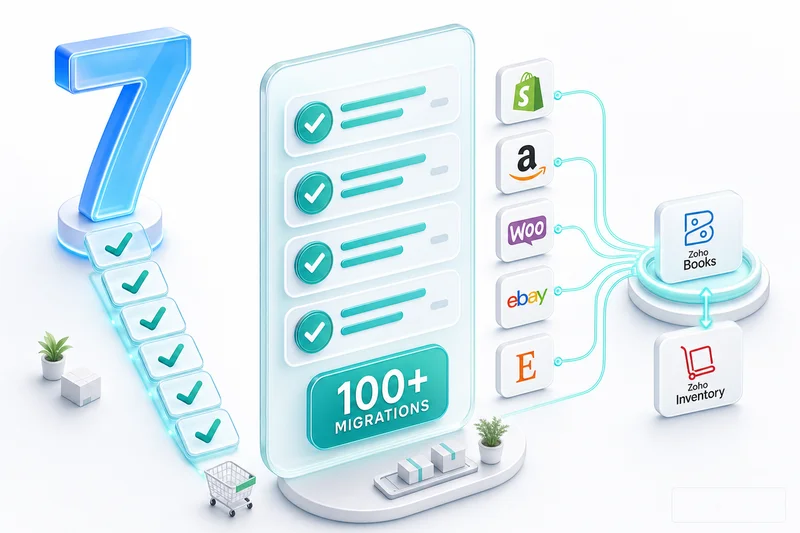
Zolify is an Official Zoho Finance Partner with a CA on staff and 100+ Zoho One eCommerce implementations completed. If you are evaluating Zoho One for your operation, we can scope the project before you commit to anything.
For the full picture of how Zoho covers the eCommerce stack, start with our Zoho for eCommerce platform guide.
Frequently asked questions
Does Zoho One include Zoho Books and Zoho Inventory?
Yes. Both are included. Zoho Books is Zoho's full accounting platform — it handles your chart of accounts, bank reconciliation, sales tax, and marketplace fee categorization for Shopify, Amazon, WooCommerce, eBay, and Etsy. Zoho Inventory is the order and stock management layer that syncs across all connected channels. You do not need to purchase either separately if you are on Zoho One.
Can Zoho One replace QuickBooks for an eCommerce business?
For most eCommerce businesses in the $500K–$20M revenue range, yes. Zoho Books (included in Zoho One) handles the same core accounting functions as QuickBooks Online: chart of accounts, bank reconciliation, invoicing, vendor bills, and financial reporting. The practical advantage over QuickBooks is that Zoho Books connects to the same data layer as Inventory and CRM — so marketplace fees, inventory costs, and customer records are all in one place without Zapier workflows. Zolify has handled 100+ migrations from QuickBooks to Zoho Books; the process typically takes four to eight weeks.
What is the difference between Zoho One and buying individual Zoho apps?
The price and the integration model. Individual Zoho apps — Books, CRM, Inventory — are licensed separately and priced per app per user. Zoho One bundles all 45+ apps for $37/user/month under the All Employee plan, which is cheaper once your team uses three or more apps. The more substantive difference is data sharing: Zoho One apps are configured on a shared data layer from the start. Separately licensed apps require deliberate integration setup to share contacts, transactions, and inventory records across products.
Does Zoho One support multiple warehouses for eCommerce fulfillment?
Yes. Zoho Inventory (included in Zoho One) supports multi-warehouse routing. You can configure which warehouse fulfills which channel or SKU, set reorder points per location, and track landed costs across locations. For sellers running a 3PL alongside a self-managed warehouse, or routing Shopify fulfillment differently than Amazon FBM, multi-warehouse configuration is part of the standard implementation scope.
Do I need to put all my employees on Zoho One?
Under the All Employee plan, yes — every employee in your organization needs a license, including those who only use one application. You cannot mix Zoho One seats with individually licensed Zoho apps in the same organization under this plan. If only some employees need the full suite, Zoho offers a Flexible User option at $105/user/month, which lets you license selectively. The All Employee plan makes economic sense when most of your team actively uses three or more Zoho apps.
Frequently Asked Questions
Zoho One is Zoho's all-inclusive business platform: 45+ applications at $37 per user per month (billed annually). It covers CRM, accounting, inventory management, analytics, customer support, marketing automation, HR, and project management under one subscription. For eCommerce sellers, the most relevant apps are Zoho Books (accounting), Zoho Inventory (stock and order management), Zoho CRM (customer relationships), Zoho Desk (customer support), Zoho Campaigns (email marketing), and Zoho Analytics (cross-channel reporting). All of these connect natively to Shopify, Amazon, WooCommerce, eBay, and Etsy.
Zoho Inventory - included in Zoho One - connects natively to Shopify, Amazon Seller Central, WooCommerce, eBay, and Etsy. Orders sync in real time, inventory levels update across all channels when stock changes on any one of them, and shipment tracking flows back to each storefront automatically. Zoho Books handles the financial side: marketplace settlements, fee categorization, and bank reconciliation for every channel. No middleware like Zapier or Make is required for the core connections.
At $37 per user per month (billed annually, All Employee plan), Zoho One costs $370 per month for a 10-person team. That covers all 45+ apps across all users, including Zoho Books, Inventory, CRM, Analytics, Desk, and Campaigns. Buying those same five apps individually for 10 users typically runs $600 to $800 per month depending on the tiers you need. The savings grow with team size and the number of apps in active use.
It depends on how many apps your team uses. The breakeven is roughly three apps per user. At three or more, Zoho One is almost always cheaper than individual subscriptions, and the integration overhead disappears because all apps share a common data layer. For a solo founder who only needs Zoho Books, buying Books individually is cheaper. For a 5-10 person team running CRM, Books, Inventory, and Analytics, Zoho One saves money and eliminates the stitching between tools.
A single-channel setup (one storefront, Books, and Inventory) typically takes four to eight weeks. A full multi-channel deployment covering Shopify, Amazon, and WooCommerce with CRM and Analytics takes eight to sixteen weeks depending on SKU count, data migration requirements, and workflow complexity. Zolify is an official Zoho Finance Partner with 100+ eCommerce implementations completed. The timeline depends on the complexity of your existing stack, not just the number of channels.
See exactly where your Shopify, Amazon, or WooCommerce ops are leaking — free.
Get a personalised eCommerce Ops Audit: inventory gaps, accounting leaks, and order-flow bottlenecks — with a Zoho fix roadmap. Delivered in 48 hours, at no cost.