Zoho vs Odoo for eCommerce: Which Platform Actually Fits How You Sell?
Odoo's open-source flexibility appeals to technical teams. But for Shopify, Amazon, and WooCommerce sellers who need accounting, inventory, and CRM running without a full-time developer, Zoho closes faster and costs less to maintain. Here is the comparison that eCommerce operators actually need.
Zoho vs Odoo for eCommerce: Odoo is an open-source ERP with real depth. Zoho is a cloud suite with built-in connectors to Shopify, Amazon, WooCommerce, eBay, and Etsy across its inventory and accounting modules. For multi-channel sellers managing real-time inventory, marketplace fee reconciliation, and post-purchase CRM, the choice comes down to one question: how much developer time do you want to spend maintaining your operations stack?
| Zoho (Books + Inventory + One) | Odoo Enterprise | |
|---|---|---|
| Shopify connector | Native, maintained by Zoho | Third-party app required |
| Amazon connector | Native, maintained by Zoho | Third-party app required |
| WooCommerce connector | Native | Third-party app required |
| eBay / Etsy connector | Native | Third-party community module |
| Marketplace fee reconciliation | Built into Zoho Books | Custom configuration required |
| Pricing (cloud, per user/month) | $37 (Zoho One, all apps) | ~$24–37 (varies by module bundle) |
| Implementation complexity | Low to medium (3–10 weeks) | Medium to high (8–20 weeks) |
| Developer dependency | Low | Medium to high |
| Open source / self-hosted option | No | Yes (Community Edition) |
Disclosure: Zolify is an Official Zoho Authorized Partner. We implement Zoho, not Odoo. This comparison is grounded in 100+ eCommerce implementations and is honest because our reputation depends on it. If Odoo is the better fit for your business, we will tell you.
Why Zoho vs Odoo matters for eCommerce sellers
Most eCommerce businesses don't start this comparison from scratch. They land here because their current stack (usually QuickBooks plus a manual export, or a Shopify app that never synced inventory correctly) stopped scaling. They want a real operations platform covering inventory, accounting, and customer data in one place.
Both platforms can get you there. Where they diverge is on the specifics: real-time marketplace inventory sync, Amazon settlement file processing, Shopify payout reconciliation, returns handling across channels, multi-currency for international sales. Run those requirements through each platform and the differences show up fast.
Zoho's native eCommerce stack: what you get without a developer
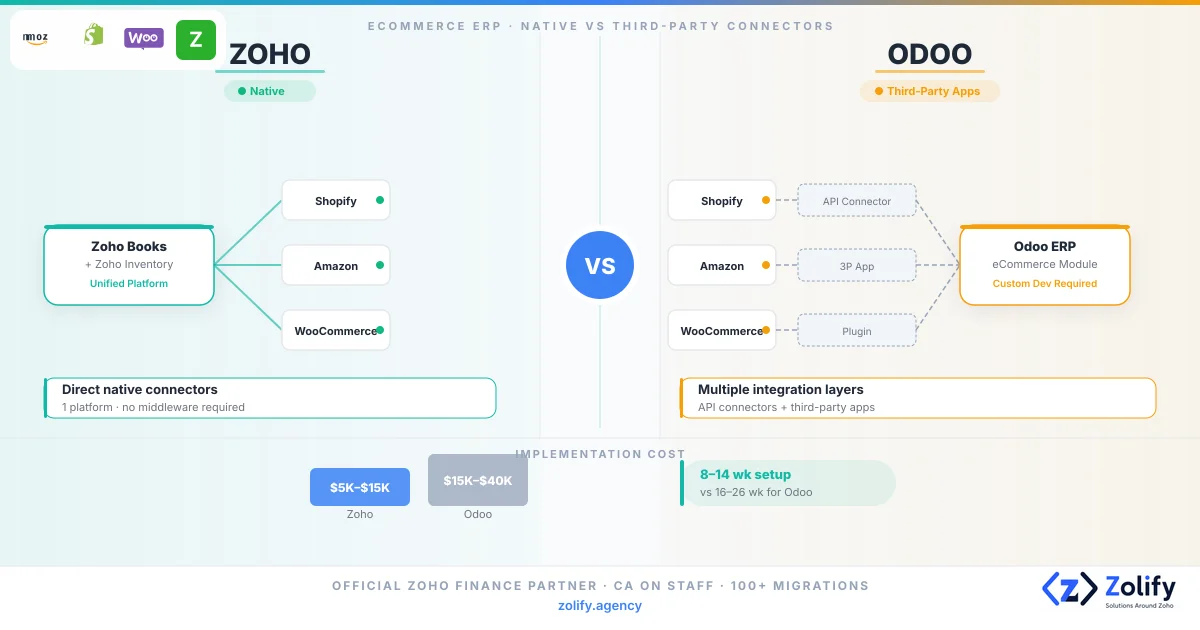
Zoho Inventory connects to Shopify, Amazon, WooCommerce, eBay, and Etsy without additional connector software. Zoho maintains these connections, not a third-party community contributor. When Amazon changes its API or Shopify updates its webhook spec, Zoho updates the connector. Your team doesn't manage that cycle.
For a seller on three channels (Shopify, Amazon FBA, and eBay, say), Zoho Inventory handles:
- Real-time stock sync across all three channels from a single inventory ledger
- Order import and fulfillment status updates
- Multi-warehouse routing (FBA stock vs warehouse stock vs dropship)
- Returns and restocking back to available inventory
Zoho Books receives those transactions automatically. Amazon settlement files post line by line (advertising fees, FBA storage charges, refund adjustments) with no manual rekeying. Shopify payouts match against individual orders. A CA reviewing the books gets a clean audit trail from transaction to bank reconciliation.
This is standard Zoho behavior for Amazon and Shopify sellers out of the box, confirmed across 100+ eCommerce implementations. Not a custom build.
Where Odoo genuinely wins
Odoo is a real platform, and any honest comparison has to say where it outperforms Zoho.
On manufacturing and supply chain, Odoo's Manufacturing module handles bill of materials, work orders, quality control checkpoints, and MRP in ways Zoho doesn't match. For eCommerce businesses that also manufacture (a furniture brand building to order, or a supplement company with production runs), that depth matters.
Odoo is also open source. Community Edition is free to download, self-host, and modify. A business with an in-house developer can build exactly the workflows they need, including custom integrations for platforms Zoho doesn't support natively.
For deployment, Odoo Community self-hosted is the only option for businesses with data residency requirements or IT policies that prohibit cloud-only SaaS. Zoho is cloud-only.
Odoo's App Store also includes community-built modules for industries like veterinary practice management, rental equipment, agricultural inputs, and food production. If your eCommerce business sits at a niche intersection, there may be an Odoo module built for it.
Marketplace integrations: the practical difference
The connector gap is the most operationally significant difference for eCommerce sellers. Odoo requires third-party apps to sync with Shopify, Amazon, WooCommerce, eBay, and Etsy. Those apps:
- Are maintained by independent developers, not Odoo
- Carry separate licensing costs (typically $30–150 per month per connector)
- Require upgrades when Odoo releases a major version
- Create a second support queue when something breaks (is it Odoo, or the connector?)
For a seller on three channels, that adds $90–450 per month in connector fees and introduces three separate upgrade cycles. On Zoho, those connections are included in the Zoho Inventory subscription, maintained by Zoho, and handled through the same support channel.
None of this makes Odoo the wrong choice. If your team can manage connectors and your customization requirements justify the overhead, the tradeoff makes sense. But for an eCommerce team that wants the stack to run without a developer on standby, the maintenance disappears with Zoho's native connectors.
Pricing: license cost vs total cost of ownership
License costs between Zoho and Odoo are closer than the open-source framing suggests. The real gap is in implementation and ongoing maintenance.
Zoho One at $37/user/month includes Zoho Books, Zoho Inventory, Zoho CRM, Zoho Analytics, and 50+ additional apps. A 5-user team pays $2,220 per year with every app included and no per-module add-ons. Zoho publishes current Zoho One pricing if you want to verify for your region and billing cycle.
Odoo Enterprise cloud pricing depends on the app bundle. A comparable stack (Accounting, Inventory, CRM, Sales) runs approximately $24–37 per user per month, similar to Zoho One. Add third-party connector apps for marketplaces and the annual licensing cost is comparable or slightly higher.
Implementation is where the gap opens. A Zoho eCommerce implementation for a 3-channel seller (Shopify, Amazon, eBay) with CA-supervised chart of accounts setup, historical data migration, and training typically runs $5,000–$15,000 through a Zoho Authorized Partner. An equivalent Odoo Enterprise implementation with custom marketplace connector work typically runs $15,000–$40,000, depending on customization scope.
Over three years, the total cost of ownership difference for a 5-user eCommerce team is often $20,000–$40,000 in Zoho's favor, driven by lower implementation cost and reduced ongoing developer dependency.
Implementation timeline and go-live speed
eCommerce businesses don't have months of runway before their operations problem costs real money. An inventory sync three hours behind loses you Buy Box status. A settlement reconciliation backlog compounds monthly.
A Zoho eCommerce implementation through Zolify follows a defined sequence:
- Chart of accounts setup and mapping (1–2 weeks): CA-supervised account structure matched to your eCommerce fee types, COGS categories, and channel revenue splits.
- Zoho Inventory configuration and channel connections (1–2 weeks): All marketplace connectors live, inventory sync tested, multi-warehouse routing configured.
- Data migration and opening balances (1–2 weeks): Historical transaction import, vendor and customer records, opening balance reconciliation sign-off by CA.
- Parallel run and training (1–2 weeks): Both old and new systems running simultaneously until the team is confident in the new stack.
Typical total: 4–8 weeks to full go-live for a 2–4 channel eCommerce operation.
Odoo implementations with marketplace customization work typically run 8–20 weeks for a comparable scope, with additional time for connector development, testing, and documentation.
Who should choose Odoo
Odoo is the better fit when:
- You have in-house developers or a dedicated IT team comfortable maintaining Odoo modules and connector upgrades
- Your business includes manufacturing operations (bill of materials, work orders, MRP)
- You have data residency or on-premise requirements that rule out cloud-only SaaS
- You're on platforms Zoho Inventory doesn't support natively and a community Odoo module exists for your channel
- Customization requirements are deep enough that the additional implementation investment is justified by the long-term flexibility
Who should choose Zoho
Zoho is the better fit when:
- You sell on Shopify, Amazon, WooCommerce, eBay, or Etsy (one channel or five)
- You want operations running without ongoing developer involvement
- You need accounting supervised by a CA who can sign off on chart of accounts structure, COGS methodology, and reconciliation procedures
- You're migrating from QuickBooks, Xero, Tally, or SAP and want a like-for-like accounting environment with better eCommerce integration
- Implementation timeline matters: you need the stack live in weeks, not months
How Zolify runs Zoho for eCommerce
Zolify has completed 100+ eCommerce implementations on Zoho across Shopify, Amazon, WooCommerce, eBay, and Etsy sellers. Every implementation is CA-supervised: the chart of accounts structure, the COGS methodology, and the channel P&L setup are reviewed by a Chartered Accountant before go-live.
As an Official Zoho Authorized Partner, Zolify's implementations carry Zoho's quality assurance standards. That credential is verifiable in Zoho's partner directory. It means the business gets a configured, working system, not a standard template that stops short of the eCommerce-specific work.
If you're still deciding, a scoped review of your channel mix, data volume, and accounting requirements is the most useful next step. That's what Zolify's eCommerce Ops Audit covers.
Related reads: QuickBooks to Zoho Books Migration Guide · What Is Zoho One? eCommerce Seller Guide · NetSuite vs Zoho One for eCommerce · Zoho Commerce eCommerce Guide
Frequently Asked Questions
For most eCommerce sellers on Shopify, Amazon, WooCommerce, eBay, or Etsy, Zoho is the better fit. Zoho Inventory has native connectors to all major marketplaces and storefronts. Odoo's marketplace integrations require third-party apps or custom developer work. Zoho Books handles marketplace fee reconciliation and multi-currency settlements without custom configuration. Odoo is more powerful for manufacturing and custom workflows but requires significantly more developer involvement to reach the same eCommerce outcome.
Odoo Community Edition is free but requires self-hosting and developer setup. Odoo Enterprise (cloud) costs approximately $24–37 per user per month depending on the app bundle. Zoho One covers accounting, inventory, CRM, analytics, and 50+ additional apps for $37 per user per month. For a 5-user eCommerce team, annual Zoho One cost is $2,220 per year. The more meaningful difference is implementation cost: Zoho implementations for eCommerce typically run $5,000–$15,000 with a CA-supervised partner. Odoo eCommerce implementations with custom marketplace work typically run $15,000–$40,000.
Yes, but through third-party apps or custom development, not natively. The Odoo App Store has community modules for Shopify and Amazon, but these are maintained by third-party developers and vary in quality, update frequency, and support depth. Zoho Inventory connects to Shopify, Amazon, WooCommerce, eBay, and Etsy natively — maintained by Zoho — without additional connector costs. For sellers managing multi-channel inventory across two or more platforms, the native connector approach reduces ongoing maintenance and API failure risk.
Yes. A migration from Odoo to Zoho Books covers chart of accounts mapping, opening balance import, vendor and customer records, and transaction history. For eCommerce businesses, the migration also includes Zoho Inventory setup and reconnection of marketplace channels to the new inventory system. A typical Odoo-to-Zoho migration for an eCommerce business with 2–5 channels takes 8–14 weeks including a parallel run period to validate data accuracy.
Zoho Books is designed with eCommerce accounting workflows in mind. It handles Amazon settlement file reconciliation, Shopify payout matching, marketplace fee categorization, and multi-currency sales from a single screen. Odoo Accounting is capable for standard double-entry bookkeeping but requires additional configuration and often custom modules to handle the specific fee structures and settlement formats that Amazon, Shopify, and other platforms produce. For businesses with a CA or CPA overseeing the books, Zoho Books is the more familiar and auditable environment.
See exactly where your Shopify, Amazon, or WooCommerce ops are leaking — free.
Get a personalised eCommerce Ops Audit: inventory gaps, accounting leaks, and order-flow bottlenecks — with a Zoho fix roadmap. Delivered in 48 hours, at no cost.