eBay Zoho Integration: Connect Your eBay Store to Zoho Books and Inventory
eBay's bi-weekly Managed Payments payout is not revenue. This guide covers the complete eBay Zoho integration: order sync and multi-channel stock in Zoho Inventory, Managed Payments reconciliation across five fee types in Zoho Books, and eBay channel P&L in Zoho Analytics.
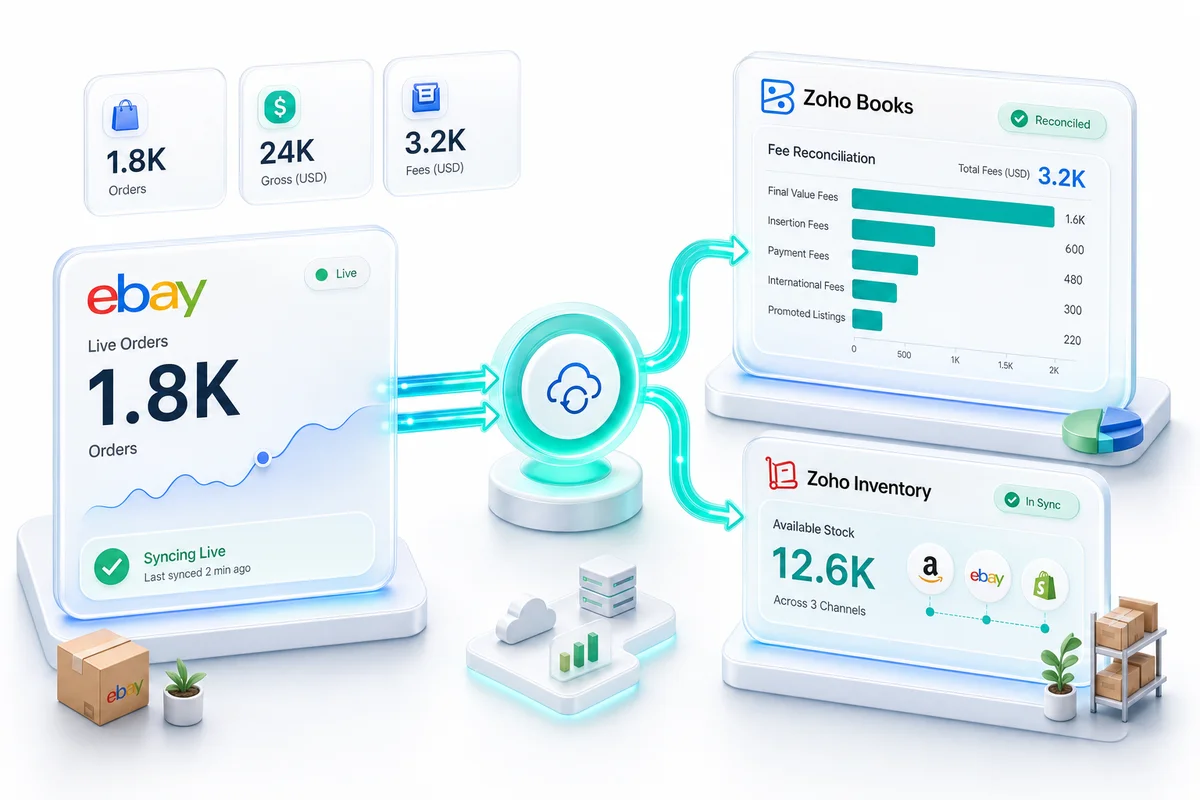
eBay sellers running Managed Payments hit the same reconciliation problem every two weeks: the bi-weekly payout lands in the bank and does not match any gross revenue figure on the eBay dashboard. Five categories of fees have already been deducted, but the payout arrives as a single net number. An eBay Zoho integration built correctly maps gross sales, final value fees, insertion fees, payment processing fees, international transaction fees, and Promoted Listings fees to separate Zoho Books accounts from day one. The payout reconciles cleanly, the P&L reflects actual selling costs, and multi-channel inventory across eBay, Shopify, and Amazon stays current through Zoho Inventory.
What the eBay-Zoho Integration Covers
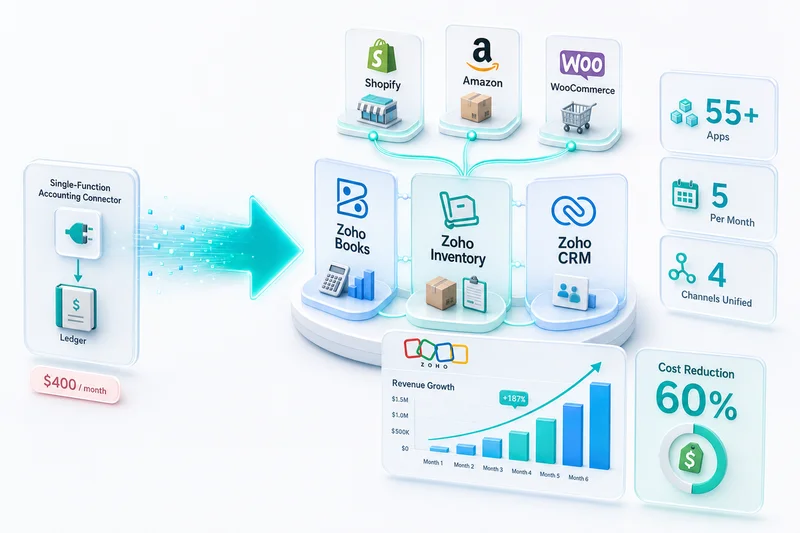
The eBay Zoho integration is not a single connection. It spans four Zoho products, each handling a distinct layer of eBay operations.
Zoho Inventory: Order Sync and Multi-Channel Stock Management
Zoho Inventory receives eBay orders in real time, updates stock on fulfilment, and manages shared inventory pools for sellers who also operate on Shopify, WooCommerce, or Amazon. A sale on any channel decrements the same pool, so a unit that sells on eBay comes off Shopify and Amazon availability within the same sync cycle.
Zoho Books: Managed Payments Reconciliation and Fee Tracking
Zoho Books maps the five eBay fee types to dedicated expense accounts, records gross sales at face value, and reconciles the bi-weekly Managed Payments payout against those accounts. The bank deposit is the output of reconciliation, not the input.
Zoho CRM: eBay Customer Data and Post-Sale Retention
eBay order data creates buyer records in Zoho CRM within eBay's data sharing policies. Repeat buyer patterns, order history, and product preferences become visible across the Zoho stack for sellers who also run a direct channel.
Zoho Analytics: Channel P&L and Promoted Listings Performance
Zoho Analytics connects to Zoho Books and Zoho Inventory to produce channel-level P&L reporting. For multi-channel sellers, eBay revenue, COGS, fees, and Promoted Listings spend appear alongside Shopify and Amazon in one dashboard without any spreadsheet exports.
For how eBay connects alongside Shopify, Amazon, WooCommerce, and Etsy in a single Zoho backend, see Zoho for eCommerce: The Complete Operations Platform Guide.
eBay Orders in Zoho Inventory
Real-Time Order Sync: eBay Listings to Zoho Inventory
Orders placed on eBay sync to Zoho Inventory as sales orders within minutes. Each order captures the buyer's shipping address, line items, and eBay order ID. Stock is reserved on order creation and depleted on fulfilment, keeping your available count accurate across channels without manual updates.
Multi-SKU Inventory: Keeping eBay Stock in Sync With Your Warehouse
Zoho Inventory tracks every eBay SKU with its own cost basis. As units sell, FIFO or weighted average cost calculates COGS per unit and passes the figure to Zoho Books automatically. Reorder points trigger purchase orders to suppliers when stock drops below a defined threshold. For guidance on choosing the right cost method for your eBay catalogue, see FIFO vs Weighted Average for eCommerce Sellers in Zoho Books.
eBay Returns and Refunds: How Zoho Inventory Adjusts Stock and COGS
Returned units from eBay re-enter Zoho Inventory at the original cost if resaleable. Units that are not resaleable require a write-down in Zoho Books. Zoho Inventory handles both outcomes systematically, adjusting stock levels and COGS without requiring manual corrections at month-end.
eBay + Shopify + Amazon in One Inventory Pool: Preventing Oversells Across Channels
Sellers who run eBay alongside Shopify or Amazon face a specific risk: if the last unit sells on eBay before the count updates elsewhere, the other channels oversell. Zoho Inventory holds the master stock count. All channels draw from the same pool, so when a unit sells on eBay, Shopify and Amazon availability updates within the sync window. For the full cross-channel configuration, see multi-channel inventory management with Zoho.
For sellers preparing ahead of BFCM, the shared inventory pool is one of the most important configurations to get right before Q4 volume hits. The BFCM inventory planning guide for Shopify and Amazon sellers covers stock positioning and reorder point setup that applies equally to eBay listings drawing from the same pool.
eBay Managed Payments and Zoho Books: Reconciliation Step by Step
Why Your eBay Bi-Weekly Payout Is Not Your Revenue
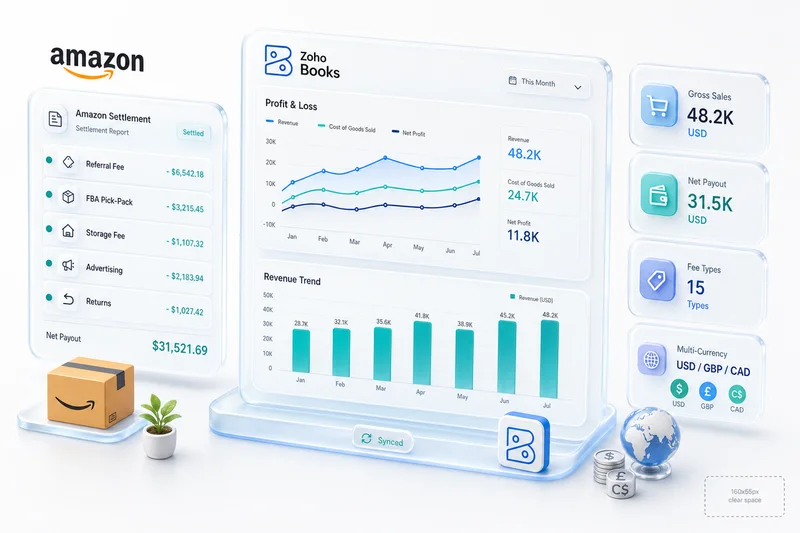
eBay Managed Payments disburses every two weeks as a net figure: gross sales for the period minus final value fees, insertion fees, payment processing fees, international transaction fees, Promoted Listings fees, and any refunds. Recording that payout as revenue understates gross sales and removes all five fee categories from the P&L as deductible expenses. For an eBay seller doing $200,000 in annual gross sales, that error can misclassify $20,000 to $40,000 in legitimate business expenses. The same Managed Payments reconciliation structure applies to Etsy sellers, detailed in the Etsy Zoho integration guide.
The Five eBay Fee Types You Must Track Separately in Zoho Books
| eBay Fee | Zoho Books Account |
|---|---|
| Final value fee (variable % of sale) | eBay Final Value Fees (Selling Expense) |
| Insertion / listing fee (per listing) | eBay Insertion Fees (Platform Expense) |
| Payment processing fee (per transaction) | eBay Payment Processing (Payment Processing Expense) |
| International transaction fee (cross-border) | eBay International Fees (Forex / Cross-Border Expense) |
| Promoted Listings fee (% of ad-driven sales) | eBay Promoted Listings (Marketing Expense) |
For the current fee rates on each category, see eBay's seller fees documentation.
Collapsing these five into a single "eBay Fees" account is the most common chart of accounts error in eBay Zoho Books implementations. Five separate accounts surface what one bucket hides: your per-transaction selling cost, your advertising efficiency, and the true cost of cross-border volume.
Final Value Fees: Your Selling Cost Per Transaction
Final value fees are the primary cost of selling on eBay: a percentage of the total sale amount including shipping and applicable taxes. The rate varies by category. In Zoho Books, final value fees post to a Selling Expense account. This is your per-transaction marketplace cost and belongs in operating expenses, not netted against revenue.
Listing and Insertion Fees: Fixed Platform Costs
Insertion fees are charged per listing once the free monthly allowance is exceeded. These are fixed costs that apply whether or not the item sells. They post to a Platform Expense account in Zoho Books, making it straightforward to see the cost of maintaining a large eBay catalogue independent of your conversion rate.
Payment Processing Fees: The Per-Transaction Settlement Cost
eBay Managed Payments charges a payment processing fee per transaction: a small percentage plus a fixed amount per order. These post to a Payment Processing Expense account. After final value fees and insertion fees, payment processing typically represents the third-largest fee category for most eBay sellers.
International Transaction Fees: Cross-Border eBay Sales in Zoho Books
eBay charges an additional fee on transactions where the buyer is located in a different country than the seller. This is separate from payment processing and reflects the cross-border settlement cost. In Zoho Books, international transaction fees post to a Forex / Cross-Border Expense account. For sellers with significant international volume, this account grows materially and should be tracked as its own cost centre rather than buried in a generic fees line.
eBay Promoted Listings Fees: Marketing Expense, Not Revenue Reduction
Promoted Listings fees apply when a buyer purchases through an eBay ad placement. The fee is a percentage of the sale price and appears in the Managed Payments statement as a deduction from proceeds. In Zoho Books, Promoted Listings fees belong in Marketing Expense, not Selling Expense or netted against revenue. This classification makes advertising cost of sales visible at the P&L level and comparable to Shopify or Amazon ad spend.
eBay Refunds and Partial Refunds: How Zoho Books Handles Them
eBay refunds reduce gross sales and reverse the associated final value fee for the refunded portion. In Zoho Books, a refund creates a credit note against the original sales invoice. The final value fee reversal posts back to the eBay Final Value Fees account. Partial refunds follow the same structure at pro-rated amounts.
eBay Tax Compliance in Zoho Books
US Sales Tax: eBay Collects and Remits for Most States (Marketplace Facilitator)
eBay acts as a marketplace facilitator for US sales tax in most states. For qualifying transactions, eBay collects from the buyer and remits to the state directly. The gross sale still appears in Zoho Books at full value; the tax component is treated as a pass-through, not revenue. Confirming the correct treatment with a CA before closing the first period prevents discrepancies between your Zoho Books records and the 1099-K eBay issues at year-end.
UK VAT and EU VAT on eBay Cross-Border Sales
For UK and EU buyers, eBay collects and remits VAT on most cross-border orders under marketplace facilitator rules. eBay sellers based in the UK or EU who exceed their domestic VAT registration threshold have obligations beyond what eBay remits on their behalf. Zoho Books tracks VAT on those transactions and generates returns in the format required by HMRC and EU authorities.
1099-K Reporting: What Your eBay Managed Payments Annual Report Means
US eBay sellers who process over $600 in Managed Payments in a calendar year receive a Form 1099-K from eBay. The 1099-K reports gross transaction value, not the net bi-weekly payout. That figure must match the gross eBay revenue recorded in Zoho Books. If you recorded net payouts as revenue, the 1099-K will show a higher number than your books and create a discrepancy the IRS may flag. For the full accounting setup that prevents this mismatch, see the eBay seller Zoho Books guide. Multi-channel sellers managing 1099-Ks from eBay, Shopify Payments, and Amazon in the same year should also see eCommerce 1099-K Reporting: What Sellers Need to Know.
The year-end accounting checklist for eCommerce sellers in Zoho Books covers the full reconciliation sequence across all channels at year-end close. Sellers approaching December should also review their Q4 performance metrics before eBay's January seller level evaluation; the eBay year-end seller performance review guide covers which Seller Hub reports to pull and how to build the Zoho Analytics dashboard that flags at-risk defect rates and late shipment rates before eBay locks in its evaluation.
Multi-Channel eBay Sellers: eBay + Shopify + Amazon in Zoho
Separate Revenue Accounts per Channel in Zoho Books
Multi-channel sellers running eBay alongside Shopify or Amazon keep separate revenue accounts per platform in Zoho Books: eBay Sales, Shopify Sales, Amazon Sales. The combined P&L shows total revenue; the channel breakdown shows which platform is most profitable after platform-specific fees. This is the structure described in the Zoho for eCommerce hub and the starting point for every multi-channel implementation.
Fee Structure Comparison Across Channels
Understanding where each platform's costs land in Zoho Books helps when comparing channel-level profitability:
| Fee Category | eBay | Shopify | Amazon |
|---|---|---|---|
| Selling fee | Final value fee (% of total) | Transaction fee (% of sale) | Referral fee (% of sale) |
| Platform / listing fee | Insertion fee (per listing) | Monthly subscription | None per listing |
| Payment processing | Managed Payments fee | Shopify Payments or gateway fee | Included in FBA or per-order fee |
| Advertising | Promoted Listings (% of ad-driven sale) | External (Meta/Google) | Sponsored Products (% of sale) |
| Cross-border fee | International transaction fee | Currency conversion fee | Varies by program |
Each fee type routes to a dedicated expense account in Zoho Books. The multi-channel P&L in Zoho Analytics then shows net margin per channel after all platform-specific costs — not just gross revenue. For the full configuration across channels, warehouses, and reorder workflows, see Multi-Channel Inventory Management with Zoho (2026).
One Stock Pool: Zoho Inventory as the Master System Across All Channels
Zoho Inventory holds the single stock of record for all active channels. Orders from eBay, Shopify, and Amazon draw from the same pool. When a unit sells on any channel, available quantity updates across all channels within the sync window. Multi-channel sellers who previously maintained separate spreadsheets per platform stop that work on day one of the Zoho configuration.
Zoho Analytics: eBay vs Shopify vs Amazon Channel P&L in One Dashboard
Zoho Analytics connects to Zoho Books and Zoho Inventory to produce channel P&L without exports. Revenue, COGS, platform fees, Promoted Listings spend, and net margin appear by channel. For sellers where eBay, Shopify, and Amazon perform differently by product category, the dashboard identifies which platform to prioritise for which products without requiring a spreadsheet pivot every month. For the full multi-channel setup, see multi-channel eCommerce with Zoho.
Common eBay-Zoho Integration Mistakes
Recording the Net Managed Payments Payout as Revenue (The Universal Error)
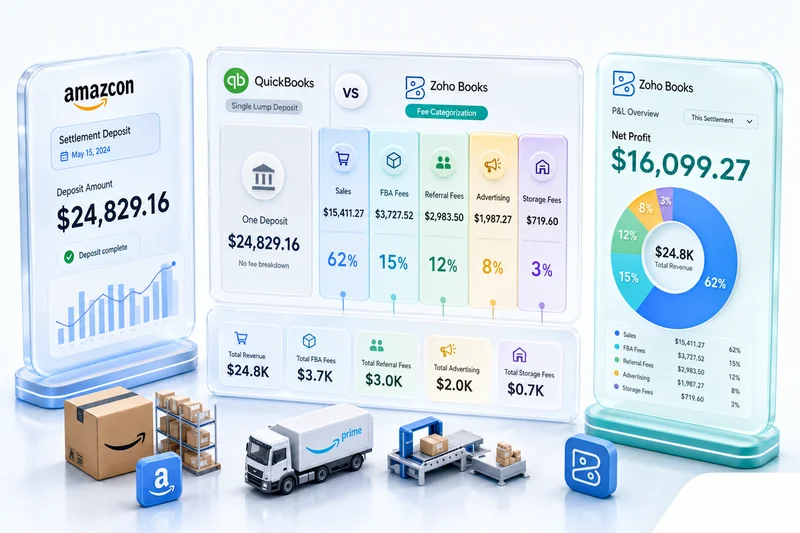
The net bi-weekly payout is what eBay deposits after deducting all five fee categories. A seller with $180,000 in annual gross eBay sales receiving net payouts of $145,000 who records $145,000 as revenue understates gross sales by $35,000 and makes $35,000 in deductible expenses invisible. The fix is a chart of accounts that maps gross sales to revenue and all five fee types to separate expense accounts, reconciled against the Managed Payments statement rather than the bank deposit. The same error pattern appears in Amazon setups, covered in the Amazon Zoho integration guide.
Collapsing All Five eBay Fee Types Into One "eBay Fees" Account
A single "eBay Fees" line collapses final value fees, insertion fees, payment processing fees, international transaction fees, and Promoted Listings fees into one figure. That removes any ability to benchmark your selling cost per transaction, measure advertising efficiency, or identify whether cross-border volume is worth the associated fee. Five accounts takes under an hour to set up and produces materially better P&L for the life of the business.
Missing International Transaction Fees on Cross-Border eBay Sales
eBay sellers with international buyers who do not configure a dedicated international fee account lose track of this cost. International transaction fees appear as a separate line on the Managed Payments statement. Without a dedicated account, they either disappear into a generic fees bucket or get missed during reconciliation. For high-volume cross-border sellers, this is a material misclassification.
Using Zapier or Make Instead of Native Zoho Inventory Sync: Why It Breaks at Scale
Zapier and Make can sync individual eBay orders to Zoho via trigger-based workflows. The limitation is that trigger-based automation moves order data but cannot reconstruct the settlement-level reconciliation eBay Managed Payments requires. Zapier does not know how to attribute the bi-weekly payout across five fee categories, apply COGS logic against a shared multi-channel inventory pool, or handle partial refund fee reversals. These are accounting operations, not data pipe operations. A no-code workflow that handles 50 orders a month produces incorrect books at 500 orders a month when settlement complexity and edge cases compound. Native Zoho Inventory sync, combined with a CA-configured chart of accounts, handles the full settlement workflow from the start. Sellers who also manage supplier invoices and purchase orders should see the eCommerce accounts payable automation guide in Zoho Books — AP automation that runs through Zoho Books natively cannot be replicated through Zapier, for the same reason the order-sync limitation applies here.
How Zolify Sets Up the eBay-Zoho Integration
Chart of Accounts Built for eBay's Five Fee Types: CA-Configured
Before the first order syncs, Zolify's Chartered Accountant configures dedicated accounts for eBay Final Value Fees, eBay Insertion Fees, eBay Payment Processing, eBay International Fees, and eBay Promoted Listings. Gross revenue accounts remain separate from all fee accounts. This foundation makes reconciliation a matching exercise rather than a monthly investigation.
Managed Payments Reconciliation Workflow: eBay Statement to Zoho Books
The bi-weekly eBay Managed Payments statement is the source document for reconciliation. Zolify builds the workflow so each statement line item maps to a Zoho Books journal entry or purchase bill for the corresponding fee category. At period-end, gross sales minus the five mapped fee accounts ties to the bank deposit. Once the accounts are structured and the workflow is running, reconciliation closes in under an hour per settlement period. For a step-by-step monthly close workflow covering the transaction report download, all six fee postings, COGS from Zoho Inventory, returns, tax pass-throughs, and clearing account reconciliation, see the eBay monthly bookkeeping guide for Zoho Books.
Multi-Channel Configuration: eBay + Shopify + Amazon in Zoho Inventory
For sellers running eBay alongside Shopify or Amazon, Zolify sets up separate revenue accounts per channel in Zoho Books and a shared inventory pool in Zoho Inventory. Channel-specific fees route to their own expense accounts. Stock counts update from a single pool across all three platforms, preventing oversell scenarios. This is the multi-channel eCommerce operations model Zolify has delivered across 100+ eCommerce implementations.
Zoho Analytics Dashboard: eBay Channel P&L From Day One
Zolify configures Zoho Analytics dashboards before go-live so the first live settlement produces a usable eBay channel P&L. Revenue, COGS, final value fees, insertion fees, payment processing, international fees, Promoted Listings spend, and net margin appear by channel from day one. For multi-channel sellers, eBay sits alongside Shopify and Amazon in the same view without any additional configuration after go-live.
Zolify is an Official Zoho Finance Partner with a CA on staff and 100+ eCommerce implementations completed. Every eBay-Zoho integration includes a CA review of the chart of accounts, fee reconciliation workflow, and multi-channel configuration before the system goes live.
Get an eBay-Zoho Integration Assessment
If your eBay Managed Payments payouts do not reconcile with your Zoho Books revenue, or if all five fee types are collapsed into one account, the financial picture you see does not reflect what eBay is actually charging.
Book an eCommerce Ops Audit and Zolify will review your eBay seller account structure, map your five fee types to the correct chart of accounts, and design the integration that produces clean books from the first settlement. As an Official Zoho Authorized Partner with 100+ eCommerce implementations and a CA on staff, Zolify has configured this integration for eBay sellers across single-channel, multi-channel, and cross-border setups.
For sellers still deciding which accounting platform to use for their eBay store, the eBay seller accounting software guide covers the key platforms and what to consider before committing to a setup.
For the broader eCommerce operations picture, see Zoho for eCommerce and the multi-channel eCommerce solution.
Frequently Asked Questions
eBay connects to Zoho through Zoho Inventory's native eBay marketplace connector for order sync and stock management, and to Zoho Books for Managed Payments reconciliation. Orders sync in real time; the bi-weekly Managed Payments statement maps to dedicated accounts in Zoho Books for each of eBay's five fee types. Zoho CRM and Zoho Analytics connect downstream for buyer data and channel P&L reporting.
Yes. Zoho Books handles eBay Managed Payments reconciliation by mapping gross sales and each of the five fee types (final value fees, insertion fees, payment processing fees, international transaction fees, and Promoted Listings fees) to separate accounts. The bi-weekly payout reconciles against those accounts rather than being recorded as revenue. Sellers who set this up correctly find month-end reconciliation closes in under an hour per settlement period.
eBay Managed Payments deducts final value fees, insertion fees, payment processing fees, international transaction fees, and Promoted Listings fees from gross sales before disbursing the payout. The deposit is what remains after all five fee categories have been subtracted. Recording the deposit as revenue understates gross sales and removes thousands of dollars in deductible business expenses from your P&L — a discrepancy that becomes visible when the 1099-K arrives at year-end.
The five eBay fee types requiring separate accounts in Zoho Books are: final value fees (selling expense), insertion and listing fees (platform expense), payment processing fees (payment processing expense), international transaction fees (forex/cross-border expense), and Promoted Listings fees (marketing expense). Collapsing all five into a single 'eBay fees' account loses the margin visibility each category provides and makes advertising efficiency invisible.
Yes. Zoho Inventory acts as the master stock system for both channels. Orders from eBay and Shopify deduct from the same inventory pool, preventing oversells. Adding Amazon to the same configuration means all three channels share one stock count in Zoho Inventory while keeping separate revenue accounts per platform in Zoho Books. During Q4 peak season, this unified pool is what prevents selling the same unit twice across channels.
See exactly where your Shopify, Amazon, or WooCommerce ops are leaking — free.
Get a personalised eCommerce Ops Audit: inventory gaps, accounting leaks, and order-flow bottlenecks — with a Zoho fix roadmap. Delivered in 48 hours, at no cost.