Etsy Zoho Integration: Connect Your Etsy Shop to Zoho Books and Inventory
Etsy's weekly Managed Payments deposit is not your revenue. Here is how to connect Etsy to Zoho Books correctly, track handmade COGS with bills of materials, and manage Etsy alongside Shopify or Amazon in one Zoho stack.
Etsy sellers running more than a few hundred orders per month hit the same wall: the weekly Managed Payments deposit lands in the bank and it does not match any figure on the Etsy dashboard. Fees have been subtracted, but they are not itemised in a way the bank statement reflects. An Etsy Zoho integration built correctly fixes this by routing gross sales, listing fees, transaction fees, offsite ads, and payment processing into separate Zoho Books accounts from day one. The deposit reconciles, the P&L is accurate, and tax season stops being a scramble.
| Etsy challenge | Zoho solution |
|---|---|
| Weekly Managed Payments deposit doesn't match gross sales | Zoho Books: gross revenue account plus four separate fee expense accounts |
| Handmade COGS can't be tracked with a purchase price | Zoho Inventory: bills of materials per SKU |
| 1099-K gross amount doesn't match recorded revenue | Zoho Books: gross revenue account matches the Managed Payments statement total |
| Multi-channel oversells when Etsy and Shopify share stock | Zoho Inventory: single shared pool, both channels deduct from the same count |
| Sales tax, VAT, and GST compliance across markets | Zoho Books: per-transaction tax tracking with audit trail |
What connecting Etsy to Zoho actually means
Connecting Etsy to Zoho is not a single switch. It involves at least two Zoho products and, for most Etsy sellers, a third.
The Etsy-Zoho stack: Books, Inventory, CRM, and Analytics
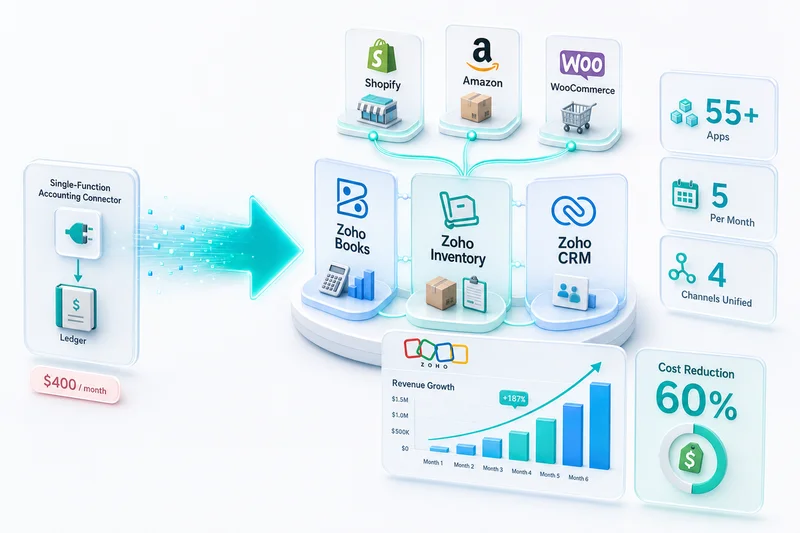
A full Etsy-Zoho integration uses Zoho Inventory to receive and fulfil orders, Zoho Books to reconcile Managed Payments and produce financial statements, and Zoho Analytics for channel-level P&L reporting. Sellers who also run Shopify or Amazon add those channels to the same Zoho Inventory pool and keep separate revenue accounts per platform in Zoho Books.
How Etsy Managed Payments flows into Zoho Books
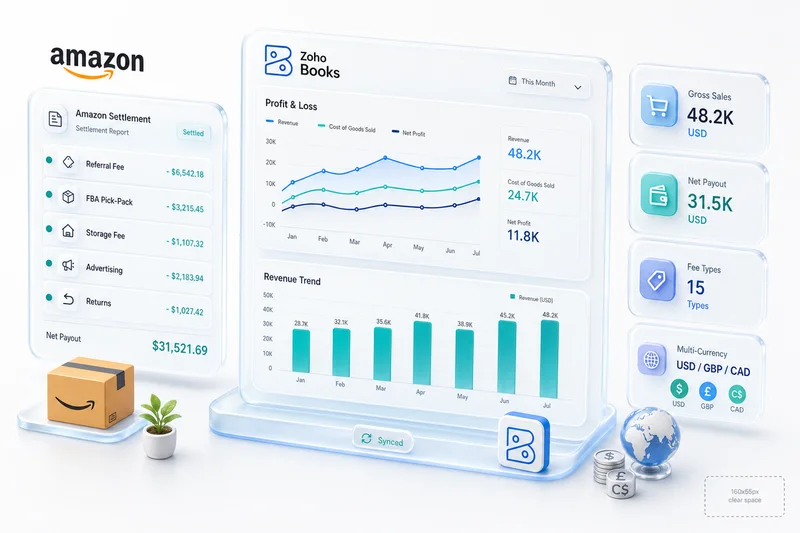
Etsy Managed Payments disburses weekly as a net figure. Gross sales (item price plus any shipping charged) are reduced by listing fees, transaction fees, offsite ads fees, and payment processing fees before the bank deposit arrives. In Zoho Books, each fee type maps to a dedicated expense account so gross sales are recorded at face value and fees appear as deductible operating expenses.
How Etsy orders flow into Zoho Inventory
Each Etsy order syncs to Zoho Inventory as a sales order. Stock is reserved on order creation and depleted on fulfilment. For handmade sellers, the depletion triggers a bill of materials calculation rather than a simple purchase-price COGS lookup. For sellers with shared Etsy and Shopify stock, the depletion comes from a single inventory pool that both channels draw from.
Is the Zoho-Etsy integration native or middleware-assisted?
Zoho has an Etsy connector in the Zoho Marketplace. For Etsy sellers who also use Shopify or other platforms, a middleware layer (custom API or a connector tool) can route orders from all channels into the same Zoho Inventory organisation. The right architecture depends on order volume, fulfilment model, and whether handmade COGS tracking is required.
Etsy Managed Payments and Zoho Books: reconciliation step by step
Managed Payments reconciliation is where most Etsy sellers using Zoho Books go wrong. The correct structure requires four separate expense accounts, not a single "Etsy fees" bucket.
Why your Etsy weekly deposit is not your revenue
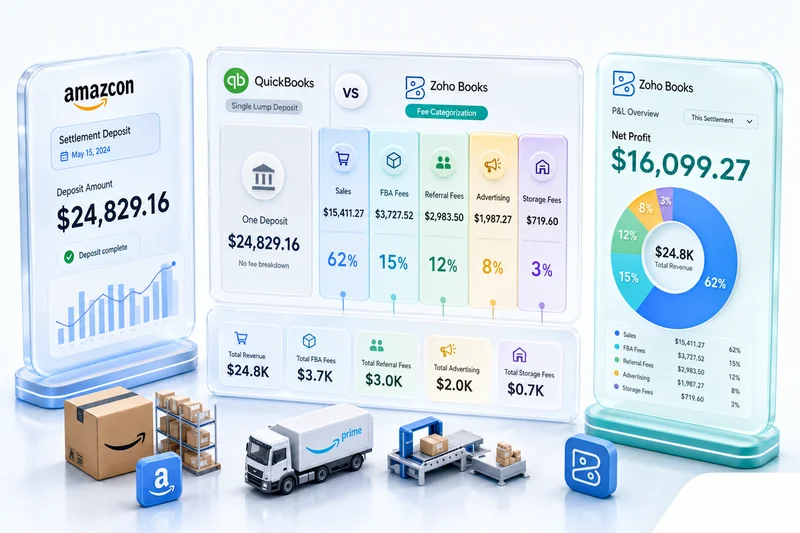
The Etsy Managed Payments deposit is a net disbursement. Gross sales for the period minus all fee categories equals the wire transfer. Recording the wire as revenue understates income and loses the expense deduction for each fee category. For an Etsy shop doing $150,000 in annual gross sales, that error can misclassify $15,000 to $25,000 in legitimate deductions.
The four Etsy fee types to track separately in Zoho Books
| Etsy Fee | Rate | Zoho Books Account |
|---|---|---|
| Listing fee | $0.20 per listing published or renewed | Etsy Listing Fees (Operating Expense) |
| Transaction fee | 6.5% of item price plus shipping | Etsy Transaction Fees (Operating Expense) |
| Offsite Ads fee | 15% for sellers under $10K/yr (opt-out available); 12% for sellers over $10K/yr (mandatory) | Etsy Offsite Ads (Marketing Expense) |
| Payment processing fee | 3% + $0.25 per transaction (US); varies by country | Etsy Payment Processing (Operating Expense) |
For the current rate schedule, see Etsy's seller fees documentation.
Listing fees ($0.20/listing): where they go in Zoho Books
Listing fees are charged at $0.20 per listing when published and again each time a listing auto-renews after a sale. They appear as a separate line on the Etsy payment account statement. In Zoho Books, they map to an Etsy Listing Fees expense account under Operating Expenses.
Transaction fees (6.5%): separate expense account, not a revenue reduction
Transaction fees are 6.5% of the item price plus any shipping and gift-wrapping charges the buyer paid. They reduce the Managed Payments disbursement but are not a reduction of revenue. In Zoho Books, they post to an Etsy Transaction Fees account under Operating Expenses, keeping gross revenue intact for margin analysis.
Offsite Ads fee (12-15%): when it's mandatory and how to track it
Etsy's Offsite Ads program charges a fee when a buyer purchases through an Etsy-promoted external ad (Google, Facebook, Pinterest). For sellers who earned under $10,000 in the previous 12 months, participation is optional and the fee is 15%. For sellers who crossed $10,000, participation becomes mandatory and the rate drops to 12%. In Zoho Books, this posts to a Marketing Expense account because it is an advertising cost, not an operating fee.
Payment processing fees: the final reconciliation line
Payment processing fees in Managed Payments are 3% plus $0.25 per transaction for US sellers; international transactions carry different rates. These post to an Etsy Payment Processing account under Operating Expenses. After all four fee accounts are recorded, the sum of gross sales minus listing fees, transaction fees, offsite ads, and payment processing should match the actual bank deposit.
Etsy refunds and partial refunds: how Zoho Books handles them
Etsy refunds reduce both the gross sales figure and the transaction fee for the refunded amount. In Zoho Books, the refund creates a credit note against the original sales invoice. The transaction fee reversal posts back to the Etsy Transaction Fees account. Partial refunds follow the same structure at pro-rated amounts.
Etsy orders in Zoho Inventory
The order sync side of the Etsy-Zoho integration handles stock movement and COGS recording. For handmade sellers, it also handles raw material depletion.
Order sync: Etsy orders to Zoho Inventory
Orders placed on Etsy sync to Zoho Inventory within minutes. The sync creates a sales order with the buyer's shipping address, the line items, and the Etsy order reference number. Zoho Inventory reserves stock against the order and the item appears in the fulfilment queue.
Handmade COGS: Zoho Inventory bills of materials for Etsy products
Etsy sellers who make what they sell cannot use a purchase price for COGS because there is no purchase price. The cost is the materials consumed per unit. Zoho Inventory's bill of materials (BOM) defines which raw materials go into each finished SKU and in what quantities. When a handmade candle sells, Zoho Inventory deducts 200g of soy wax, 5g of fragrance oil, and one wick from raw material stock, then records COGS at the summed material cost.
Sellers who use purchase price instead of BOM either understate COGS (if materials were bought in bulk at a per-unit rate that looks low) or overstate it (if the estimate includes waste and overhead inconsistently). BOM is the precise method and Zoho Inventory supports it natively. For the full account setup methodology for COGS across an eCommerce business, see eCommerce chart of accounts for Zoho Books.
Stock depletion: how Zoho Inventory updates your material count per sale
Once the BOM is configured, every fulfilled Etsy order automatically adjusts raw material stock levels. A seller who uses 500g of beeswax per candle and fulfils 30 candle orders will see 15kg deducted from the beeswax inventory record without any manual entry. When beeswax stock falls below the reorder point, Zoho Inventory can trigger a purchase order to the supplier.
Etsy + Shopify in one inventory pool: preventing oversells
Sellers who run an Etsy shop alongside a Shopify store face a specific risk: if a handmade item sells on both channels simultaneously before either channel's stock count updates, they oversell. Zoho Inventory prevents this by holding the master stock count. Both Etsy and Shopify deduct from the same pool, so if the last unit sells on Etsy, the Shopify listing goes unavailable within the sync window.
For the full multi-channel setup framework, see Multi-Channel Inventory Management with Zoho. The eCommerce Inventory Management Software guide covers the broader inventory stack context. Sellers connecting Etsy alongside WooCommerce can follow the same shared inventory model - see the WooCommerce Zoho integration guide.
Etsy tax compliance in Zoho Books
The tax layer is where a correctly built Etsy-Zoho integration pays for itself fastest. For sellers comparing Zoho Books against dedicated tax tools for managing 1099-K, VAT, and sales tax obligations, eCommerce Sales Tax Accounting Software covers the full landscape.
US sales tax: Etsy collects and remits for most states, but you still need the data
Etsy acts as a marketplace facilitator for US sales tax. For the majority of US states, Etsy collects from the buyer and remits to the state directly, so the seller does not handle remittance. The transaction still appears in Zoho Books as a gross sale; the tax component is excluded from revenue or tracked as a cleared liability depending on how Etsy nets it. Confirming the correct treatment with a CA before closing the first month is worth the call. See eBay Seller Zoho Books and the eBay Zoho integration guide for how the same Managed Payments structure applies to eBay.
UK VAT and EU VAT on Etsy sales: what Etsy handles and what Zoho Books tracks
For UK and EU buyers, Etsy collects and remits VAT on orders fulfilled from outside those markets. However, Etsy sellers based in the UK or EU who exceed their domestic VAT registration threshold have their own VAT obligations that Etsy does not cover. Zoho Books tracks VAT on those transactions, generates VAT returns, and maintains the audit trail required by HMRC and EU tax authorities.
Australian GST: how Etsy and Zoho Books work together for AU-based sellers
For Australian buyers purchasing from non-AU sellers, Etsy remits GST under Australia's Low Value Imports rules. AU-based Etsy sellers who exceed the AUD $75,000 GST registration threshold must register and remit independently. Zoho Books supports BAS preparation and GST reporting for AU-based Etsy sellers.
1099-K reporting: what your Etsy payment account statement means for US tax filing
US Etsy sellers who process over $600 in Managed Payments in a calendar year receive a Form 1099-K from Etsy. The 1099-K reports gross transaction value, not net deposits. This figure must match the gross Etsy revenue recorded in Zoho Books. If you recorded net deposits as revenue, the 1099-K will show a higher number than your books and create a discrepancy the IRS may flag.
Multi-channel Etsy sellers: Etsy + Shopify + Amazon in Zoho
Etsy sellers who expand to Shopify or Amazon do not need separate accounting systems. Zoho handles all three in one organisation.
Separate revenue accounts: Etsy, Shopify, Amazon in one Zoho Books organisation
Zoho Books uses a chart of accounts where each sales channel has its own revenue account. Etsy Sales, Shopify Sales, and Amazon Sales are separate lines. The combined P&L shows total revenue; the channel breakdown shows which platform is most profitable after platform-specific fees. This structure is the starting point for any multi-channel Etsy seller. See marketplace fee reconciliation in Zoho Books for the accounting setup when consolidating Shopify, Amazon, and Etsy revenue in a single Zoho Books organisation. For the full operational setup — Zoho Inventory, Books, and CRM — when expanding from Etsy to Amazon or Shopify, see multi-channel inventory management with Zoho for how to manage a shared inventory pool across channels.
One inventory pool: Zoho Inventory as the master stock system
Zoho Inventory receives orders from all active channels and deducts from a single stock pool. The integration prevents oversell scenarios and eliminates the need to maintain separate spreadsheets for Etsy stock, Shopify stock, and Amazon stock. For handmade sellers, the BOM calculation runs on orders from any channel.
Zoho Analytics: Etsy vs Shopify channel P&L in one dashboard
Zoho Analytics connects to Zoho Books and Zoho Inventory to produce channel-level P&L dashboards. An Etsy seller who also runs Shopify can see revenue, COGS, platform fees, and net margin per channel without exporting anything to a spreadsheet. For sellers where channel attribution drives buying and pricing decisions, this reporting layer is what makes the Zoho stack worth the setup investment.
Common Etsy-Zoho integration mistakes
These four errors appear consistently in Etsy implementations set up without eCommerce accounting experience on the team.
Recording the net Etsy deposit as revenue (the universal Managed Payments error)
The most common error across all Managed Payments platforms (Etsy, eBay, Amazon) is treating the bank deposit as revenue. On a $150,000 gross Etsy year, the net deposit after fees might be $125,000. Recording $125,000 as revenue understates income for financial reporting and hides $25,000 in deductible expenses. The fix is recording gross sales as revenue and each fee category as a separate expense account. For how eBay's five specific fee types map to Zoho Books accounts, see the eBay Zoho integration guide.
Not tracking Offsite Ads fees — mandatory for sellers over $10K
Once an Etsy seller crosses $10,000 in annual gross sales, Offsite Ads participation is mandatory. The 12% fee on any Offsite Ads conversion is significant, and sellers who do not configure a dedicated Etsy Offsite Ads account in Zoho Books either miss the deduction entirely or lump it into a generic "Etsy fees" account where the marketing expense disappears in P&L. The risk is highest during BFCM, when Offsite Ads conversions can double; see the Etsy and Zoho Books accounting guide for the Zoho Books reconciliation setup for Etsy's fee structures.
Using purchase price instead of bills of materials for handmade COGS
Handmade sellers who set COGS as the purchase price of their main raw material skip secondary materials, packaging, and waste factor. A candle with $2.10 in primary material cost might have $3.40 in total material cost when wick, fragrance, jar, and label are included. Recording $2.10 instead of $3.40 overstates gross margin by 38% on that SKU. Bills of materials in Zoho Inventory eliminate this error.
Missing VAT obligations for Etsy sellers in EU and UK markets
Etsy-based sellers in the EU or UK who exceed their VAT registration threshold are responsible for their own VAT returns, even though Etsy handles VAT for buyers purchasing from outside those regions. Sellers who assume Etsy's marketplace facilitator handling extends to their own domestic VAT obligations carry audit exposure. Zoho Books tracks the transaction data; a CA confirms the threshold and filing structure.
How Zolify sets up the Etsy-Zoho integration
Zolify has configured Zoho Books and Zoho Inventory for Etsy sellers across handmade goods, vintage resale, and multi-channel operations, with 100+ eCommerce implementations behind every configuration decision. Every setup follows the same CA-validated structure.
Chart of accounts built for Etsy's four fee types
Zolify's CA configures a chart of accounts with dedicated accounts for Etsy Listing Fees, Etsy Transaction Fees, Etsy Offsite Ads, and Etsy Payment Processing before the first order syncs. Gross revenue accounts are kept separate from fee accounts. This foundation makes reconciliation mechanical rather than a monthly investigation.
Managed Payments reconciliation workflow: monthly Etsy statement to Zoho Books
The Etsy monthly payment account statement is the source document for reconciliation. Zolify builds the workflow so statement line items map to Zoho Books journal entries or purchase bills for each fee category. At month-end, the Zoho Books balance for Etsy revenue minus fee accounts ties to the statement total. Once the accounts are correctly structured, the reconciliation takes under an hour.
Bills of materials setup for handmade COGS tracking
For handmade Etsy sellers, Zolify configures Zoho Inventory bills of materials for each SKU. The BOM lists every raw material, the quantity per unit, and the unit cost. As orders fulfil, COGS calculates automatically from the BOM rather than from a flat purchase price. The CA reviews the BOM structure for completeness (including packaging and consumables) before go-live.
Multi-channel configuration: Etsy + Shopify in Zoho Inventory and Books
For sellers who run Etsy alongside Shopify, Zolify sets up separate revenue accounts per channel in Zoho Books and a shared inventory pool in Zoho Inventory. Channel-specific fees (Etsy transaction fees, Shopify payment processing) route to separate expense accounts. This is the multi-channel eCommerce setup model Zolify deploys across Shopify, Amazon, eBay, and Etsy sellers.
Zolify is an Official Zoho Finance Partner with a CA on staff. With 100+ eCommerce implementations completed, every Etsy-Zoho integration includes a CA review of the chart of accounts, COGS method, and fee reconciliation workflow before the system goes live.
Get an Etsy-Zoho integration assessment
If your Etsy Managed Payments deposits do not reconcile with your Zoho Books revenue, the chart of accounts structure is almost certainly the cause. Zolify runs a discovery sprint that maps your Etsy fee types, COGS method, and multi-channel setup to the correct Zoho Books and Inventory configuration.
Book an eCommerce Ops Audit to start, or see the multi-channel eCommerce solution for sellers running Etsy alongside Shopify or Amazon.
For Etsy sellers still deciding on accounting software before committing to Zoho, Etsy Accounting Software: The Complete Guide covers the full comparison.
Frequently Asked Questions
Etsy connects to Zoho through the Zoho Marketplace extension or a middleware connector. Orders sync to Zoho Inventory in real time; Managed Payments data maps to Zoho Books through a monthly reconciliation workflow that covers all four Etsy fee types.
Yes. Zoho Books handles Etsy Managed Payments reconciliation, including the four fee types (listing, transaction, offsite ads, payment processing) as separate expense accounts. It also tracks US 1099-K data, UK and EU VAT, and Australian GST for Etsy sellers.
Etsy Managed Payments disburses a net figure: gross sales minus listing fees ($0.20/listing), transaction fees (6.5%), offsite ads fees (12-15%), and payment processing fees. Recording the deposit as revenue understates gross sales and misses thousands of dollars in deductible business expenses.
Zoho Inventory uses bills of materials (BOM) to calculate the cost of handmade products. Each Etsy SKU gets a BOM listing the raw materials and quantities consumed per unit. When an order is fulfilled, Zoho Inventory deducts materials from stock and records COGS at the BOM cost, not a flat purchase price.
Yes. Zoho Inventory acts as the master stock system for both channels. Orders from Etsy and Shopify deduct from the same inventory pool, preventing oversells. Zoho Books keeps separate revenue accounts per platform so channel-level P&L stays clean.
See exactly where your Shopify, Amazon, or WooCommerce ops are leaking — free.
Get a personalised eCommerce Ops Audit: inventory gaps, accounting leaks, and order-flow bottlenecks — with a Zoho fix roadmap. Delivered in 48 hours, at no cost.