Etsy Accounting Software: Zoho Books for Sellers (2026)
Etsy Managed Payments changed how sellers receive and categorise revenue. Most accounting software wasn't built for it. Here's which options handle the fee complexity, and which break when your statement gets complicated.
For most Etsy sellers, Zoho Books is the accounting software that gets the job done properly: Managed Payments reconciliation at the statement level, all four Etsy fee types posted to separate accounts, and native Zoho Inventory integration for handmade product COGS. QuickBooks Online works at low volume but depends on third-party plugins and has no bill of materials support. Wave breaks once Managed Payments complexity sets in.
Etsy accounting has the same structural problem as eBay: your bank deposit is not your revenue. When Etsy Managed Payments deposits $1,840 into your account, that figure is gross sales minus a listing fee on each item, minus a 6.5% transaction fee on each sale, minus offsite ads fees if Etsy drove the traffic through its Offsite Ads program, and minus payment processing fees on every transaction. Recording that deposit as "Etsy Revenue" produces financial statements that are wrong from the first line.
For Etsy sellers who make physical products, there's a second layer: tracking material costs per finished item. Generic accounting software handles invoices and bank feeds. It was not built for handmade product COGS with variable material inputs, or for Etsy's four-fee statement structure.
The right Etsy accounting software reconciles the Managed Payments statement (not just the payout), categorises all four fee types separately, and connects to inventory for accurate COGS.
TL;DR: The right Etsy accounting software reconciles the Etsy Managed Payments statement (not just the bank deposit), maps four distinct fee types to separate accounts, tracks handmade product COGS through bill of materials, and handles international VAT for UK, EU, and AU buyers. Zoho Books meets all four. QuickBooks Online and Xero meet two with paid plugins. Wave and FreshBooks break at fee and inventory complexity. See our eCommerce accounting software guide for the full category comparison.
Why Etsy Sellers Need Accounting Software That Understands Etsy
Etsy eCommerce sellers face accounting problems that a generic small-business setup doesn't anticipate: disbursements that bundle gross sales and fees into one net figure, four fee categories requiring distinct treatment for tax purposes, handmade product costs that vary by batch, and international VAT obligations if you ship to UK, EU, or Australian buyers.
Etsy Managed Payments: Your Payout Is Not Your Revenue
Etsy migrated fully to Managed Payments by 2021. Every Etsy seller now receives a single periodic disbursement that reflects gross sales minus all fees Etsy deducted during the period. The number that hits your bank account bears no resemblance to gross revenue.
Recording the net payout as revenue produces two accounting errors simultaneously: gross revenue is understated (fees were already removed) and business expenses are understated (those fees are invisible in the bank feed). Your gross margin looks healthier than it actually is. Both surface at tax time, and both have been building since the first deposit you recorded without reading the underlying statement.
Four Fee Types Inside Every Etsy Statement
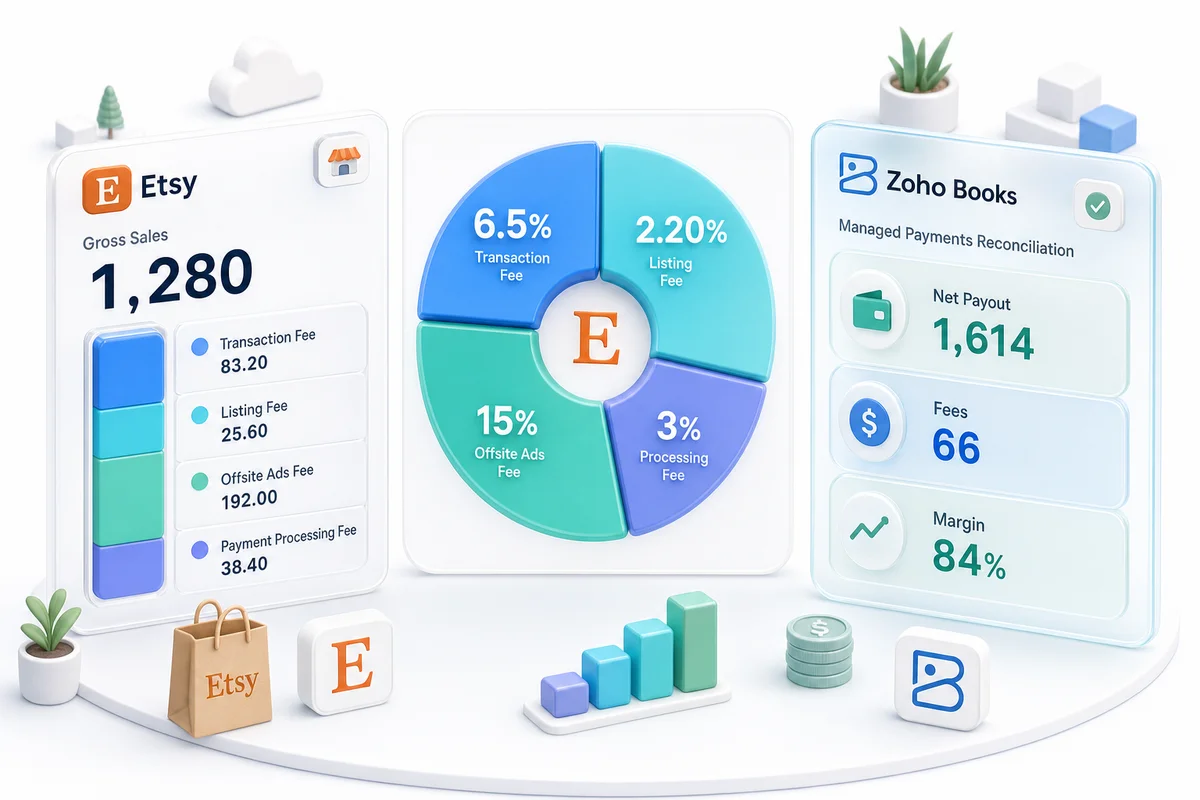
A single Etsy Managed Payments statement contains:
| Fee Type | Rate |
|---|---|
| Listing fee | $0.20 per listing (charged on each new or renewed listing) |
| Transaction fee | 6.5% of the sale price including shipping |
| Offsite Ads fee | 12% for sellers over $10K/year; 15% for sellers under $10K/year (on Offsite Ads-driven sales only) |
| Payment processing fee | 3% + $0.25 per transaction in the US; varies by country |
Each needs its own expense account. Combining them into a single "Etsy Fees" line gives you a number but no visibility into which fee category is compressing your margin or what a rate change by Etsy actually costs you.
Handmade COGS: Tracking Material and Labour Costs for Etsy Products
Etsy's core seller base makes physical products: jewellery, ceramics, textiles, candles, leather goods. Unlike resellers who buy finished goods at a known cost, handmade sellers have input costs that vary by batch - raw materials at fluctuating prices, packaging, and production time. Standard accounting software has no mechanism for tracking cost-per-unit from raw ingredients to finished product.
Zoho Inventory's bill of materials tracks this at the component level. Each product's bill of materials lists input materials, quantities, and costs. When an order fulfils, COGS calculates from the actual bill of materials rather than a manual estimate. That figure flows to Zoho Books automatically.
International Etsy Sales: UK VAT, EU VAT, Australian GST - Who Pays What?
Etsy collects and remits VAT and GST on behalf of sellers in most international jurisdictions, including the UK, EU member states, and Australia. For buyers in those regions, Etsy adds the applicable tax and remits it to the relevant authority. Most Etsy sellers do not have a direct VAT or GST remittance obligation in those jurisdictions.
What it means for your books: the VAT or GST Etsy collected should not appear as your revenue. Your accounting software needs to recognise Etsy-collected tax as a pass-through item, not income. Getting this wrong inflates reported revenue and creates a phantom liability.
Etsy + Shopify or Etsy + eBay: Multi-Channel Revenue Separation
Many Etsy sellers also run a Shopify store or sell on eBay alongside Etsy. Each channel has a different fee structure, different payout timing, and different currency mix. Accounting software that handles each channel as a separate revenue source - with distinct fee accounts per platform - produces a clear channel-level P&L. Software that pools all deposits into one revenue bucket tells you your bank balance, not your business performance. If you're running Shopify alongside Etsy, Shopify's native inventory breaks at multi-channel scale in ways that affect stock accuracy across both channels - worth understanding before you configure cross-channel operations. For the full picture of how Zoho's stack handles cross-channel inventory, accounting, and CRM, see the Zoho for eCommerce guide.
The 4 Accounting Software Options Etsy Sellers Actually Use
QuickBooks Online - Popular, But Etsy Integration Is Plugin-Dependent
QuickBooks Online is the most common default for small businesses, including Etsy sellers who haven't specifically researched alternatives. At low volume it handles basic bookkeeping. For Etsy sellers, the structural gap: no native Etsy integration exists. You need a third-party plugin to import Etsy Managed Payments data, adding $20–40 per month in software cost and a separate integration to maintain.
Multi-currency requires QuickBooks Plus at $115/month. Inventory tracking is basic and has no bill of materials support for handmade products. Etsy sellers who add Shopify or eBay typically need a separate plugin per channel.
Xero - Strong Multi-Currency, Basic Etsy Fee Support
Xero supports multi-currency from its Growing plan and suits Etsy sellers with significant UK or EU sales. Like QuickBooks, Xero requires a third-party Etsy integration. Mapping four fee types to separate accounts requires manual configuration that most Xero generalists won't set up specifically for Etsy. No native bill of materials support exists for handmade COGS.
If your accountant is Xero-trained and you sell primarily to UK or EU buyers, Xero is a workable option. The Etsy reconciliation layer still needs someone who understands Etsy's statement format and chart-of-accounts design.
Zoho Books - Etsy Managed Payments Reconciliation + Handmade Inventory
Zoho Books handles the full Etsy accounting stack through the Zoho ecosystem: Zoho Inventory connects for order data and stock management (including bills of materials for handmade products), Zoho Books handles financial recording, and the chart of accounts can be built specifically for Etsy's four fee categories. Multi-currency is included on all paid plans (Zoho Books Pricing, 2026).
The setup requires more initial configuration than QuickBooks to get the Etsy-specific account structure right. That configuration produces accurate financials. A correctly configured Zoho Books setup records gross Etsy sales to revenue, each fee type to its own expense account, and COGS to Zoho Inventory's bill of materials calculation - automatically, on every transaction.
Wave / FreshBooks - Free Tiers That Break When Fees Get Complex
Wave is free and handles basic invoicing and expense tracking. FreshBooks is invoice-centric, designed for service businesses and freelancers. Both work at very low volume.
Neither was built for marketplace sellers. Wave has no native Etsy integration, no bill of materials support, and no inventory module. FreshBooks has limited inventory and minimal Etsy integration options. Both break when Etsy Managed Payments reconciliation becomes the central accounting task, which happens above 50 orders per month. Under 30 monthly orders with no physical inventory, Wave is a reasonable starting point. Above that, you will rebuild sooner than you expect. See the Zoho Books vs Wave Accounting comparison for eCommerce sellers for a full feature breakdown comparing lightweight tools against Zoho Books.
Why Zoho Books Works for Most Etsy Sellers
Etsy Managed Payments: Reconcile the Statement, Not Just the Payout
The Etsy Managed Payments monthly statement lists every transaction with full fee detail. When Zoho Books reads that statement rather than just the bank deposit, each line maps to an account: gross sales to revenue, each fee type to its designated expense account, disbursement reconciling to the actual bank deposit.
That also catches Etsy statement errors - occasional mis-posted fees, missing credits, or Offsite Ads charges that don't match the published rate for your account tier.
Fee Categorisation: Listing, Transaction, Offsite Ads, Payment Processing
With the right chart of accounts in Zoho Books, Etsy fees don't collapse into a single line item. Listing fees go to a dedicated Listing Expense account. Transaction fees go to Cost of Sales, tied directly to each transaction. Offsite Ads fees land in Advertising Expense, separate from the mandatory per-transaction fees. Payment processing fees go to Bank Charges or a dedicated processing account.
The result: a P&L where each fee category is visible, auditable against Etsy's published rate schedule, and comparable month-over-month so margin compression by fee type is traceable.
Zoho Inventory: Handmade Product COGS With Bills of Materials
For Etsy sellers with physical products, Zoho Inventory's bill of materials tracks input materials and costs for each finished product. A candle seller lists wax, fragrance oil, wick, and jar per unit. A jewellery maker lists metal, stones, and findings per piece. When an Etsy order fulfils, COGS records from the actual bill of materials cost rather than a rough average. That COGS flows to Zoho Books on each fulfilment event.
For sellers who run production batches, Zoho Inventory's manufacturing orders track material consumption per batch and update inventory levels accordingly.
Multi-Currency: Handle UK, CA, AU, and EU Etsy Markets in One Account
Zoho Books supports multi-currency on all paid plans. Etsy sales in GBP, EUR, CAD, and AUD sit in the same account with exchange rate handling applied automatically. Monthly statements consolidate to your home currency. Foreign currency gains and losses post to the correct accounts without manual conversion entries each period.
The Zoho Ecosystem: Inventory + Accounting on One Login
Zoho Inventory and Zoho Books share a native connection: no third-party middleware, no API keys to maintain, no reconciliation lag between the inventory system and the accounting system. When an Etsy order fulfils in Zoho Inventory, COGS, stock levels, and revenue all update in Zoho Books from the same event. For the step-by-step connector setup, see the Etsy-Zoho integration guide. For Etsy sellers who add a Shopify store or eBay account later, multi-channel inventory management with Zoho extends the same connection across all channels without adding new software layers.
Etsy Accounting Software Comparison: Zoho Books vs QuickBooks
| Factor | Zoho Books | QuickBooks Online |
|---|---|---|
| Etsy integration | Via Zoho Inventory (native ecosystem) | Third-party plugin ($20–40/mo) |
| Four fee type categorisation | Configurable with correct chart of accounts | Requires manual setup or add-on |
| Bill of materials for handmade COGS | Native in Zoho Inventory | Not available natively |
| Multi-currency | Included on all paid plans | Plus tier only ($115/mo) |
| Etsy Managed Payments reconciliation | Statement-level with proper setup | Deposit-level without add-on |
| Base price (accounting only) | $15/mo (Standard) | $35/mo (Simple Start) |
| Price with inventory tracking | $50/mo (Professional) | $115/mo (Plus); no BOM support |
| Full ecosystem (CRM, analytics, ops) | Native via Zoho | Separate third-party apps |
Etsy Integration Depth: Native vs Plugin vs Manual Import
Zoho Inventory connects to Etsy natively within the Zoho ecosystem. Orders sync, stock levels update, and COGS records on fulfilment without a separate third-party account. QuickBooks requires a plugin from the QuickBooks App Store: a separate account, a separate monthly subscription, and a third point of failure when something breaks during reconciliation.
Fee Categorisation Head-to-Head
Zoho Books, configured with an Etsy-specific chart of accounts, posts all four fee types to their own accounts from day one. QuickBooks fed only from a bank feed records the net Etsy deposit as revenue and no fees at all. QuickBooks with an Etsy plugin records gross transactions but still requires deliberate chart-of-accounts work to separate listing fees from transaction fees from Offsite Ads fees from processing fees - work that most generalist accountants won't do without being specifically asked.
COGS Tracking for Handmade Products
Zoho Inventory includes bill of materials functionality. QuickBooks has no native equivalent for production-based COGS. Etsy sellers who make physical products and use QuickBooks typically estimate COGS manually or maintain a separate spreadsheet, which produces approximations rather than transaction-level accuracy.
Total Cost for a $100K Etsy Business
A seller doing $100K/year on Etsy who needs inventory with bill of materials, multi-currency for UK buyers, and correct fee categorisation:
QuickBooks route: QuickBooks Plus ($115/mo) + Etsy integration plugin ($25–40/mo) = $140–155/mo, or $1,680–1,860/year. No bill of materials support at any price point.
Zoho route: Zoho Books Standard ($15/mo) + Zoho Inventory Standard ($79/mo) = $94/mo, or $1,128/year. Bill of materials included.
The Zoho route costs 33–40% less and includes the handmade COGS tracking that QuickBooks cannot provide.
When Zoho Books Is NOT the Right Choice for Etsy Sellers
If Your Accountant Is Committed to QuickBooks or Xero
If your tax accountant insists on QuickBooks or Xero and the transition cost isn't worth the friction, stay with your accountant's platform. A Zoho Books setup maintained by someone unfamiliar with the platform creates problems faster than a QuickBooks setup handled consistently. Zoho Books exports clean financial statements for CPA review, but if your accountant wants direct ledger access in QuickBooks, that bridge doesn't exist.
If You Sell Only on Etsy With Under $30K Revenue (Wave May Be Enough)
Etsy-only sellers under $30K annual revenue who don't sell physical products - digital downloads, printables, SVG files - and operate in a single currency get modest benefit from Zoho Books. Wave with a careful manual reconciliation workflow may be sufficient.
That changes as soon as you add physical inventory, exceed $30K revenue, or start selling to international buyers. The eCommerce bookkeeping complexity grows faster than most Etsy sellers anticipate.
If You Have No Physical Inventory (Digital Products Only)
Digital product sellers on Etsy have no COGS to track and no inventory to manage. The primary accounting need is correct Etsy fee categorisation and multi-currency handling. For digital-only Etsy sellers under $50K revenue, QuickBooks Simple Start or a well-configured Xero may be a reasonable fit without needing Zoho Inventory.
Etsy + Shopify or Etsy + eBay: Multi-Channel Setup in Zoho Books
Keeping Etsy and Shopify Revenue Separate in One Set of Books
Etsy and Shopify have different fee structures, different payout timing, and different tax treatment in some jurisdictions. Zoho Books configured with separate revenue and expense accounts for each channel produces a channel-level P&L without manual aggregation. Etsy gross sales, Etsy fee expenses, Shopify gross sales, and Shopify payment processing fees each appear as distinct line items. See the Shopify accounting software guide for how the Shopify side of this setup works. Etsy sellers planning to launch on Amazon or Shopify and needing the full operational stack — not just accounting — should see the Etsy and Zoho integration guide, which covers how Etsy connects to Zoho Inventory, Books, and CRM as the foundation for multi-channel expansion.
eBay + Etsy: Managing Two Marketplace Platforms From Zoho
eBay and Etsy both use Managed Payments models with net disbursements. The reconciliation logic for each is structurally similar, but the fee categories differ: eBay has six fee types, Etsy has four, and neither maps to the other. Zoho Books handles both with separate chart-of-accounts sections for each marketplace. For the eBay-specific fee structure, see our eBay seller accounting software guide.
Multi-Channel P&L: Which Channel Is Actually More Profitable?
Running Etsy alongside eBay or Shopify without channel-level P&L visibility gives you a combined business result but no insight into which channel earns its keep. A Zoho Books setup with correct channel separation lets you compare gross margin, fee burden, and net channel profitability side by side. For Etsy sellers who suspect their Shopify store is more profitable but can't prove it, that P&L comparison is often the answer - and the starting point for a growth decision. If Amazon is part of your channel mix, the same account-separation logic applies to FBA fees, referral fees, and refunds - see how Zoho Books handles Amazon settlement deposits for the implementation specifics.
For sellers managing three or more channels, multi-channel eCommerce operations is the more complete solution.
How Zolify Sets Up Etsy Seller Accounting in Zoho Books
Chart of Accounts Built for Etsy Revenue and Fee Structure
The default Zoho Books chart of accounts was not designed for marketplace sellers. Zolify's CA builds an Etsy-specific chart of accounts before the first transaction syncs: a dedicated revenue account for Etsy gross sales, separate expense accounts for each of the four Etsy fee types, pass-through accounts for Etsy-collected VAT and GST on international sales, and COGS accounts tied to Zoho Inventory's bill of materials. The full account structure is covered in the eCommerce chart of accounts guide for Zoho Books.
This configuration is what makes every month-end statement useful. The errors most Etsy sellers accumulate — net payout recorded as revenue, fees merged into one line, handmade COGS estimated rather than calculated — come from skipping this step and finding the variance at year-end.
Etsy Managed Payments Statement Import and Categorisation Workflow
Zolify configures a monthly workflow for importing Etsy Managed Payments statements into Zoho Books. Each statement line maps to the correct account: gross sales to revenue, each fee type to its expense account, disbursement reconciling to the bank deposit. Discrepancies flag before month-end close rather than six months later during tax preparation.
This replaces the most common DIY approach: record the deposit as revenue, then attempt to reconstruct fee totals from Etsy's statement at year-end when the numbers don't add up.
Handmade COGS Setup: Bills of Materials in Zoho Inventory
For Etsy sellers with physical products, Zolify configures Zoho Inventory's bill of materials for each product category. Each BOM lists input materials, packaging, and cost-per-unit based on current supplier pricing. When purchase orders arrive from suppliers, costs update automatically in the BOM. When Etsy orders fulfil, COGS records from the live BOM cost rather than a fixed average entered months ago.
For sellers who run production batches - making 50 candles from one batch of wax - Zoho Inventory's manufacturing orders track the batch cost and allocate it across units produced.
Month-End Close Checklist for Etsy Sellers
With the right Zoho Books setup, Etsy month-end close becomes a repeatable process: import the Etsy Managed Payments statement, verify each fee category against Etsy's published rates for your account tier, reconcile the bank deposit, review inventory valuation in Zoho Inventory against physical stock, produce the P&L. For sellers on Zolify's managed accounting service, that process runs on a fixed schedule with CA oversight - no quarterly scramble to reconstruct what happened.
Get an Etsy Accounting Assessment
Etsy seller accounting breaks in predictable ways: net payout recorded as revenue, four fee types merged into one line, handmade COGS estimated from memory, international VAT misclassified as income. Zolify's CA has corrected the same structural errors across 100+ eCommerce implementations, including Etsy sellers whose books were technically functional but financially misleading.
If your current Etsy books record the Managed Payments deposit as revenue and stop there, your P&L is wrong in at least four places. Request an eCommerce Ops Audit and we'll identify exactly where the numbers are drifting and what a correct Zoho Books configuration looks like for your Etsy operation.
Zolify is an Official Zoho Finance Partner with a CA on staff. The Etsy setups we build are accurate from the first transaction - not the kind that get corrected after the first tax filing when the numbers don't add up.
Related reading: Etsy seller accounting with Zoho Books | Etsy BFCM seller operations with Zoho Books | Etsy and Zoho integration guide
Frequently Asked Questions
Most Etsy sellers start with QuickBooks Online or Wave because they're familiar or free. At low volume those work adequately. The problem surfaces when Etsy Managed Payments disbursements arrive and sellers record the net payout as revenue, which overstates gross sales and understates deductible fees. Zoho Books is the option that handles Etsy Managed Payments reconciliation correctly, mapping listing fees, transaction fees, offsite ads fees, and payment processing fees to separate accounts.
Etsy Managed Payments deposits are net amounts - gross sales minus all fees Etsy deducts. To reconcile correctly, read the Etsy Managed Payments monthly statement (not just the bank deposit) and post each line separately: gross sales to a revenue account, listing fees to a listing expense account, transaction fees to cost-of-sales, offsite ads fees to advertising expense, and payment processing fees to bank charges. Software that only reads your bank feed records the net deposit as revenue, which produces structurally wrong financials.
Zoho Inventory's bill of materials feature tracks raw material costs for each finished product you sell on Etsy. When an Etsy order fulfils, Zoho Inventory calculates COGS based on the actual material inputs defined in the bill of materials. That figure flows automatically into Zoho Books, so your P&L reflects the real cost of making each product rather than an estimate.
Wave works for Etsy sellers with very low volume, single currency, and no physical inventory. Once you add Etsy Managed Payments reconciliation complexity, multiple fee types, handmade product COGS tracking, or international VAT, Wave runs out of road. It has no native Etsy integration and no inventory module with bill of materials support. For Etsy sellers processing more than 50 orders a month or shipping to international buyers, Wave is not adequate.
An Etsy seller's chart of accounts needs a dedicated revenue account for Etsy gross sales and separate expense accounts for listing fees, transaction fees, offsite ads fees, and payment processing fees. Sellers with physical products need COGS accounts tied to Zoho Inventory's bill of materials. Recording all Etsy income as a single Sales line and netting fees against it hides your real expense structure and produces a P&L that understates both gross revenue and deductible business expenses.
See exactly where your Shopify, Amazon, or WooCommerce ops are leaking — free.
Get a personalised eCommerce Ops Audit: inventory gaps, accounting leaks, and order-flow bottlenecks — with a Zoho fix roadmap. Delivered in 48 hours, at no cost.