eCommerce Bookkeeping: How to Stop Losing Money on Manual Data Entry
Manual data entry errors hit 4% without verification. For 500 orders/month, that's 20 bookkeeping mistakes compounding every month. Here's how to fix it.
eCommerce bookkeeping is the process of recording, categorizing, and reconciling every financial transaction your online store generates — orders, marketplace fees, payment gateway deductions, platform-collected sales tax, returns, and multi-channel payouts from Shopify, Amazon, WooCommerce, eBay, and Etsy. A standard business records one entry per sale. An eCommerce seller records six or more, and gets it wrong in ways that surface months later as a CPA bill or an IRS notice.
Here's the part that matters most heading into Q4: Black Friday and Cyber Monday aren't just your highest-revenue weekend. They're the weekend that exposes every bookkeeping shortcut you took in January. Triple order volume plus 24%+ return rates plus multi-marketplace payouts all landing in the same two-week window. If your bookkeeping process is manual, Q4 doesn't just slow you down — it creates a backlog that follows you into January, February, and tax season.
60% of small business owners say they're not knowledgeable about accounting. Roughly 70% don't have an accountant at all (DocuClipper / IBIS World, 2025). For most eCommerce sellers, bookkeeping means a spreadsheet, a prayer, and a panic session before tax filing.
That works at 20 orders a month. At 200, it starts leaking money. At 500, it's actively costing you: missed deductions, miscategorized fees, tax filing errors. The problem isn't that sellers are bad at bookkeeping. It's that eCommerce bookkeeping is genuinely harder than regular business bookkeeping — and most sellers don't realize it until the IRS sends a letter or their CPA sends them back to fix six months of entries.
For a full breakdown of how different tools compare, read our eCommerce accounting software guide.
TL;DR: Manual data entry produces error rates up to 4% (DocuClipper, 2025). At 500 orders/month, that's 20 bookkeeping errors compounding every period. Automated eCommerce accounting on Zoho Books eliminates manual entry entirely. Zolify's CA-backed setup — with 100+ eCommerce implementations and Official Zoho Authorized Partner status — ensures marketplace fees, returns, and multi-channel revenue hit the right accounts from day one.
Why eCommerce bookkeeping is harder than regular business bookkeeping
eCommerce bookkeeping is harder because a single order generates multiple fee types, tax obligations, and inventory movements that don't exist in standard business transactions. A plumber invoices a client, gets paid, records the income. An eCommerce seller processes an order on Amazon that involves a referral fee, an FBA fulfillment fee, a storage fee, a possible advertising deduction, sales tax collected by the marketplace, and a currency conversion if the buyer is international. That's one order. The plumber has one entry. The seller has six.
Multiply that by hundreds of orders across multiple platforms and the complexity doesn't just scale — it changes categories entirely.
The 15+ fee types in every Amazon settlement
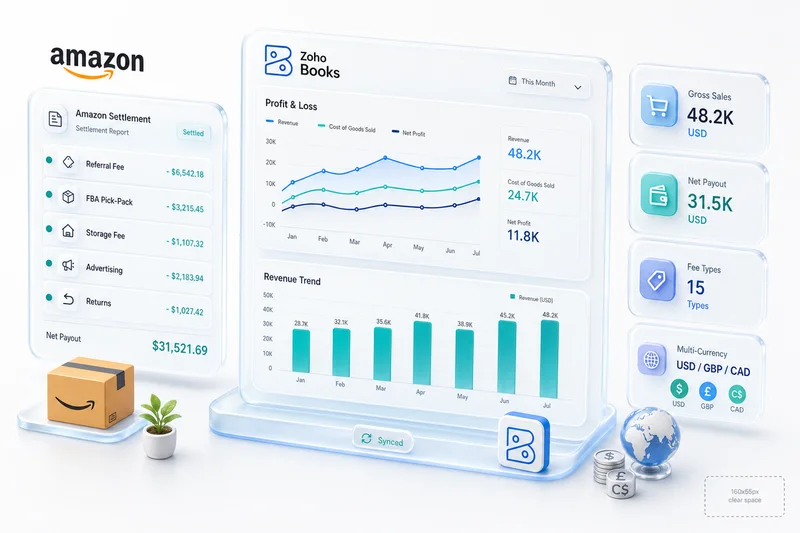
Amazon settlements land every two weeks and contain more than 15 line item types. Referral fees, FBA pick-and-pack fees, monthly storage fees, long-term storage fees, advertising cost deductions, refund administration fees, reimbursements for lost or damaged inventory, and more. Each one belongs in a different account on your chart of accounts.
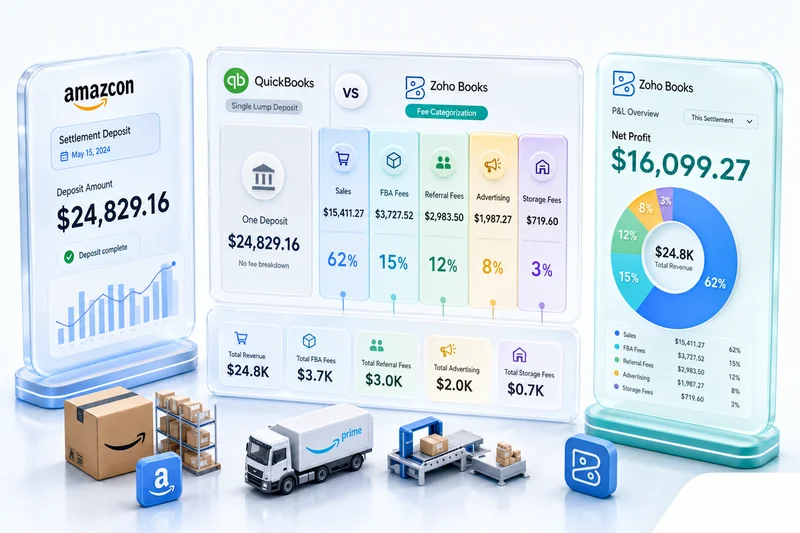
Most sellers dump the entire settlement deposit into a single "Amazon Sales" account. That makes your revenue number wrong, your expense categorization wrong, and your profit margin meaningless. When your CPA asks for clean books at tax time, they want books that separate all of this. If your bookkeeping didn't separate it from the start, someone has to go back and untangle it. For a full walkthrough of how this reconciliation works in Zoho Books, see our eCommerce marketplace fee reconciliation guide.
Payment gateway fees that fragment Shopify revenue
Every Shopify transaction loses 2.4%–2.9% plus $0.30 to payment processing. Third-party gateways add another 0.5%–2%. If your bookkeeping records the gross deposit instead of separating the sale from the fee, your revenue is overstated on every single transaction. Over a year, that adds up to thousands in phantom income you'll owe taxes on.
Multi-channel revenue that needs consolidation, not duplication
34% of eCommerce sellers now operate on two or more marketplaces (Mirakl 2026 Seller Report, 2026). Each marketplace has its own payout schedule, its own fee structure, and its own reporting format. Pulling revenue from Shopify, Amazon, WooCommerce, eBay, and Etsy into a single accurate P&L is the core challenge. Most manual processes either double-count revenue (recording both the marketplace sale and the bank deposit) or miss it entirely.
Returns and chargebacks that distort monthly numbers
Manual data entry produces error rates up to 4%, while automated systems reach 99.96%–99.99% accuracy (DocuClipper, 2025). For a seller processing 500 orders a month, that gap is 20 bookkeeping errors per period, each one affecting COGS, tax liability, and margin calculations that compound until someone catches and fixes them.
Online return rates average 24.5%, with fashion sellers hitting 30–40%. Online returns jumped 39.2% year-over-year in recent data (Capital One Shopping Research, 2026). That rate spikes further in November and December, when gift purchases and size mismatches drive post-BFCM return volumes that can run 2–3× the monthly average into January.
Each return needs a revenue reversal, a fee adjustment, an inventory restock, and sometimes a write-off. If your bookkeeping handles returns by simply subtracting from the next deposit, your monthly revenue, COGS, and fee numbers are all wrong.
Q4 is when manual bookkeeping finally breaks
Every manual bookkeeping process has a volume ceiling. Q4 — October through January — is when most eCommerce sellers find theirs.
BFCM order volume typically runs 3–5× a normal week. Returns on those orders flow back through December and January. Marketplace payouts multiply: Amazon biweekly settlements, Shopify daily deposits, eBay weekly payouts, all arriving with different fee structures and cutoffs. A manual process that barely kept up at 400 orders a month hits a wall at 1,200.
The consequences aren't just bookkeeping backlog. They're financial visibility problems that affect real decisions: inventory restocking, cash flow planning, supplier payment timing. If your books are three weeks behind during the highest-revenue period of your year, every decision you make on pricing, promotions, and stock levels is based on stale data.
Settlement timing mismatches
Amazon's biweekly settlement may cross month-end. If you record by deposit date instead of sale date, your November and December revenue numbers are wrong — and the discrepancy doesn't surface until you try to reconcile in January.
Return volume overflow
Post-BFCM returns typically peak in the first two weeks of January. A manual process that was already behind before Christmas gets buried. Returns recorded late distort January P&L and make year-end reconciliation harder than it needs to be.
Year-end close pressure
Your CPA needs clean books by late January or early February for corporate filing deadlines. If you're still catching up on BFCM entries in January, the year-end close either gets rushed or gets expensive. CPAs who have to reconstruct entries charge for it.
The sellers who avoid this aren't smarter about bookkeeping. They automated before the volume arrived.
The real cost of manual eCommerce bookkeeping
Manual data entry without verification produces error rates as high as 4%, or 4 errors per 100 entries. Automated systems hit 99.96%–99.99% accuracy (DocuClipper, 2025). The math is simple: a Shopify store processing 500 orders a month generates up to 20 errors through manual entry. Per month. Those errors compound because each one throws off downstream calculations: COGS, tax liability, profit margins.
But error rates are just the visible cost. The invisible costs are worse.
Hours lost to manual reconciliation
50% of finance teams take longer than 5 business days to close their monthly books. 94% still use Excel somewhere in their close process, and half say Excel is a primary reason the close drags on (Ledge.co, 2025). Cash reconciliation alone eats 20–50 hours per month across 3–5 systems.
For an eCommerce seller doing this without dedicated finance staff, that's the founder or an ops manager spending evenings matching bank deposits to marketplace payouts instead of running the business.
Tax risk from miscategorized revenue
The IRS failure-to-file penalty is 5% of unpaid tax per month, up to 25%. For returns filed more than 60 days late, the minimum penalty is $510 in 2025. Failure-to-pay adds another 0.5% per month, also up to 25% (IRS, 2025).
Those penalties aren't just for people who skip filing. They hit when your books are wrong enough that you underreport income or miss a filing deadline because your records are a mess. eCommerce sellers with miscategorized marketplace fees, unrecorded refund reversals, or missing multi-state tax obligations face real risk.
<!-- [UNIQUE INSIGHT] --> > 51% of employer firms cite managing uneven cash flow as a top financial challenge (Federal Reserve Small Business Credit Survey, 2025). For eCommerce sellers, "uneven cash flow" often isn't a cash problem at all. It's a bookkeeping problem. Revenue looks uneven because marketplace payouts, refund timing, and fee deductions aren't recorded correctly. Fix the books and the cash flow picture usually looks less scary.
The real cost of hiring a bookkeeper
The median annual wage for a bookkeeping clerk is $49,210 (Bureau of Labor Statistics, 2024). That's about $4,100/month for a full-time hire who probably doesn't understand Amazon settlement reports or WooCommerce subscription accounting. A part-time bookkeeper runs $500–2,000/month but comes with the same knowledge gap.
The third option: automated accounting with professional configuration. One-time setup ($2,000–$10,000 depending on complexity), software costs ($50–150/month), and optional managed support on top. More accurate than manual entry, cheaper than a full-time hire, and actually built for how eCommerce data flows.
Three approaches to eCommerce bookkeeping, ranked
Three options exist for handling eCommerce bookkeeping: DIY with spreadsheets, a generic bookkeeping service, or eCommerce-specialized accounting operations. Only the third handles marketplace fee structures, multi-channel revenue consolidation, and return accounting correctly from day one.
Comparison: manual vs generic service vs Zoho Books (Zolify)
| Capability | Manual / Spreadsheets | Generic Service | Zoho Books — Zolify |
|---|---|---|---|
| Amazon fee separation (15+ types) | Manual, error-prone | Partially | Automated, correct |
| Shopify gateway fee split | No | Rarely | Every transaction |
| Multi-channel consolidation | Manual merge | Manual merge | Native, no duplication |
| Returns (revenue + COGS reversal) | Manual | Manual | Automated |
| Month-end close time | 5+ days | 3–5 days | Under 1 day |
| CA oversight | No | Unlikely | Yes (on staff) |
| BFCM volume readiness | Breaks | Struggles | Scales |
| Year-end clean books for CPA | No | Usually not | Yes |
1. DIY with spreadsheets: cheap until it costs you
Some version of this is where most sellers start. Download CSVs from each marketplace, paste into a master spreadsheet, manually categorize transactions, hope the formulas don't break. It costs nothing in software but everything in time.
At under 50 orders a month, this works. Above that, you're one mis-pasted column away from a tax filing error. And you've got zero audit trail. If the IRS asks how you calculated a specific deduction, you're pointing at cell D47 in a spreadsheet that's been modified 200 times. In Q4, when you're reconciling 1,200+ orders across three marketplaces, that spreadsheet becomes a liability.
2. Generic bookkeeping service: better, but missing eCommerce context
The global finance and accounting outsourcing market is worth $54.79 billion in 2025, projected to reach $81.25 billion by 2030 at 8.21% CAGR (Mordor Intelligence, 2025). 65% of companies outsource to free up internal staff, and 63% cite improved accuracy as a reason (Insignia Resources, 2025).
Services like Bench and Pilot handle basic bookkeeping well. They categorize income, track expenses, and produce monthly financial statements. Where they fall short for eCommerce: they don't understand marketplace settlement structures, don't separate 15+ Amazon fee types into the right accounts, and don't handle multi-channel revenue consolidation natively. You get clean-looking books categorized the same way they'd categorize a consulting firm.
<!-- [PERSONAL EXPERIENCE] --> > We've taken over from generic bookkeeping services for eCommerce clients three times in the past year. Each time, the books looked clean on the surface. Monthly P&L, proper formatting. But Amazon referral fees were lumped under "cost of goods sold" instead of selling expenses. Shopify processing fees were combined with bank fees. Returns were subtracted from revenue without reversing the associated COGS. Tidy numbers. Wrong numbers.
3. eCommerce-specialized accounting operations: the Zolify approach
This is what we do. Not generic bookkeeping. Not just software setup. Full-service eCommerce accounting operations built on Zoho Books, configured by a Chartered Accountant who understands marketplace fee structures, and managed on an ongoing basis if you want it.
The gap between approach #2 and approach #3 is specialization. A generic bookkeeper categorizes your transactions. An eCommerce accounting specialist configures the system so transactions categorize themselves correctly from day one. Every Amazon fee type lands in the right account. Every Shopify processing fee gets separated from revenue. Every return reverses the correct entries. Automatically.
For a detailed look at how the full automation layer works end-to-end — from order ingestion to trial balance — see our guide to eCommerce accounting automation on Zoho Books.
For Shopify merchants specifically, see how Zoho Books handles Shopify accounting, covering fees, payouts, and reconciliation included.
The eCommerce bookkeeping checklist (monthly)
Running a clean close every month comes down to the same tasks done in the same order. Here's what a CA-configured Zoho Books setup handles automatically — and what still needs a human review:
Weekly (or after each marketplace payout) - Reconcile marketplace settlement reports against bank deposits - Verify marketplace fees split into correct accounts (referral, FBA, storage, advertising) - Flag any transactions that didn't auto-categorize
Month-end - Reconcile all payment gateway accounts (Shopify Payments, PayPal, Stripe) - Process all returns: reverse revenue, reverse COGS, adjust inventory - Reconcile platform-collected sales tax against your liability account - Review multi-channel revenue: confirm no double-counting between marketplace and bank deposit entries - Pull exception report from Zoho Books for transactions requiring manual review
Quarterly - Review chart of accounts for new fee types (Amazon adds categories with no notice) - Reconcile inventory against Zoho Inventory counts - Prepare financial statements for CPA review - Verify multi-state nexus obligations haven't changed
Pre-Q4 (September / October) - Test exception-handling rules at 3× normal volume - Confirm return account mappings cover all marketplace refund types - Verify AP workflows are configured for BFCM supplier payment timing (see eCommerce accounts payable automation) - Run a mock month-end close using prior October data to identify any gaps
Setting up the right chart of accounts is what makes this checklist manageable — for a complete setup guide, see our eCommerce chart of accounts guide for Zoho Books.
What eCommerce bookkeeping automation actually looks like
Automated eCommerce bookkeeping means transactions enter your accounting system already categorized correctly — fees separated, returns reversed, sales tax mapped — so reconciliation is checking exceptions, not rebuilding from raw CSVs.
94% of finance teams still use Excel somewhere in their monthly close process, and half say it's the primary reason close takes so long (Ledge.co, 2025). With automated data flows in Zoho Books, reconciliation shrinks from days of manual matching to reviewing exceptions the system already flagged.
Orders flow into Zoho Books without anyone touching a keyboard
When a customer places an order on Shopify, Amazon, WooCommerce, eBay, or Etsy, the order data flows into Zoho Books. An invoice gets created with the correct line items. The payment gateway fee is separated into its own expense account. Tax collected by the marketplace goes to the right liability account. Inventory quantities update in Zoho Inventory.
No CSV downloads. No copy-paste. No "I'll catch up on bookkeeping this weekend."
Marketplace fees get categorized correctly on day one
This is the part most automation setups get wrong. They connect the data pipe but use default account categories. Our CA reviews your specific fee structure on each marketplace and creates dedicated accounts for each fee type. Amazon referral fees go to selling expenses. FBA fees go to fulfillment costs. Advertising deductions go to marketing expenses. These aren't generic categories you'll need to re-sort later.
Month-end close drops from days to hours
Because data flows in correctly from the start, reconciliation isn't a project. Bank deposits match what Zoho Books expects because the system already accounts for marketplace fee deductions. Revenue numbers are accurate because returns were processed with full reversal entries. Your CPA gets clean books, not a puzzle.
<!-- [ORIGINAL DATA] --> > After implementing automated Zoho Books configurations for eCommerce clients, we consistently see month-end close time drop from 3–5 days to under half a day. The biggest time savings aren't from faster data entry. They're from eliminating the correction cycle: enter data, find errors, fix errors, re-reconcile. When data enters correctly, there's nothing to fix.
Your CPA gets clean books at tax time
Only 29% of companies have implemented automated accounts payable (DocuClipper, 2025). That means 71% are still handling some part of their financial workflow manually. eCommerce sellers who automate their bookkeeping on Zoho Books hand their CPA a clean trial balance, categorized by channel, with every fee type properly separated. No "we need to go back and re-classify these transactions" conversations in March.
For sellers managing 10 or more active suppliers, the AP side — PO matching, multi-approver bill workflows, and batch payment release — is where the biggest manual bottleneck sits before Q4. Zoho Books handles the full eCommerce accounts payable automation cycle natively, without Zapier. If you're configuring this for the first time, do it before BFCM — the setup takes 3–4 weeks and you want it tested at normal volume before holiday traffic arrives.
How Zolify's managed accounting works for eCommerce sellers
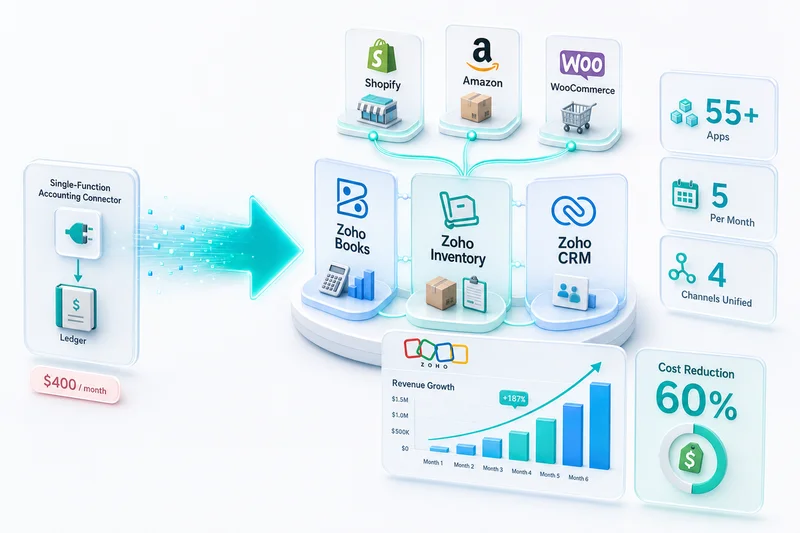
Zolify is an Official Zoho Authorized Partner with a Chartered Accountant on staff. We've completed 100+ eCommerce implementations — Shopify, Amazon, WooCommerce, eBay, and Etsy — and set up and optionally manage the full accounting operation for online businesses at every volume level.
CA-led setup: chart of accounts built for your revenue streams
Only 29% of companies have implemented automated accounts payable (DocuClipper, 2025), which means most eCommerce sellers still hand their CPA a reconciliation puzzle at tax time. Our CA-led Zoho Books setup separates all 15+ Amazon fee types, Shopify payment fees, and return reversals into the correct accounts from day one, so the CPA closes in hours instead.
Before anything connects, our CA maps your specific operation. Which platforms do you sell on? What fee structures does each one have? Do you have subscription revenue from WooCommerce? International sales with multi-currency? FBA vs FBM inventory on Amazon?
The chart of accounts gets built from those answers, not from Zoho's defaults or a generic template. Your actual business structure drives every account category.
Ongoing operations: what we handle monthly
For clients on managed accounting, we handle monthly reconciliation, fee categorization review, financial statement preparation, and exception handling (transactions that don't fit neatly into automated rules). You focus on selling. We focus on making sure the numbers are right.
What you still own (and why that matters)
We don't take over your business decisions. We give you accurate numbers so you can make better ones. Which channel is most profitable after all fees? Which product lines have the best margins? Where are you losing money to returns? Those are your calls. We just make sure the data behind them is correct.
If you sell on Amazon specifically, read our detailed guide on Amazon seller accounting with Zoho Books.
Stop doing your own eCommerce bookkeeping
If you're spending more than 5 hours a month on manual bookkeeping, or you're not confident your books are right, it's time to change the approach. Q4 makes the stakes concrete: a bookkeeping process that's barely holding together at current volume will not hold together at BFCM volume.
Zolify's eCommerce Ops Audit reviews your current bookkeeping workflow across every platform you sell on and identifies where money is leaking: miscategorized fees, missing entries, incorrect return accounting. We work with sellers on Shopify, Amazon, WooCommerce, eBay, and Etsy.
The audit is the first step. What comes after depends on what we find.
See our full eCommerce accounting and operations services to learn how Zolify works with eCommerce sellers.
Accurate bookkeeping is the foundation of a well-run eCommerce operation — for the full picture of how Zoho connects accounting, inventory, CRM, and operations across Shopify, Amazon, WooCommerce, eBay, and Etsy, see Zoho for eCommerce: The Complete Operations Platform Guide.
Frequently Asked Questions
eCommerce bookkeeping is the process of recording, categorizing, and reconciling every financial transaction an online store generates - including marketplace fees, payment gateway deductions, platform-collected sales tax, returns, and multi-channel revenue from Shopify, Amazon, WooCommerce, eBay, and Etsy. Unlike standard bookkeeping, a single eCommerce order can produce 6 or more separate accounting entries. Errors in any one of them compound until a CPA or a tax filing surfaces them.
DIY costs nothing in software but 10–20+ hours of your time monthly. A generic bookkeeping service runs $500–$2,000/month. Automated Zoho Books with professional configuration costs $50–$150/month in software after a one-time setup fee of $2,000–$10,000 depending on complexity. At 500+ orders/month, the automated approach is usually the cheapest when you factor in accuracy and time saved.
Recording marketplace deposits as revenue without separating fees. If Amazon deposits $3,200 from a settlement and you record $3,200 as sales, you've missed the $800+ in fees that reduced your gross revenue. Your income is overstated, your expenses are understated, and your profit margin calculation is fiction. This is the single most common error seen during migrations.
With Zolify, a single-channel setup takes 3–6 weeks. Multi-channel operations (Shopify + Amazon + WooCommerce) take 6–10 weeks. The time is spent on chart of accounts configuration and testing with real transaction data. Getting the accounting logic right takes longer than connecting the APIs.
Yes. Automated bookkeeping handles transaction recording, categorization, and reconciliation. A CPA handles tax strategy, filing, and compliance decisions that require professional judgment. Automation gives your CPA clean, properly categorized data instead of a reconciliation puzzle to untangle before they can start their work.
See exactly where your Shopify, Amazon, or WooCommerce ops are leaking — free.
Get a personalised eCommerce Ops Audit: inventory gaps, accounting leaks, and order-flow bottlenecks — with a Zoho fix roadmap. Delivered in 48 hours, at no cost.