How to Choose an eCommerce Operations Partner: 7 Questions That Reveal the Truth
Most eCommerce sellers evaluate operations partners on price first. That order produces expensive mistakes. Seven questions, asked in the right sequence, separate genuine eCommerce operations experience from generalist consultants who list it as a skill.
When a Shopify seller starts selling on Amazon, or a WooCommerce store adds eBay and Etsy, back-end operations don't scale automatically. Inventory needs to sync across channels. Orders need to flow through to accounting without manual entry. Marketplace fees from five different platforms need to land in the right Zoho Books accounts. The eCommerce operations partner you hire to build that infrastructure determines whether your systems work — or require constant manual correction.
Most sellers evaluate partners on price first. That produces expensive mistakes. It's an especially costly error in Q4: year-end is the worst time to discover your eCommerce ops partner can't handle a BFCM surge. When order volume hits 8-10x and a sync gap means overselling on Amazon while your Shopify inventory shows stock, the partner you hired based on the lowest hourly rate becomes the most expensive decision you made all year.
Direct answer: Choose an eCommerce operations partner by asking seven questions about their production track record, accounting expertise, platform-specific experience, discovery process, Q4 readiness, and post-launch support — in that order. Cost comes last. A partner who answers all seven with specifics has genuine eCommerce operations experience. A partner who hedges on more than two probably does not.
Why the wrong partner is more expensive than the right one
You can migrate to a better Zoho setup later. Recovering from an integration built incorrectly is expensive and slow: wrong chart of accounts mapping, marketplace fees pooled into a single account, inventory sync that handles 95% of orders and silently drops the other 5%.
The total cost of a bad implementation includes:
- Manual reconciliation hours to locate where the integration broke
- Incorrect COGS and gross margin data producing bad purchasing decisions
- Stockouts from inventory counts that stopped syncing without anyone noticing
- A second implementation project to fix what should have been built correctly
In Q4, each of these gets worse. A bad inventory sync that produces one stockout per week produces ten per day during BFCM. A fee reconciliation error that's a nuisance in June is a tax problem in December. For sellers planning ahead, BFCM inventory planning in Zoho Inventory begins in October — and it assumes the underlying integration is already correct.
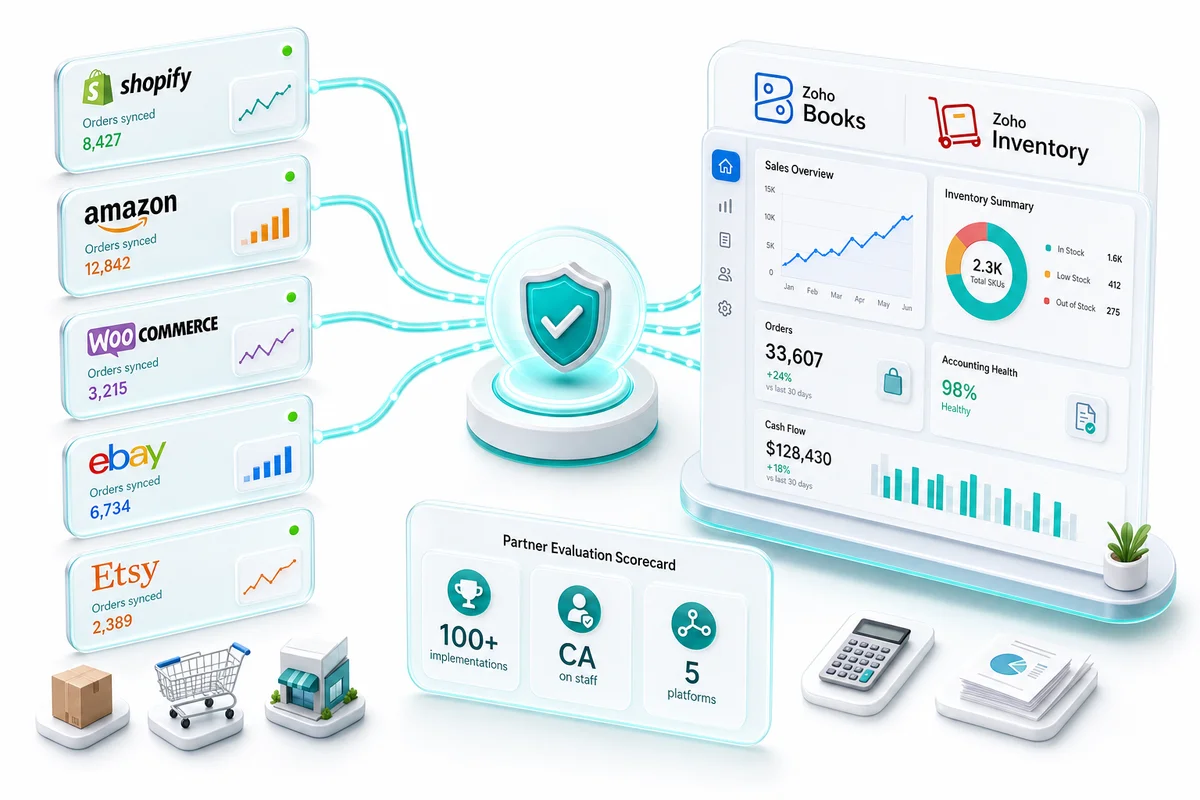
Across Shopify, Amazon, WooCommerce, eBay, and Etsy — each with its own fee structures, data formats, and settlement timing — there is real operational complexity behind "we connect you to Zoho." How a partner handles that complexity is what the seven questions below actually reveal.
The 7 questions to ask any eCommerce operations partner
These questions are ordered deliberately. Start with expertise and track record. Cost comes last.
1. How many eCommerce integrations have you delivered in production?
Ask for a number. "Dozens" and "many" are not answers. "100+ eCommerce integrations across Shopify, Amazon, WooCommerce, eBay, and Etsy" is an answer.
Production means real financial data flowing through live systems for real businesses — not sandbox testing or proof-of-concept work that never went live. Production eCommerce integrations surface edge cases that test environments do not: partial Amazon shipments with mixed FBA and FBM fulfillment on the same order, Shopify refunds where the payment processing fee reversal hits at a different rate than the original transaction, eBay managed payments settlement timing that differs from the gross amount by more than just the final value fee.
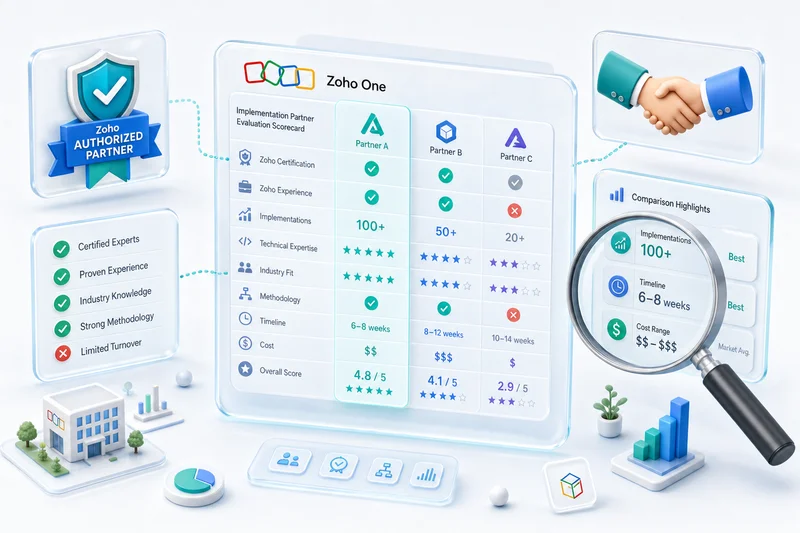
Partners with 20–50 projects have encountered some of this. Partners with 100+ have built process around it — including the Q4 edge cases that only appear when volume spikes.
2. Is there a CA or CPA on your team?
This question eliminates a large portion of Zoho consultants immediately — including most US-based generalists.
eCommerce accounting isn't standard accounting. Amazon FBA fees include referral fees, fulfillment fees, storage fees, advertising charges, and reimbursements — each belonging in a different Zoho Books account for your P&L to show real margin by channel and by product category. Shopify Payments fees are handled differently from Shopify transaction fees on non-Shopify payment processors. WooCommerce, eBay, and Etsy each have their own fee formats.
A developer who configures Zoho maps all of this to "marketplace fees." A CA or CPA maps each fee type to the correct account, validates that COGS flows through correctly, and catches the chart of accounts errors that make your financials look clean in the system while being operationally wrong.
This matters most at year-end. For sellers managing eCommerce accounts payable and supplier payments through Zoho Books, the difference between a CA-validated configuration and a developer-only setup shows up directly in how painful — or painless — your Q4 close is.
For sellers moving from manual reconciliation to eCommerce accounting automation, the difference between a CA-validated integration and a developer-only integration shows in month-end close time and in whether your gross margin data is usable for decisions.
3. Which platforms have you connected, and what specifically did that involve?
Shopify experience doesn't transfer automatically to Amazon. Amazon FBA experience doesn't transfer to eBay managed payments. Each platform has different APIs, different data structures, different settlement timing, and different fee formats.
Ask specifically: how do you handle Amazon's FBA settlement report? How do you map Etsy transaction fees to Zoho Books? What is your approach to WooCommerce refunds that partially reverse Stripe fees?
If the answer is platform-specific and detailed — the partner has done it. If the answer is "we connect via API and it works" — they're figuring it out on your project.
Partners with genuine multi-channel experience have configured the Shopify-Zoho integration for Shopify-specific scenarios (Shop Pay installments, Shopify Markets multi-currency, Shopify Collabs), the Amazon connection for FBA vs FBM handling and sponsored products cost allocation, and WooCommerce for the payment gateway variation that matters when multiple platforms feed into the same Zoho Books chart of accounts. See how the Shopify-Zoho integration works in practice for a platform-specific example of what genuine experience looks like.
4. How do you handle marketplace fee reconciliation for my specific channels?
This is the depth test.
Ask the partner to walk through how they map Amazon's referral fee, FBA fulfillment fee, storage fee, and sponsored products charge in Zoho Books. The correct answer has each in a separate account: sales commissions for referral fees, fulfillment costs for FBA fees, storage costs for inventory holding, advertising costs for sponsored products. The wrong answer is "they all go into an Amazon fees account."
For Amazon sellers using Zoho Books for accounting, fee categorization by type isn't a fine point — it's the difference between knowing your actual margin on Amazon versus knowing you spent some money on Amazon.
Ask the same question for each platform you sell on. A partner who answers it for Shopify, Amazon, WooCommerce, eBay, and Etsy has done all five. A partner who can only answer confidently for two is showing you their actual experience boundary.
5. What does your discovery process look like before you start building?
Correct implementations start with paid discovery. A partner ready to give a fixed price without understanding your current systems, your workflows, and your specific edge cases is either padding the estimate with a contingency for unknowns or hasn't thought through what your setup requires.
A proper discovery sprint for eCommerce operations runs 2–3 weeks at $500–$700. The deliverable is a documented scope: which storefronts, which Zoho products, which workflows, which edge cases, and a fixed-price implementation estimate with a defined timeline. You know exactly what you're buying before the implementation starts.
Discovery also reveals the migration complexity that sellers often underestimate. For businesses moving from QuickBooks to Zoho Books for eCommerce operations, discovery documents the chart of accounts mapping requirements, the historical data scope, and the parallel-run period needed before cutover — all of which affect both timeline and cost.
6. How do you prepare for Q4 volume spikes, and what happens if something breaks during BFCM?
This is the question most sellers forget to ask. It's also the one that separates partners who run integrations from partners who maintain them under pressure.
An integration that runs cleanly in July doesn't automatically hold up when order volume hits 8-10x in November. BFCM volume surfaces edge cases that normal traffic doesn't: rate-limit behavior on Amazon's API, inventory webhook delays on Shopify when thousands of orders land in minutes, Zoho Inventory sync queues that get backed up during peak windows.
Ask specifically: how do you prepare clients for BFCM? Do you stress-test integrations before peak periods? What is your response time when an order sync fails during a sale? Do you have dedicated support coverage on Black Friday and Cyber Monday?
For sellers running multi-channel inventory across Shopify, Amazon, WooCommerce, and eBay, an integration outage during BFCM produces overselling, stockouts, and inventory count errors that take days to manually untangle. The question isn't whether issues will occur — it's whether your partner is watching and able to respond.
Partners who offer monthly retainer support — ongoing sync monitoring, error resolution, and updates when platform APIs change — are structured to maintain what they build through peak periods and beyond. Partners who consider the project complete at go-live are transferring all ongoing risk to you.
7. What are your hourly rates, and how does that compare to other options?
Cost belongs last — not because it's unimportant, but because you can't evaluate cost without first understanding whether the partner can do the work.
US-based Zoho consultants typically charge $150–$250/hour. A 150-hour eCommerce implementation at US rates costs $22,500–$37,500. The same project with an experienced eCommerce operations partner with 100+ implementations runs $4,200–$9,000 at $28–$60/hour. That's a 60–80% cost difference on the implementation alone.
For a side-by-side breakdown of what US-based consultants include versus an eCommerce specialist's scope at each price point, see Zolify vs US-based Zoho consultants for eCommerce.
On long-term managed services — ongoing sync monitoring, error resolution, optimization, API update maintenance — the difference compounds. Monthly support at $200/hour is difficult for SMBs to sustain. Monthly support at $40–$60/hour is sustainable.
The relevant consideration isn't offshore versus onshore. It's whether the partner has the eCommerce operations depth that questions one through six reveal. A US-based consultant with 15 Zoho implementations — none specifically for multi-channel eCommerce — is not more qualified than an offshore partner with 100+ eCommerce integrations validated by a CA. They're more expensive. Premium expertise and premium rates are not the same thing; geography drives the rate, and domain expertise is what you should be paying for.
How to read the answers
Use this reference when evaluating responses:
| Question | Green flag | Red flag |
|---|---|---|
| Production track record | Specific count, platform breakdown | "Many projects," no specifics |
| CA/CPA on team | Named credential, accounting examples | "We understand finance" |
| Platform specifics | Detailed per-platform walk-through | "We integrate with all of them" |
| Fee reconciliation | Account-by-account mapping by fee type | "Goes into a fees account" |
| Discovery process | Paid sprint, documented deliverable | Fixed quote from a free call |
| Q4/BFCM & post-launch support | Stress-testing, peak coverage, defined SLAs | "We fix bugs if you report them" |
| Rates | Transparent hourly + comparison context | Avoids direct numbers |
A partner who answers five or more questions with green-flag specifics is worth serious consideration. A partner who hedges on three or more is learning on your project — and you really don't want to discover that in November.
How Zolify answers these questions
Zolify has completed 100+ eCommerce implementations connecting Shopify, Amazon, WooCommerce, eBay, and Etsy to Zoho Books, Zoho Inventory, Zoho CRM, and Zoho One. Our CA on staff reviews every chart of accounts configuration, validates fee mapping for each platform, and signs off on financial data flows before go-live. As an Official Zoho Authorized Partner, we have direct access to Zoho partner resources and support escalation when edge cases require it.
On fee reconciliation: we map Amazon referral fees, FBA fulfillment fees, storage fees, sponsored products charges, and reimbursements to separate Zoho Books accounts. We do the same for Shopify, WooCommerce, eBay, and Etsy — each platform mapped to the account structure that makes your P&L reflect actual margin by channel, not a single "marketplace expense" line that tells you nothing useful.
On Q4 readiness: we run pre-BFCM sync checks for all retainer clients in October, verify rate-limit handling and webhook reliability under load, and maintain dedicated coverage on Black Friday and Cyber Monday. If a sync fails at 2am on November 29, someone is watching.
On discovery: every engagement starts with a paid discovery sprint at $500–$700. The deliverable is a documented scope, architecture recommendation, and fixed-price estimate. You don't commit to implementation until the scope is defined.
On rates: $28–$60/hour depending on resource type and project complexity. Post-launch managed services from $1,500/month. These rates reflect eCommerce specialization and CA/CPA accounting expertise at a cost structure that works for the SMBs and mid-market eCommerce businesses we serve — not as a "budget offshore" option, but as a premium eCommerce operations partner at rates that US-based generalists can't match.
For the full scope of what an eCommerce operations implementation covers, see our eCommerce operations services.
Evaluating your current setup before Q4? Get an eCommerce Ops Audit → — a no-commitment review of your current systems, workflows, and integration gaps from an eCommerce operations team with 100+ implementations and a CA on staff. Don't head into BFCM without knowing whether your integration can handle the load.
Frequently Asked Questions
Look for a documented production track record (100+ implementations is a credible benchmark), a CA or CPA on the team who understands eCommerce fee accounting, platform-specific experience with Shopify, Amazon, WooCommerce, eBay, and Etsy, a paid discovery sprint process, and transparent post-launch support. Ask for specifics on each point — vague answers on any of these indicate a generalist, not an eCommerce specialist.
The primary difference is cost: US-based Zoho consultants charge $150-250/hr; experienced offshore partners with eCommerce specialization charge $28-60/hr. The 60-80% cost difference does not reflect quality — it reflects geography and cost of living. Evaluate offshore partners on the same criteria you would a US firm: production track record, accounting credentials, platform experience, and references. An offshore partner with 100+ eCommerce implementations and a CA on staff outperforms a US generalist with 20 Zoho projects on eCommerce-specific work.
A single storefront connected to Zoho Books and Zoho Inventory typically costs $2,500-$6,000. Multi-channel setups covering Shopify, Amazon, and WooCommerce start from $6,000. Full-stack Zoho One implementations with CRM, marketing automation, and custom workflows start at $10,000. Ongoing managed services for sync monitoring and support run $1,500-$5,000 per month. Always start with a paid discovery sprint ($500-$700) that defines scope and produces a fixed-price estimate.
A discovery sprint for eCommerce operations documents your current storefront setup (Shopify, Amazon, WooCommerce, eBay, Etsy), existing tools and manual processes, desired end state in Zoho, gap analysis, recommended architecture, scope of work, and a fixed-price project estimate. It typically runs 2-3 weeks and costs $500-$700. The deliverable means you know exactly what you are committing to before the implementation starts.
Ask: How many eCommerce integrations have you delivered in production? Do you have a CA or CPA on your team? Can you describe how you handle Amazon FBA fee reconciliation specifically? What is your discovery process before starting a build? What post-launch support do you offer, and how does your team prepare for BFCM volume spikes? A partner who answers all five with specifics has genuine eCommerce operations experience. A partner who hedges on three or more is learning on your project.
See exactly where your Shopify, Amazon, or WooCommerce ops are leaking — free.
Get a personalised eCommerce Ops Audit: inventory gaps, accounting leaks, and order-flow bottlenecks — with a Zoho fix roadmap. Delivered in 48 hours, at no cost.